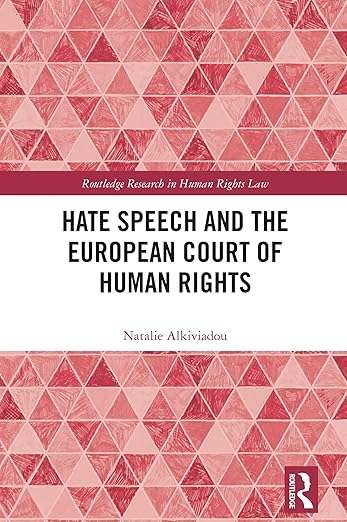
 The European Court of Human Rights (ECtHR) has traditionally maintained that freedom of expression safeguards speech that may "offend, shock or disturb." However, its stance on hate speech is not in line with this core principle. My book, "Hate Speech and the European Court of Human Rights" (Routledge, 2025), argues that the ECtHR's current trajectory, anchored in what I term the "low-threshold hatred paradigm" jeopardizes free speech by permitting restrictions on expression that is merely insulting or prejudicial, without any requirement of incitement to violence or hostility. Drawing on doctrinal analysis and normative critique, the book contends that the ECtHR's hate speech jurisprudence suffers from conceptual ambiguity, internal inconsistencies, and a lack of empirical grounding. The book examines hate speech jurisprudence of the now defunct European Commission on Human Rights and the ECtHR to allow for an inclusive analysis from the very onset of relevant cases. This guest blog will feature a series of five posts that highlight some of the book's key findings. The first post provides a general overview of some of the key issues developed in the book, followed by thematic explorations in the subsequent entries.
Definitions and justifications
The book starts off with the conceptual foundation for the book's critique. The initial chapter evaluates the disjointed and variable understanding of hate speech among international, regional, and national entities, such as the Council of Europe, the United Nations, the European Union, and prominent social media platforms. I contend that this ambiguity influences the ECtHR's jurisprudence, which is characterized by an unclear threshold and depends on normative rather than empirical evaluations of harm.