Europe’s economic relationship with China is entering a harder and more openly confrontational phase. What was once framed in Brussels as a debate over de-risking is now evolving into a more muscular industrial and trade strategy aimed at protecting Europe’s manufacturing base from Chinese competition.
Four of the EU’s biggest economies are pressing for tougher trade measures to defend European industry against “the rise of unfair trade practices” amid a surge of exports from China.

Spain, France, Italy and the Netherlands, which have historically differed over trade policy, circulated a joint paper with Lithuania ahead of a key European Commission meeting on Friday on how to handle China, Financial Time reported two days ago. Some of the EU’s main trading partners are “imposing new trade barriers or contributing to systemic and structural industrial overcapacity”, the paper says, without mentioning specific countries by name. “This situation has had a direct impact on the European industry, which lost 1 mn jobs between 2019 and 2025.” But EU commissioners regularly accuse China of exporting overcapacity and trade defence measures are at the highest level in almost 20 years, as per the FT report. The paper proposes ways to make it quicker and easier to impose higher tariffs on imports and fight circumvention. It says current measures take too long and have a narrow scope that is easily evaded by companies or countries, such as “by using a third country or by establishing themselves within the EU”.
Also Read | China expresses 'grave concern' over EU's proposed Industrial Accelerator Act
There is a growing sense across European capitals that Chinese state-backed industrial overcapacity is hollowing out key sectors of Europe’s economy, from steel and automobiles to batteries and clean technology. The proposed Industrial Accelerator Act and the latest joint non-paper circulated by five EU countries show that Europe is no longer relying only on anti-dumping tariffs or rhetorical pressure. It is beginning to redesign the architecture of market access itself, tying subsidies, procurement and industrial policy to strategic autonomy and local production.
Europe’s anxiety over industrial decline
At the heart of Europe’s tougher posture lies a deep fear of deindustrialisation. The EU’s Industrial Accelerator Act, unveiled in March, was conceived against the backdrop of mounting factory closures, shrinking industrial employment and rising strategic dependence on external suppliers. European industry lost one million jobs between 2019 and 2025, as per the paper. As epr another estimate, around 200,000 jobs have already disappeared in Europe’s energy-intensive industries and automotive sector since 2024, while another 600,000 jobs in car manufacturing are considered vulnerable over the coming decade.
European policymakers increasingly believe these losses are not simply the result of normal market competition. Instead, they argue that Chinese firms benefit from massive state subsidies, preferential financing, lower regulatory costs and strategic industrial planning that European companies cannot match under existing market conditions. The concern is especially acute in sectors linked to the green transition such as electric vehicles, batteries, solar panels, aluminium and steel.
Also Read | Aiming at China, Quad announces massive USD 20 bn critical minerals framework
For the EU, the fear is not merely economic. It is geopolitical. European officials increasingly worry that dependence on Chinese supply chains could expose the continent to coercion or disruption during periods of political tension. China’s restrictions on exports of critical minerals and semiconductors have reinforced these anxieties. The Financial Times noted that the proposed “resilience tool” discussed by the five EU countries is specifically linked to concerns about excessive concentration of supply chains.
The Industrial Accelerator Act
The Industrial Accelerator Act unveiled in March represents one of the clearest signs that Europe is moving away from its traditional free-market orthodoxy. The legislation introduces explicit “Made in Europe” conditions for public funding and procurement in strategic industries.
The provisions are remarkably detailed. Electric vehicles would need to meet a 70 percent EU content threshold, while aluminium and cement producers would face a 25 percent local content requirement. Foreign firms from countries controlling more than 40 percent of global market share in a sector would be required to ensure that at least half of the associated economic activity benefits EU workers. Foreign ownership would be capped below 49 percent in certain cases. Companies would also be encouraged to transfer technology, establish joint ventures with European firms and devote part of their global research spending to Europe.
Although the Commission insists these measures comply with World Trade Organization (WTO) rules, the direction is unmistakable. Europe is increasingly using industrial policy as a strategic tool rather than treating market openness as an end in itself. The legislation mirrors trends already visible in the United States through the Inflation Reduction Act. But Europe’s approach has a distinct motivation. Unlike the US, which is focused on technological rivalry and national security, Europe is also responding to fears that its industrial core could gradually erode under pressure from Chinese imports.
The new trade coalition inside Europe
Perhaps the most striking development is the coalition now advocating tougher measures. Historically, EU member states have been sharply divided on China policy. France has long supported stronger trade barriers and industrial protection. The Netherlands traditionally favoured open markets. Spain actively courted Chinese investment. Italy often oscillated between commercial pragmatism and strategic caution.
The Financial Times described the latest joint paper by Spain, France, Italy, the Netherlands and Lithuania as evidence of a broader “mood shift” inside Europe. The five countries are asking Brussels to use tariffs and trade investigations more aggressively and to develop entirely new instruments to counter economic coercion and industrial overcapacity. These countries want the European Commission to speed up trade investigations, allocate more staff to enforcement units and make wider use of safeguards that can quickly restrict imports across entire sectors. They also propose allowing anti-subsidy duties to target specific companies rather than only products or countries. Another key recommendation is to incorporate “economic security” into trade defence decisions, effectively linking industrial policy with geopolitical strategy.
This marks a significant conceptual change. Europe is no longer treating trade purely as an economic issue. It is increasingly viewing trade policy through the lens of strategic vulnerability and industrial resilience.
French President Emmanuel Macron has emerged as one of the strongest advocates of this tougher approach. Macron recently proposed creating a European equivalent of America’s Section 301 mechanism, which allows Washington to impose tariffs against countries accused of unfair trade practices.
Germany remains the central obstacle
Yet despite the growing consensus, Europe is still far from united. Germany remains the biggest internal constraint on any hardline EU strategy towards China. Euronews reported that Germany declined to endorse the joint non-paper circulated by the five countries. Instead, German Trade Minister Katherina Reiche travelled to Beijing this week seeking deeper industrial cooperation and market access for German firms.
Germany’s dilemma is structural. No other European economy is as deeply intertwined with China. Bilateral trade reached €250 billion in 2025, according to Germany’s Federal Statistical Office. Around 5,200 German companies operate in China, particularly in automobiles, machinery and electrical engineering. Even though Germany’s trade deficit with China has widened to a record €87 billion, it still sees China as indispensable to its industrial future. German policymakers fear that excessive confrontation could jeopardise access to one of the world’s largest consumer markets at a time when Germany’s export-driven economy is already under strain.
This dependence explains Germany’s cautious position. Chancellor Friedrich Merz had earlier floated the idea of a trade agreement with China, though the European Commission publicly pushed back against it. Germany continues to believe that engagement and cooperation remain preferable to outright economic confrontation.
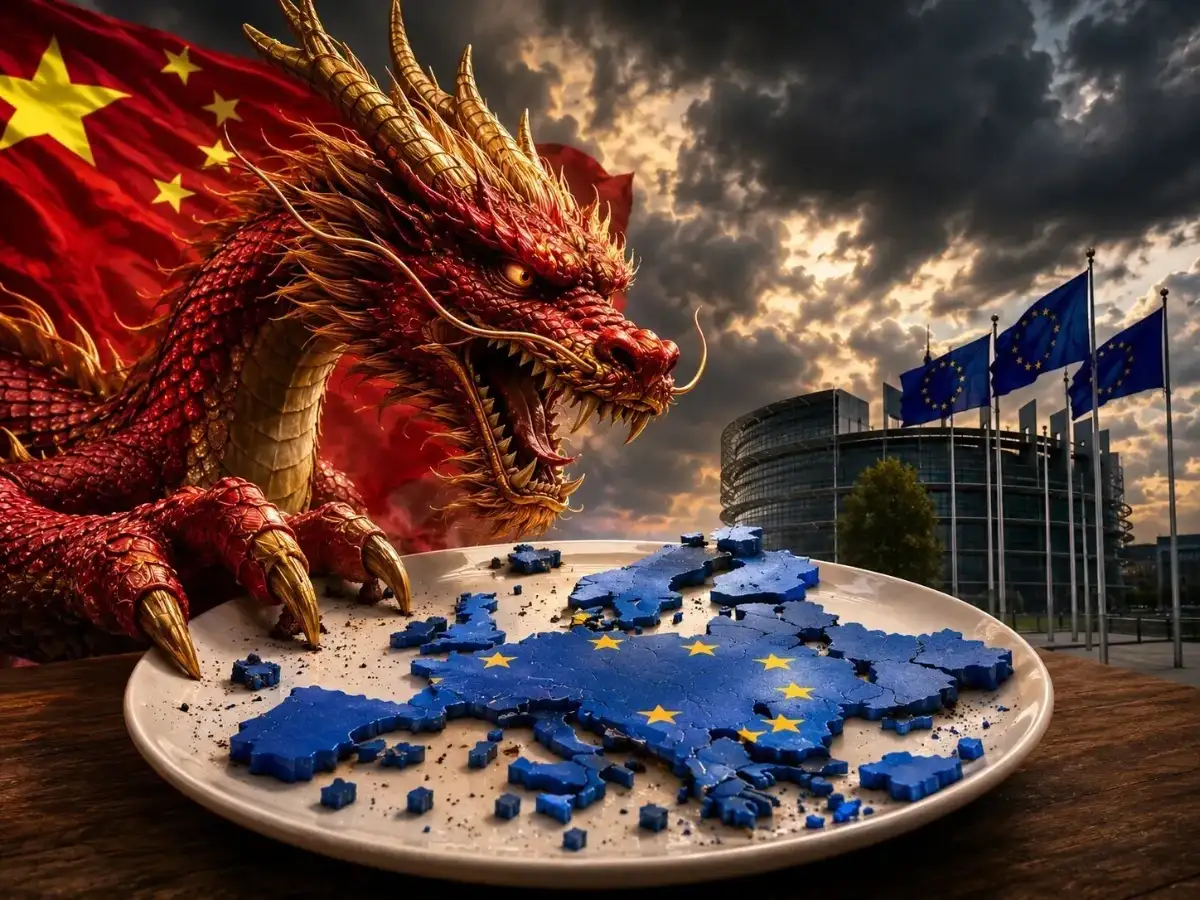
However, pressure inside Germany itself is increasing. A report by the Centre for European Reform warned that China’s growing dominance in automobiles, machinery and chemicals could undermine Germany’s innovation base and increase China’s leverage over Germany. The report used a striking phrase, saying that “China has already eaten much of German industry’s lunch and is preparing to start on dinner.” The contradiction at the heart of Germany’s China policy is becoming harder to sustain. German firms still need Chinese markets, but they are simultaneously being undercut by Chinese competitors backed by state subsidies.
Europe’s broader strategic shift
The emerging EU strategy is not simply about tariffs. It reflects a broader shift of Europe’s economic philosophy. For decades, the EU championed open markets, multilateral trade rules and global supply chain integration. But recent crises including the pandemic, the energy shock after the Ukraine war and growing tensions with China have altered European thinking. Strategic autonomy has become one of EU's central organising principles.
This shift is visible in the language now used by European officials. Terms such as “economic security”, “industrial resilience” and “strategic sovereignty” increasingly dominate policy discussions. The proposed resilience tool captures this evolution. It would allow the EU to intervene when supply chains become excessively concentrated in particular countries or firms. The EU is also becoming more willing to use trade policy defensively. According to the Financial Times, trade defence measures are now at their highest level in almost two decades. the EU is increasingly prepared to impose anti-subsidy tariffs, scrutinise foreign investments and restrict market access in sensitive sectors.
This marks a departure from Europe’s earlier assumption that economic interdependence would naturally produce stability and convergence.
China’s response and the risk of escalation
China views these developments with growing alarm. Chinese officials argue that Europe is abandoning free trade principles and embracing disguised protectionism. China has warned of retaliatory measures and accused the EU of violating WTO rules. For Chinese firms, Europe’s evolving policies create substantial uncertainty. Companies may increasingly be forced to localise production, enter joint ventures or transfer technology to retain access to European subsidies and procurement opportunities.
At the same time, Europe’s measures could accelerate the fragmentation of global trade. Chinese exporters may redirect goods to other markets if barriers rise in Europe. China could also retaliate against European companies operating in China, particularly German manufacturers that remain heavily invested there. The risk is that the current trade tensions evolve into a broader strategic economic confrontation. Europe is not seeking full-scale decoupling from China in the manner advocated by some. But it is clearly moving towards selective disengagement in sectors considered strategically important.
The transformation is already visible. What began as de-risking is gradually becoming a doctrine of industrial defence. Europe’s leaders increasingly believe that maintaining industrial capacity and technological sovereignty now requires active intervention against distorted competition from China. The coming years will determine whether this strategy succeeds in reviving European industry or whether it deepens the fragmentation of the global trading system.