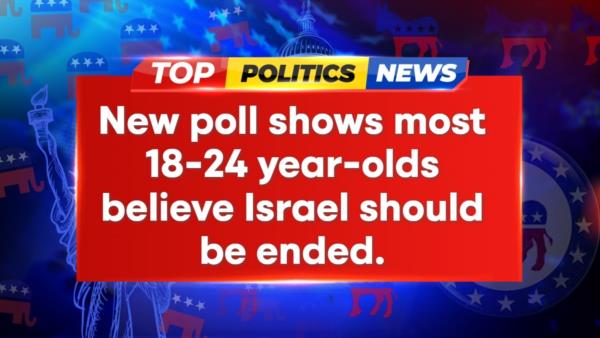
In a recent Harvard-Harris poll, a surprising number of 18 to 24 year-olds reportedly held the belief that 'Israel should be ended,' suggesting that the nation be handed over to the United States. This stance has provoked discussions centred around the propagation of such beliefs in modern American universities, where critics argue that notions of free speech can often be one-sided.
The New York Times recently published an article on the issue, suggesting that efforts to control anti-Semitism on college campuses were leading to a 'chilling effect' on pro-Palestinian speech. Critics argue that this freedom might veer towards anti-Jewish, anti-Semitic rhetoric and pro-Hamas sentiments, creating bias and hindering any balanced discussion on the subject.

This controversy occurs 70 days after the Israel-Gaza conflict, where debates over the implications of the widely used phrase 'from the river to the sea' -- a call advocating for a Jew-less Palestine -- dominated global discourse. Critics state that the persistent illusion of achieving a Palestine that spans 'from the river to the sea' may offer little recourse other than promoting hostility towards Israelis.
Moreover, it's argued that young adults may not fully comprehend the historical complexity of the Israeli-Palestinian conflict. Their perceptions of the issue are reportedly being shaped by social media platforms such as TikTok and college curriculums promoting DEI (Diversity, Equity, Inclusion) models where Jews are perceived as oppressors due to perceived success and resultant privilege.
Within such frameworks, the history of the conflict, including instances of terrorism from suicide vests or violence at music festivals, fall into obscurity. Critics present the solution as a comprehensive understanding of the historical and religious complexities of the conflict. They contend that a simple binary perception of Israel as an oppressor doesn't take into account the country's status as one of the few in the region that offers equal rights to men and women, and to Muslims, Christians, and Jews alike. Therefore, the call now is for a true representation of religious and ideological diversities in such discussions.