
Get all your news in one place.
100’s of premium titles.
One app.
Start reading
Tom’s Hardware
Tom’s Hardware
Technology
Mark Tyson

Hardware hacker installs Minecraft server on a cheap smart lightbulb — single 192 MHz RISC-V core with 276KB of RAM, enough to run tiny 90K byte world

Minecraft server installed on a smart lightbulb.

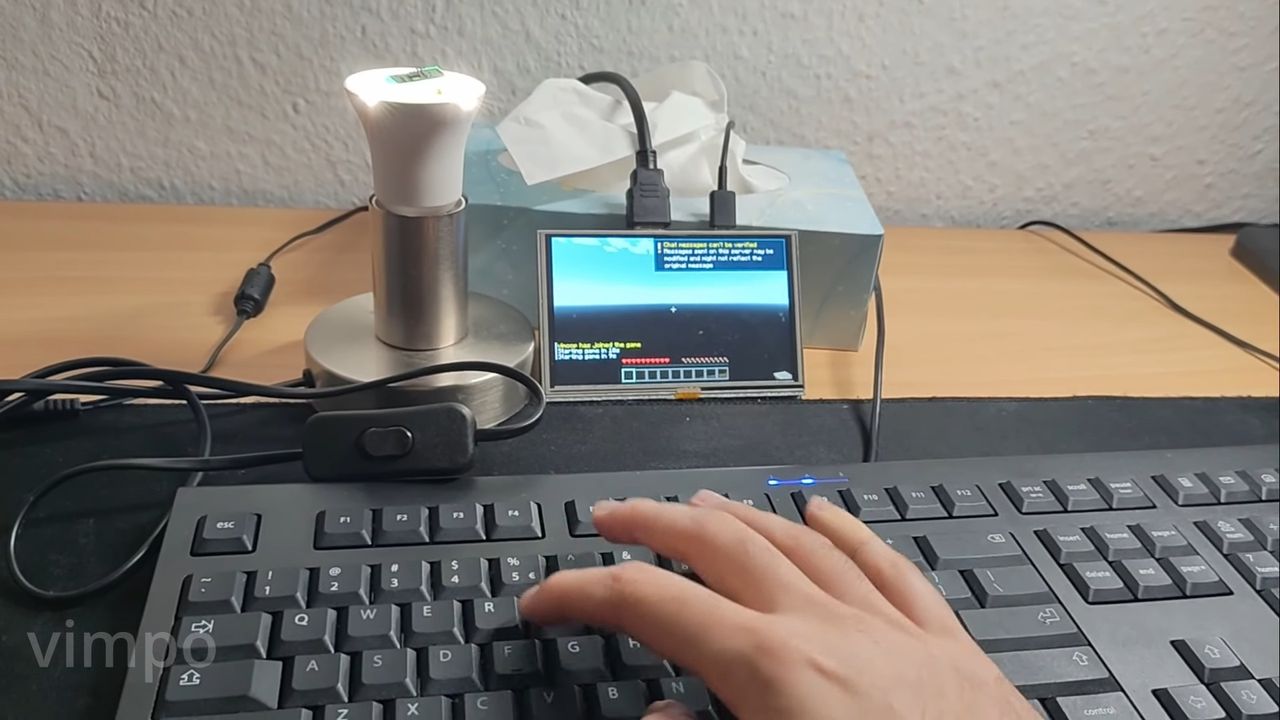
A hardware hacker has installed a Minecraft server on a cheap smart lightbulb. Vimpo shows how this feat was completed and demonstrates the server working in a brief video, embedded below. Key to this achievement was the bulb’s BL602 RISC-V-powered microcontroller.

Hardware hacksawing

Vimpo begins their quest by taking a knife to the unfortunate AliExpress-bought LED bulb. Oldies like me still find it jarring to see a lightbulb popped open without terrible consequences – but LEDs don’t need to reside in a delicate vacuum.

Next up, our intrepid hacker desolders the microcontroller from the center of the bulb, where it sits surrounded by an array of LEDs. Remember, this lightbulb's microcontroller is powered by a BL602, which features a single RISC-V core, running at up to 192 MHz, and partnered with 276KB RAM, 128KB ROM, and sporting a modicum of I/O.

We then see the detached microcontroller with wires soldered individually to its headers. Vimpo confirms the connections are fine by quickly hooking up the wires to turn the lightbulb on and off.

A simple USB-to-serial adapter board is soldered to these connections for a steady, usable interface. We now have a ‘system’ ready, with monitor and input peripherals, upon which to run a Minecraft server.

Software shenanigans

Of course, hardware is only half of Vimpo’s solution. To get a Minecraft server operating on the limited resources of a smart bulb, the hacker has put together a system running an implementation dubbed Ucraft. You can find Ucraft code resources on GitHub, plus a guide to building the server system on a Linux machine.

Ucraft is gloriously compact, with a “binary size is approximately 46K bytes without authentication and 90K bytes with the authentication library,” says Vimpo. “Memory usage varies based on the number of active players. In the worst-case scenario with 10 players, heap usage will be around 70K bytes with authentication and 20K bytes without authentication.” However, the hacker is first to admit that Ucraft “lacks most, if not all, features of the vanilla server.”

Three players playing the game on the server (Image credit: Vimpo )

In some ways, Minecraft is becoming the new Doom, used as a springboard for outlandish projects. Minecraft is now a leading light in inspiring hardware and software hackers to push the boundaries of the computing world. For example, in recent months, we’ve seen a 5-million-parameter ChatGPT AI model in Minecraft, as well as Minecraft running entirely in 8MB of VRAM on an old GPU, and another Minecraft server implemented using 63-year-old COBOL code.

Follow Tom's Hardware on Google News, or add us as a preferred source, to get our latest news, analysis, & reviews in your feeds.

Sign up to read this article
Read news from 100’s of titles, curated specifically for you.
Already a member? Sign in here
Related Stories
Top stories on inkl right now
One subscription that gives you access to news from hundreds of sites
Already a member? Sign in here
Our Picks
Fourteen days free
Download the app
One app. One membership.
100+ trusted global sources.