
Scientists have discovered what may be the world's oldest cave art. Handprints on cave walls in a largely unexplored area of Indonesia are believed to date back to at least 67,800 years ago.
The tan-colored prints analysed by Indonesian and Australian researchers on the island of Sulawesi were made by blowing pigment over hands placed against the cave walls, leaving an outline. Some of the fingertips were also tweaked to look more pointed.
It's not yet clear whose hands made the prints. They could be from an ancient human group called Denisovans who lived in the area and may have interacted with our Homo sapiens ancestors before eventually going extinct.
Or they may belong to modern humans venturing away from Africa, who could have wandered through the Middle East and Australia around this time. Fine details on the cave art, including the intentionally modified fingertips, point to a human hand.
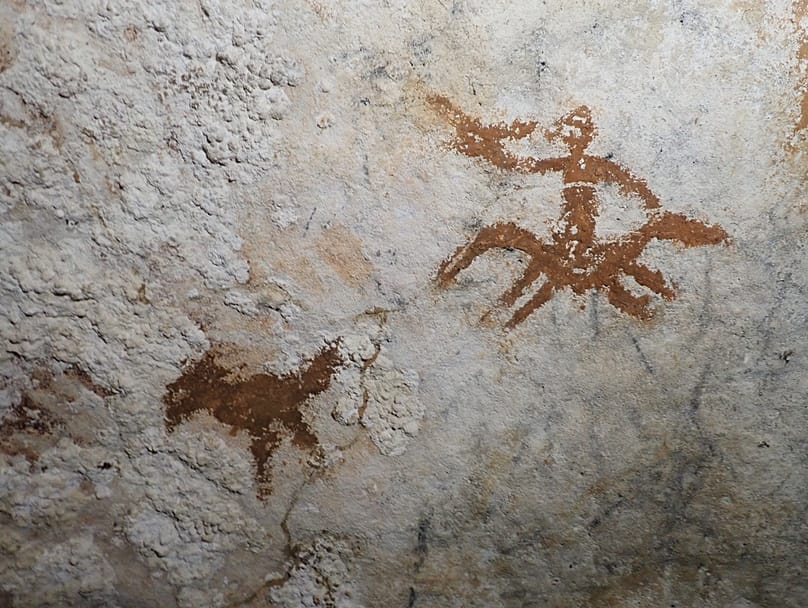
The new art from southeastern Sulawesi is the oldest to be found on cave walls. The stencils also represent a more complex tradition of rock art that could have been a shared cultural practice, said study author Maxime Aubert with Griffith University, who published the study in the journal Nature.
This prehistoric art form suggests the Indonesian island was home to a flourishing artistic culture. To figure out how old the paintings were, researchers dated mineral crusts that had formed on top of the art.
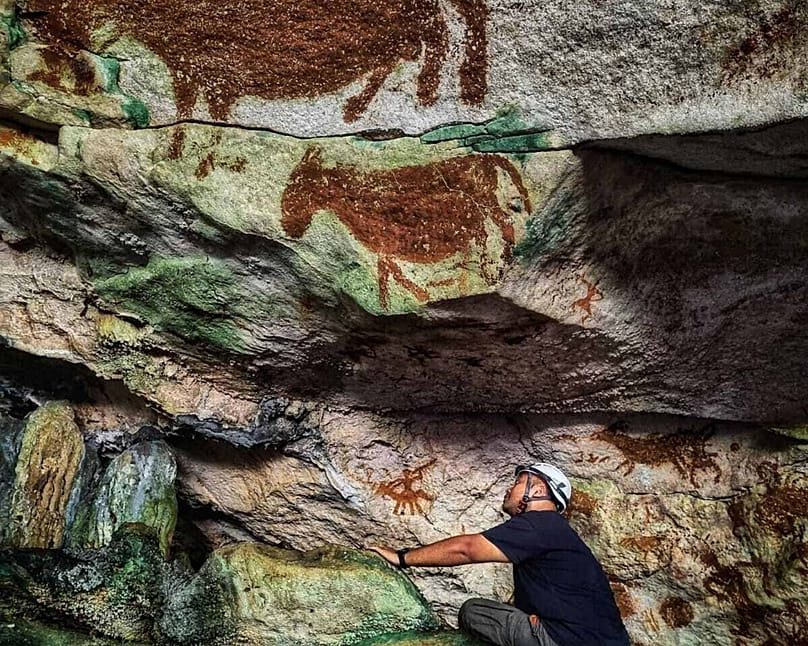
Scientists are eager to understand when early humans learned to make art, moving from dots and lines to more meaningful representations of themselves and the world around them. These cave drawings help firm up a timeline for the dawn of human creativity.
Other drawings discovered in the same area of the island, including a human figure, a bird and horse-like animals, were found to be created much more recently, some of them about 4,000 years ago.
Indonesia is known to host some of the world’s earliest cave drawings, and scientists have analysed countless examples of ancient art across the globe — including simple marks on bones and stones that go back hundreds of thousands of years. Cross-hatched markings on a piece of rock in South Africa have been dated to about 73,000 years ago.