
Get all your news in one place.
100's of premium titles.
One app.
Start reading
Digital Camera World
James Artaius

Canon RF-S 14-30mm f/4-6.3 IS STM PZ review: THE must-have lens for APS-C content creators

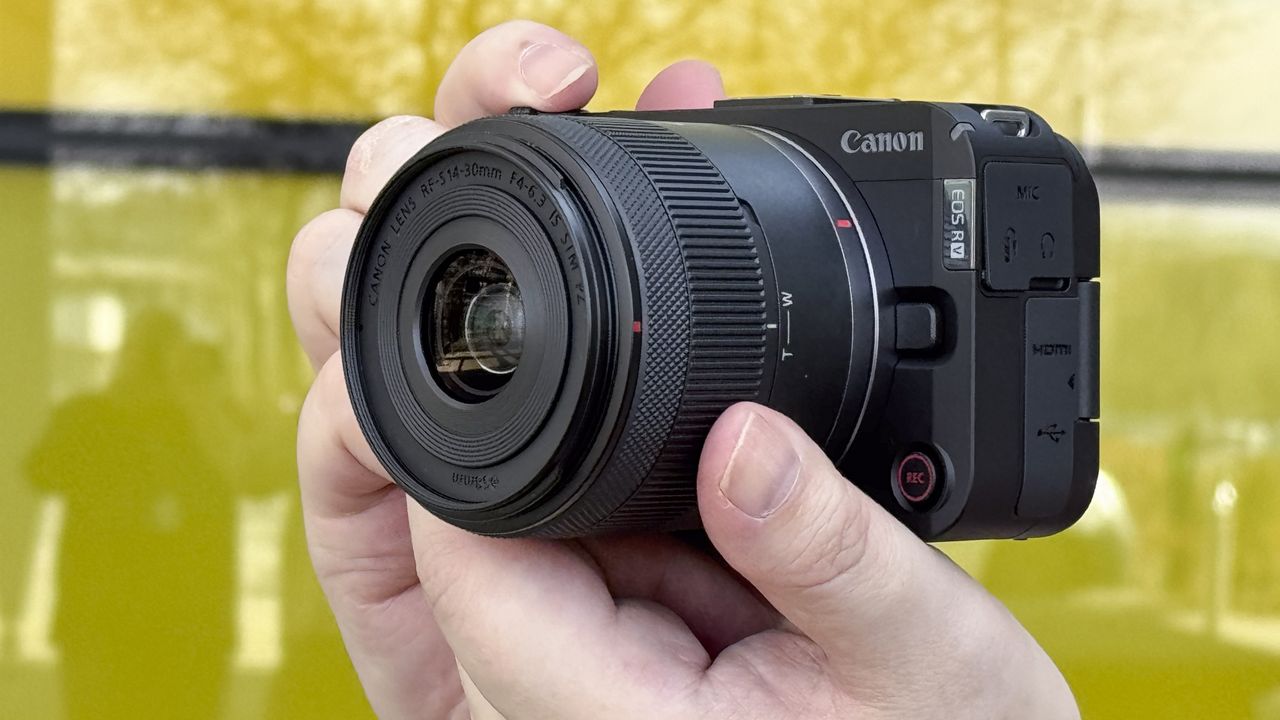
Canon RF 14-30mm f/4-6.3 STM PZ lens mounted to a Canon EOS R50 V.

It may not look it, but the Canon RF-S 14-30mm f/4-6.3 IS STM PZ marks an important first for the EOS R system: it's the first RF lens with integrated power zoom – meaning that you can push in and pull out shots with silky smooth electronic zooming.

It's no coincidence that the Canon RF-S 14-30mm f/4-6.3 IS STM PZ was launched in tandem with the Canon EOS R50 V, as it's a lens that's tailor-made for the new content creation powerhouse. However, it's also perfect for anyone creating videos or vlogs on any of Canon's APS-C bodies.

Photographers need not apply, as this is essentially a video-only optic. But if you're a creator then buckle up, because this is a lens that you're guaranteed to want on your camera.

Canon RF-S 14-30mm f/4-6.3 IS STM PZ: Price & availability

The Canon RF-S 14-30mm f/4-6.3 IS STM PZ was launched with a price tag of $369 / £379 / AU$1,499.

The closest comparable lens is the Canon RF 15-30mm f/4.5-6.3 IS STM, priced at $639 / £589 / AU$950. While it is similarly specced, it's a full-frame RF lens – so it's considerably bigger and over twice the weight. Crucially it is also a manual zoom, so it lacks the signature motorized capability of the RF-S 14-30mm.

Another integrated power zoom option is the premium Canon RF 20-50m f/4L IS USM PZ. As a full-frame L-series lens, this carries a much higher price tag of $1,399 / £1,439 / AU$2,199.

Canon RF-S 14-30mm f/4-6.3 IS STM PZ: Specifications

Lens

Mount

Canon RF-S

35mm focal length

22.4-48mm

Image stabilization

Up to 5 stops (when combined with IBIS, up to 7.5 center / 5.5 corner)

Weather sealing

No

Focus

Auto

Control ring

Yes

Lens construction

10 elements in 9 groups (2 PMo aspherical, 1 ultra-low dispersion)

Minimum aperture

f/32

Minimum focus distance

0.15m

Maximum magnification

0.38x

Filter size

58mm

Dimensions

62 x 69.6mm

Weight

181g

Canon RF-S 14-30mm f/4-6.3 IS STM PZ: Build & handling

As noted, the Canon RF-S 14-30mm f/4-6.3 IS STM PZ is the first integrated power zoom lens for the RF system. And this distinction (along with the price) sets it apart from Canon's other power zoom lenses, the RF 24-105mm f/2.8 PZ and RF 70-200mm f/2.8 PZ, both of which require the additional PZ-E2 adapter.

But of course, those are L-series lenses that cost thousands and are aimed at professional videographers; the RF-S 14-30mm is a super-affordable lens that's aimed at content creators.

Its closest comparative is the RF 15-30mm f/4.5-6.3, which on paper looks like a very similar lens. But make no mistake, that's a very different lens.

For starters, it lacks the motorized power zoom that makes the RF-S 14-30mm so desirable for video. But it's also a full-frame lens, designed for full-frame cameras, and so it's a darned sight bigger and weighs twice as much.

No, if you're a content creator using an RF-S body like the EOS R50 V, R50, R100, R10 or R7, this new PZ lens is exactly what you need. In fact, for a lot of people, it might be the only lens you need.

Its primary party trick is the power zoom. By turning the zoom ring on the lens barrel, you activate a smooth motorized zoom that instantly makes your footage look more professional. A gentle turn will perform a gradual zoom, and the more you turn the ring the faster the zoom will be.

The zoom feature can also be controlled by the R50 V's zoom switch, and it can even be activated when shooting remotely with the Camera Connect app. This is ideal if you're capturing video on a tripod that's out of arm's reach, or if your camera is delicately balanced and you don't want to introduce shake by handling the camera of lens.

The Canon RF-S 14-30mm f/4-6.4 IS STM PZ has a control ring, too, which you can customize to whatever exposure setting suits you best – I always like my video lenses to have aperture control, which is especially handy when you're self-shooting as you can reach to the nose of the lens and make a quick adjustment.

There's no weather-sealing on this lens, though the majority of Canon's APS-C bodies aren't sealed either so I don't think this is a huge omission.

Much more important is the inclusion of image stabilization, which is good for up to 5 stops on most cameras – but goes all the way up to 7.5 stops (in the center; 5.5 in the corners) on a camera with in-body image stabilization.

(Image credit: Chris George)

Canon RF-S 14-30mm f/4-6.3 IS STM PZ: Performance

The first thing to bear in mind is that the Canon RF-S 14-30mm f/4-6.3 IS STM PZ is an APS-C lens, which means that its effective focal range is 22.4-48mm in full-frame terms (thanks to the 1.6x crop of Canon's APS-C sensors).

This is a pretty ideal range for vloggers and content creators; it gives you a working width for arm's length filming and working in small spaces, and an almost 50mm "standard" field of view for natural everyday environmental filming.

(It's worth noting that some cameras – like the EOS R50 V and R10 – feature a further 1.56x crop when shooting 4K 60p video, which will reduce the image to 64% of the horizontal area in total.)

Something that really impressed me about the RF-S 14-30mm is the close-focus distance. At just 15cm / 5.9 inches, it enables you to keep subjects in focus even when they're really close to the lens.

This is especially important for creators filming reviews or tutorials, when holding small objects up to the camera is called for. I tested it out by holding tiny Happy Meal Transformers toys up to the lens, and it handled them perfectly.

Of course, the most important thing about a power zoom lens is the power zoom feature itself – and it works brilliantly here. I love the creative opportunities it opens up, which just aren't possible using a manual zoom lens.

Having a subtle push-in while filming B-roll makes your footage feel so much more engaging, and being able to silently and smoothly zoom in or out adds bags of production value. It's a brilliant storytelling tool if you use this lens for filmmaking, too, as you can add professional pushes and pulls on your subject to create dramatic effect.

Canon RF-S 14-30mm f/4-6.3 IS STM PZ: Sample images

(Image credit: James Artaius)
Zoomed in to 30mm…  (Image credit: James Artaius)
… and zoomed out to 14mm (Image credit: James Artaius)
Zoomed out to 14mm…  (Image credit: James Artaius)
… and zoomed in to 30mm (Image credit: James Artaius)
(Image credit: James Artaius)

Canon RF-S 14-30mm f/4-6.3 IS STM PZ: Sample video

Canon RF-S 14-30mm f/4-6.3 IS STM PZ: Lab results

We run a range of lab tests under controlled conditions, using the Imatest Master testing suite. Photos of test charts are taken across the range of apertures and zooms (where available), then analyzed for sharpness, distortion and chromatic aberrations.

We use Imatest SFR (spatial frequency response) charts and analysis software to plot lens resolution at the center of the image frame, corners and mid-point distances, across the range of aperture settings and, with zoom lenses, at four different focal lengths. The tests also measure distortion and color fringing (chromatic aberration).

Sharpness:

(Image credit: Future)

Sharpness is very good in the center of frame, particularly at larger apertures, and is consistently so throughout the focal range. Corner sharpness is average at all apertures and focal lengths, but again, at least it's fairly consistent at all focal lengths.

Fringing:

(Image credit: Future)

Fringing is noticeable at all focal lengths and apertures, although it shouldn't be too distracting.

Distortion:

(Image credit: Future)

As we've now come to expect from ultra-compact, wide-angle zoom lenses, there's a heavy reliance on firmware to correct lens distortion. The RF-S 14-30mm is a perfect example of this, as with this in-camera correction disabled, huge barrel distortion is revealed, which only becomes acceptable at focal lengths longer that 23mm.

Canon RF-S 14-30mm f/4-6.3 IS STM PZ: Verdict

I've been using power zoom lenses on other cameras for over a decade, and I'm beyond thrilled that there's finally an affordable option for the RF system.

Canon is exceptionally smart to offer this lens in a bundle with the R50 V, as they're a pretty perfect pairing for content creators. But I think that creators should take that as a huge hint, because the Canon RF-S 14-30mm f/4-6.3 IS STM PZ is a great lens for shooting video content on any APS-C camera.

Certainly the slow aperture range limits your ability to shoot in low light, or to achieve background blur behind your subjects. But for the kind of filming for which this lens is intended – creators using ring lights and other lighting in their home setups – I don't think this is much of a problem.

For anyone starting their videography or creation journey, and anybody who needs an everyday video lens with a smooth electronic zoom that can be controlled locally or remotely, the RF-S 14-30mm is a great and affordable solution for APS-C bodies.

If you're looking for a more premium power zoom optic, take a look at the Canon RF 20-50mm f/4L IS USM PZ – a full-frame L-series lens (which is an equivalent 32-80mm when used on an APS-C body) that boasts weather sealing and superior optics – albeit for about a thousand bucks more.

Sign up to read this article
Read news from 100's of titles, curated specifically for you.
Already a member? Sign in here
Related Stories
Top stories on inkl right now
One subscription that gives you access to news from hundreds of sites
Already a member? Sign in here
Our Picks
Fourteen days free
Download the app
One app. One membership.
100+ trusted global sources.