
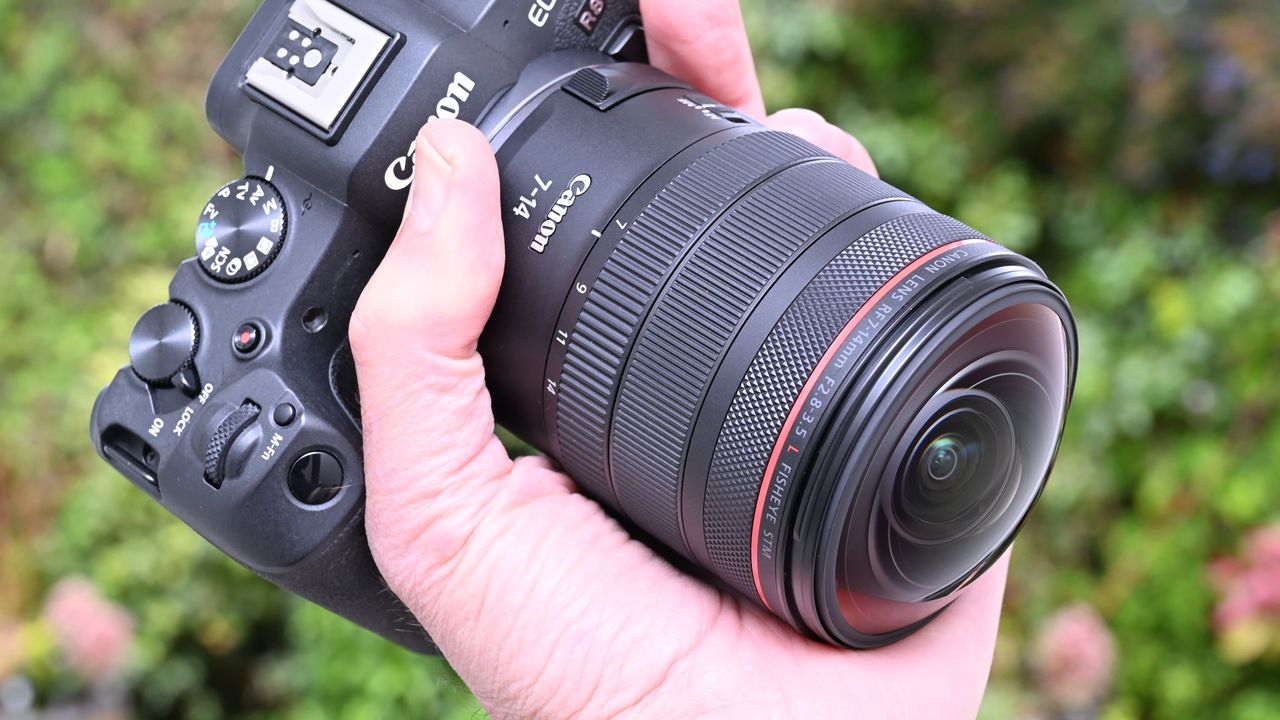
After a decade and a half, the Canon RF 7-14mm f/2.8-3.5L Fisheye STM is here – the long-awaited upgrade to the cult classic Canon EF 8-15mm f/4L Fisheye USM DSLR lens from 2011.
Just like the old EF version, I love the Canon RF 7-14mm f/2.8-3.5L Fisheye STM because of how uniquely creative it is: a zoom that goes from circular fisheye (as in, "proper fisheye" with the circular, porthole-style images) at 7mm to a diagonal fisheye (aka "full frame fisheye", which stretches the image across the entire frame) at 14mm.

But far from just the old lens with an RF mount, this new version offers significant upgrades over its predecessor: better image quality, faster aperture, more extreme field of view, lighter weight and the ability to convert imagery to 180° 2D VR content.
The Canon RF 7-14mm f/2.8-3.5L Fisheye STM might be the single most niche lens on the market but, if you happen to be someone whose work demands or rewards its unique properties, this might be a genuine dream lens for you. It definitely aims to be one of the best fisheye lenses on the market.

Canon RF 7-14mm f/2.8-3.5L Fisheye STM: Price
The Canon RF 7-14mm f/2.8-3.5L Fisheye STM came to market in February 2026 with a price tag of $1,899 / £1,719 / AU$2,799. As I’d expect, that’s a bit of a hike from the 15-year-old DSLR equivalent, the Canon EF 8-15mm f/4L Fisheye USM selling for around $1,249 / £1,389 / AU$1,769. You might be thinking that the new RF edition is expensive for a fisheye lens, and you’d be dead right.
For comparison, Venus Optics makes a native RF-mount fisheye zoom that stretches from circular to diagonal fisheye effects on a full-frame EOS R-system camera. The Laowa 8-15mm f/2.8 FF Zoom Fisheye in question only costs $699 / £699 / AU$1,299, less than half as much. Don’t need a circular fisheye effect? The excellent 7Artisans 10mm F2.8 II Fish-Eye ED is also available in Canon RF mount, for just $278 / £259 / AU$419. A sizeable caveat is that both of these third-party fisheyes are manual focus only, and have no autofocus capability? On the other hand, depth of field is so gargantuan that you barely need autofocus anyway.
Canon RF 7-14mm f/2.8-3.5L Fisheye STM: Specifications
Mount |
Canon RF |
Equivalent focal lengths |
APS-C: 11.2-22.4mm |
Image stabilization |
N/A |
Weather sealing |
Yes |
Focus |
Auto / manual |
Control ring |
Yes (clicked) |
Aperture ring |
No |
Lens construction |
16 elements (5x ultra-low dispersion, 2x aspheric), 11 groups, 9-blade aperture, Super Spectra coating, Air Sphere coating, fluorine coating |
Minimum aperture |
f/22 at 7mm, f/29 at 14mm |
Minimum focus distance |
0.15m |
Filter size |
(Drop-in rear filters) |
Dimensions |
76.5mm x 109.4mm (87.6 x 131.7mm with hood) |
Weight |
476g |
Canon RF 7-14mm f/2.8-3.5L Fisheye STM: Build & handling
After years of handling the old EF 8-15mm, picking up the RF 7-14mm felt like coming back home. The lenses feel familiar, though the RF version is noticeably lighter at just 476g (compared to 540g) – but it's also noticeably longer, at 109.4mm (versus 83mm).
That extra length accommodates some welcome new features on the exterior, such as a function button and RF control ring (clicked), though you do lose the old focusing scale. However, it's how that space is used inside that provides the biggest benefit.

The Canon RF 7-14mm f/2.8-3.5L Fisheye STM has a more complex optical formula than its predecessor, now boasting 16 elements (over 14 in the EF version) including 5 ultra-low dispersion elements (instead of 2) to offer even better control of chromatic aberrations and color fringing.
On top of that, there are a pair of aspheric elements to offer improved distortion compensation and better correction for spherical aberration – the latter being particularly important, being as the new lens has a faster maximum aperture (f/2.8) than the old one (f/4).

The front element, as you'll have observed, is a bulbous affair, so conventional filters won't work here – but the RF lens carries over the EF version's old trick of accepting filters at the rear.
However, instead of old-school gel filters, the RF 7-14mm accepts drop-in filters that were designed for Canon's EF-EOS R mount adapter, including the specialist Variable ND Filter A and Circular Polarizing Filter A.

And where the EF lens had a Limit switch, the RF version improves the formula by not only enabling you to lock the position but also to lock it in the "C" position for diagonal coverage on an APS-C camera (where, due to the crop factor, it starts to achieve full-frame coverage at 8.7mm / 13.92mm equivalent, rather than at "full lock" on the long end).

As you'd expect of an L-series lens, build quality is excellent and you'll find rubber seals to provide full weather sealing – along with a fluorine coating to protect the front element. Another similarity with the older EF lens is that the zoom and focus mechanisms are fully internal, so the overall physical length of the lens remains fixed at all settings.

One unusual feature for a fisheye lens is that this one comes with a detachable hood. Due to the extreme viewing angle of circular fisheye lenses, they generally don’t have a hood, but rather a 2-stage front cap that slides over the front of the lens. Diagonal fisheye lenses normally come with a fixed, integral hood that gives protection to the bulbous front element, as well as reducing the risk of ghosting and flare. This lens comes with a hood that you can fit and remove at will.

Canon RF 7-14mm f/2.8-3.5L Fisheye STM: Performance
If you're upgrading from the old EF 8-15mm, you'll be pleased to hear that the Canon RF 7-14mm f/2.8-3.5L Fisheye STM delivers superior image quality – particularly around the edges. Canon told me that it performs better than the RF 15-35mm f/2.8L in this respect, which is backed up by my own experience of both lenses.
You're obviously still going to bump into aberrations as you examine the extreme warp at the frame edge, especially in circular fisheye mode. Even so, I feel that given the optical gymnastics that this lens is performing, they're very well controlled. The aberrations are also easily corrected in Photoshop, becoming a bit of a non-issue.

You're maybe wondering what the difference is between the circular and diagonal images, and how a photo compares when shot at the opposite zoom extremes. So here are a couple of shots of the exterior of Canon's snazzy UK and European headquarters to illustrate…


Perhaps this is your first time seeing what a difference in perspective there really is between circular and diagonal fisheye effects, as well as just how different both effects are to using a regular 'rectilinear' ultra-wide-angle lens. Perhaps you're also wondering exactly what the applications for this lens might be.
Well, given their unique ability to capture the whole sky, circular fisheyes were originally employed to document atmospheric conditions. This means they're great for astrophotography, along with star and skyscapes. In circular or diagonal format this lens is also great for landscapes and architecture – and, especially if you're a Nineties kid, it's also perfect for action sports.
As someone who grew up watching far too many 411VM and CKY videos, my first instinct was obviously to use the Canon RF 7-14mm f/2.8-3.5L Fisheye STM for skateboarding photos and videos – aping the Super8 style that encapsulated skate culture of that era.
But I think the real untapped potential for this lens is its application for virtual reality content. Equirectangular conversion is possible using Canon's EOS VR Utility, enabling you to turn your 190° circular fisheye stills or video into 2D VR content for viewing on computers or headsets.
This is currently supported for photos captured on the Canon EOS R5, R5 Mark II, R5 C, R6 Mark II and R6 Mark III. Conversion is also supported for open gate video recorded on the R6 Mark III (and it's possible, probable even, that an update will extend this support to the EOS C50).

I find the VR potential hugely exciting, and the Canon RF 7-14mm f/2.8-3.5L Fisheye STM might just have become the breakthrough tool for the company's underappreciated EOS VR technology.
People are always asking me what EOS VR does, or who it's for, or who is supposed to be creating with it. Well, whoever the 2026 version of Bam Margera is, I think this tech will be his springboard to take VR content in a new direction – and to a new audience – in ways that are as groundbreaking as those skate videos were 30 years ago.
All of which is to say that I'm going to need to field this lens way more than I was able to in my initial hands-on, because there is a mountain of potential here!

Canon RF 7-14mm f/2.8-3.5L Fisheye STM: Sample images
The following gallery of example images was shot at Wells Cathedral in the English county of Somerset. As you go through the sequence, you’ll notice that the images are in pairs, shot of the same subject from the same vantage point at both 7mm (circular fisheye) and 14mm (diagonal fisheye) focal lengths.

Canon RF 7-14mm f/2.8-3.5L Fisheye STM: Verdict
When I say that the Canon RF 7-14mm f/2.8-3.5L Fisheye STM is a niche optic, I'm not exaggerating. After all, the RF mount is now eight years old and it's only now getting this lens – which tells you what the demand has (or, rather, hasn't) been.
But if you're one of the many enthusiasts and professionals who has been clinging onto your old EF 8-15mm f/4L Fisheye, your day has finally come – and this new RF version is definitely worthy of your attention.
It's physically lighter, its focal range is wider, its aperture is faster, its image quality is better, it has a control ring, it has a function button, it supports Canon's drop-in filters and it can be used for VR content.
While it will likely continue to be a boutique choice for astro, architectural, landscape and sports shooters, I think there's a world of potential for content creators, VR enthusiasts and anyone looking to add genuinely creative flourish to their photo and video arsenal.
The Canon RF 7-14mm f/2.8-3.5L Fisheye STM isn't a lens for everybody, but it's a lens that can do things no other lens can do. Which means that if you've found yourself reading this far, then yes – you probably do need it!
|
Features ★★★★★ |
Even in the realm of zoom lenses, it’s very rare to find an optic that’s two completely types of lens in one package. And this one comes complete with autofocus and a drop-in filter holder. |
|
Design ★★★★★ |
More lightweight than its EF forebear, the fisheye zoom is easy to manage and is designed to have great handling, with three independent control rings plus a removable hood. |
|
Performance ★★★★★ |
The lens is impressively sharp right out to the edges (or circumference) of images, especially for a fisheye with such an expansive perspective. Unwanted aberrations are kept well under control. |
|
Value ★★★★☆ |
The Canon is undeniably expensive and costs much more than RF-mount prime and zoom alternatives from independent manufacturers, even if they lack autofocus. |

Alternatives