
I’ve been testing bird feeder cameras since they first hit the market in early 2020, but as a wildlife photographer, bird box cameras have been in my arsenal for over a decade.
The market has moved enthusiastically towards AI bird identification and apps that let you keep tabs on the local birds through your phone. And the big brands that dominate today’s best bird box cameras and feeder guides have mostly abandoned wires in favor of all-in-one plastic gadgets that gamify wildlife watching.

But I’ll be honest; I’d like to revisit a time when watching birds didn't require a strong Wi-Fi signal or an app update every few weeks. Cue the Green Feathers cable-connection bird-box camera starter pack. This includes a physical cable to transmit nesting action directly to a TV or monitor, and in the case of the kit I’m testing, a nest box.
It's a system you can set up quickly in theory, but you'll need some level of patience to work out how to wire your box to the house and potentially feed and waterproof cables. The well-crafted wooden nestbox is designed to frame the camera, paired with an RCA-to-HDMI adapter to send the signal (or the direct AV connections if your TV, like mine, is old enough to have these). You can also buy this camera without a box for a more modest price, and fit it to your own house, making it a versatile buy.
Older analog cameras often locked users out of modern HD televisions unless they bought expensive extra splitters. By packaging this universal adapter directly into the kit, I can see Green Feathers bridging the gap for less tech-savvy users, traditional nature lovers, or photographers who want a Wi-Fi-free birding window.
There are obvious compromises to this simpler system, of course; the lower 700 TV Lines resolution will be disappointing to HD lovers, and without smartphone connectivity, you can only watch the box in real time. But I’ve been very keen to discover if this hardwired classic can still hold its own against the modern smart tech dominating, or if it feels too archaic for modern users and modern screens.
Green Feathers TV connectable camera: Specifications
Video Standard |
PAL |
Image Sensor |
OV7949/OV7950 |
Vertical Resolution |
700 TV Lines |
Pixel Resolution |
512(H) x 582(V) |
Minimum Colour Illumination |
1 Lux |
Minimum B/W Illumination |
0 Lux (IR On) |
Lens |
28mm |
Viewing Angle |
110 degrees |
White Balance |
Auto |
S/N Ratio |
>48dB(AGC Off) |
Backlight Compensation |
Auto |
Electronic Shutter |
1/50(1/60)-1/100,000 seconds |
Operation Temperature |
−20 – 50°C |
Power Supply |
12V DC <500mA |
Camera Dimensions |
44 × 44 × 33 mm |
Green Feathers TV connectable camera: Price
The Green Feathers cable-connected camera is at the DIY, affordable end of the bird camera market, and it's refreshing to find a product without any smart features to bump the price up. The company is based in the UK, and prices start from £55 (approx. $73) for just the camera and a 20m power cable. You can buy cables up to 50 meters at £84 (~$112), or go for a full kit with a sturdy bird box included (£99/$132). Green Feathers sent me this cable-connection bird-box camera starter pack for testing.
It’s a fairly budget-friendly buy compared to unbranded, standalone Wi-Fi cameras on Amazon that often require you to source your own nesting box and separate adapters. Near £100 isn't pocket change for an analog TV setup, but I think the handmade, 21mm thick sustainable wooden box and a dedicated HDMI converter sweeten the deal. I'll go into the design and build quality in more detail below, but both are worthy of the retail price.
This kit is much cheaper than app-driven alternatives like Green Feathers’ own 3rd Gen Wi-Fi camera bundle, which is closer to £150. It also avoids the premium smart tech tax of trendy AI options like the Birdfy Nest Duo or Birdbuddy ecosystems that can exceed $250/£200.
Features-wise, you have to get comfortable with what you're getting for the low price tag – a very basic 700 TV lines analog resolution with a 512 x 582 pixel count and no phone alerts or storage. If you want a reliable, lag-free live stream of nesting birds wired straight to your TV without faffing around with apps and Wi-Fi signals, though, the value is very reasonable.
Green Feathers TV connectable camera: Design & Handling
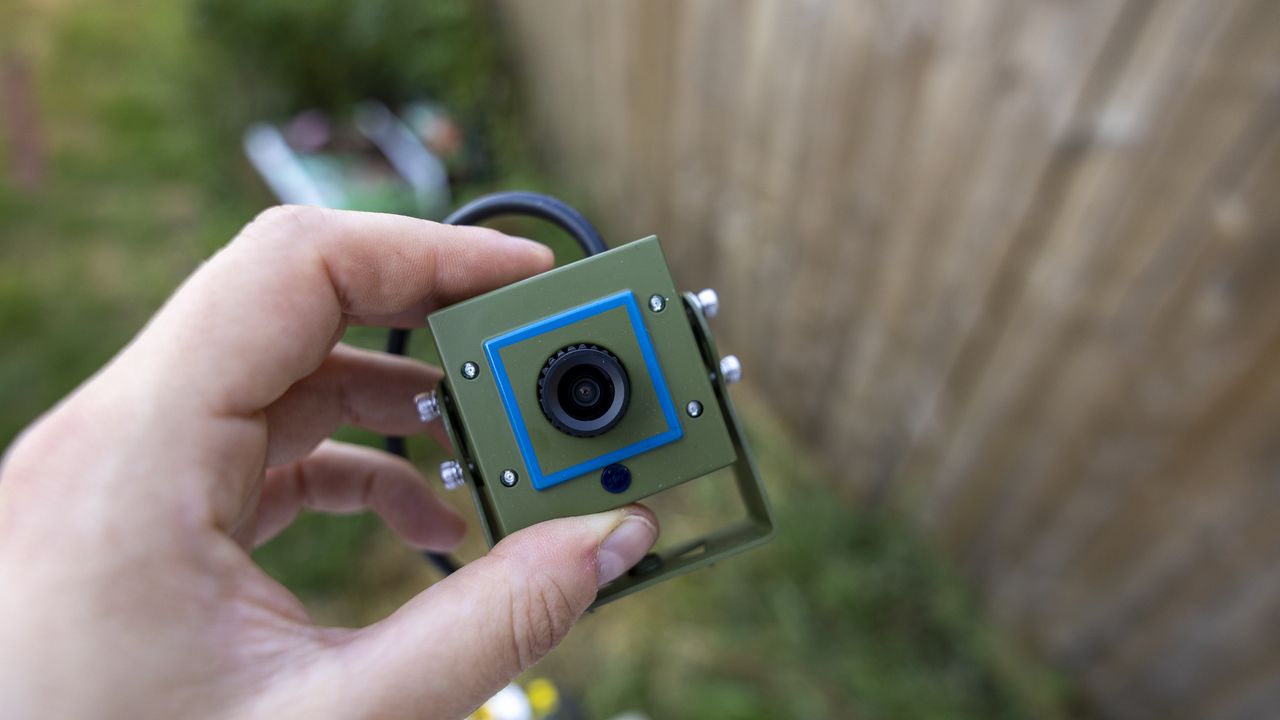
The Green Feathers' TV connection bird box camera looks almost identical, with a blue square around the lens instead of green (matching the box's labels).
If you’re getting used to modern Wi-Fi and smartphone app setups, opening up and setting up the Green Feathers TV-connectable camera might feel like stepping back in time. Its design and wired cabling immediately took me back to my university days (as a wildlife photographer) and a simpler, far more traditional era of wildlife surveillance.
The core bit of kit in the box is a compact metal cube measuring 44 x 44 x 33mm. I tested this as part of a complete setup with the Green Feathers bird box, but the camera is sold as a standalone unit you can use with an existing wooden nest box or even a hedgehog house.
Physically, the camera unit looks almost identical to its Wi-Fi-enabled alternative, with the same pinch-sized metal box, bar a subtle visual distinction. Where the Wi-Fi model features a green square accent frame around the lens, this TV-connectable version has a blue one.
What I found less straightforward was working out where all the power and video cables should go. A thick power and video cable emerges directly from the top of the casing, no problem. The rest of the bundled cabling setup felt thick and well-made, with the HDMI converter box and heavy-duty AV lines well-labelled and colored. The only component that’s a bit cheap by comparison is the indoor transformer plug and its power lead. Though practically speaking, since this section is set to be indoors by a television, it’s not a dealbreaker.
This camera demands more patience than modern smart setups during physical installation. Choosing a site for your bird box isn't just about finding a sheltered, enticing spot for garden birds; you also have to factor in how on earth you’re going to route a long physical cable (the length is up to you at the point of purchase) back into your house to reach the television.
Getting the wiring sorted took a good hour or more of trial and error as I scouted out a sensible path that wouldn't be disturbed, less a trail across the garden for my dog to untangle, etc. I eventually managed to feed the wire through the same exterior wall opening used by our home internet router, threading it from the outside in.
It’s a far more involved, traditional process than popping a wireless smart camera onto a wall plate, but this approach has the benefit of being both satisfying and simple (once the cables are tucked away and connected to your TV's HDMI port). You get an immediate and direct physical feed on the big screen every time you switch on your television. And as there’s no app to set up or talk about, the handling largely, neatly, ends there.
Green Feathers TV connectable camera: Performance
Note: As I'm testing this system outside the UK's bird-nesting window, the sample TV screen images show the interior perspective, depth of field, and image clarity inside the timber nest box. It’s also not possible to take direct shots from the camera, as it’s a live feed only.
Using the Green Feathers TV-connectable camera delivers an immediate advantage over its Wi-Fi sibling: visual stability. Though hugely helpful for keeping an eye on boxes that might be remote (or just peeking at activity when you’re away from home), with wireless wildlife cams, you’re relying on good signal strength. Here, the video feed travels over a direct physical cable straight to your television’s HDMI port, meaning the connection is solid and immune to home Wi-Fi drops (which happen a lot since I changed providers). The moment you switch the TV to the designated HDMI channel, the feed is just there, live and available.
When reviewing the image quality of this camera, I first wanted to be mindful that I was viewing the picture on a much bigger screen (50-inch) than my smartphone. And with the daylight feed on a modern LCD, the optical performance looked surprisingly strong. I also found that the manual focus ring helped here. Though I had no birds to monitor, I found that the image resolves fine micro-details across the interior pretty crisply. Looking at the screen, the grooves of wood grain and rough saw marks on the back panel were clearly visible.
Color accuracy and white balance were also good when viewing the feed. The natural pine box looked rich and warm without being saturated, which bodes well for colorful feathers. Dynamic range was more predictably mixed. The sharp contrast between the wooden interior and the daylight piercing through the entrance hole and floor seams results in noticeable highlight clipping. But the camera balances shadow detail across the lower corners so that the dark floor space is visible without becoming too noisy.
When light levels drop inside the box (mainly at night), the built-in infrared night vision is activated. On-screen, the monochrome IR feed looked evenly illuminated. The invisible IR LEDs cast a soft light across the box without any major hot spots directly under the lens. And because these LEDs emit no visible red glow, the TV feed can run indefinitely to monitor nocturnal roosting activity without disturbing the birds.
Of course, because you’re viewing a raw live feed rather than with an accompanying smart app on your phone, you can't record or grab instant snapshots at the touch of a button. What you see on the screen really is strictly real-time viewing.
Despite this (or maybe because of it), there’s something deeply satisfying about the TV-connectable setup. It’s powered continuously by mains electricity, so I don’t have to measure the battery or solar performance like I often would with bird feeder cameras. I found I had a permanent (clear enough) window into my nest box whenever I wanted it, without waiting for a signal buffer or battery recharge.
Green Feathers TV connectable camera: Verdict
I’ve been rethinking my use of tech (mainly my smartphone) recently, so testing the Green Feathers TV-Connectable Camera came at a fortuitous time. I found its old-school simplicity delightful, though I know many won’t get on with the wiring and planning required. But in a time when wildlife camera tech is about app notifications and AI, this system strips away all the noise to give you a direct, uninterrupted connection to your living room TV via HDMI.
Routing the long physical cable from my garden wall, through the router port, and into the TV was definitely a project that took an afternoon of trial and error. Though once I did get those wires channelled away, I didn’t have to think much more about them. And now, if I toggle over to the HDMI channel, I can view an uncompressed 1080p live stream that doesn’t suffer from buffering.
The optical quality inside the box isn’t bad given the camera’s low specs, and being able to manually adjust the focus ring means you should be able to get a decently sharp picture in different-sized boxes or houses. Yes, you lose out on smartphone convenience here, but without a battery to recharge or subscription costs to worry about, I think there’s still a clear market for this affordable bird camera. It’s a dedicated, zero-latency wildlife monitoring device that traditionalists and tech-averse nature lovers will get a lot from, without spending a lot.
|
Features ★★★☆☆ |
Purely plug-and-play. No modern smartphone app perks or remote alerts |
|
Design ★★★★☆ |
Tiny, solid camera can hide in small spaces. The cabling requires physical routing |
|
Performance ★★★★☆ |
True-to-life daytime colors, resolution lacks modern sharpness on big screens |
|
Value ★★★★☆ |
Good price for the complete kit with a handmade box and HDMI adapter included. |
Should you buy the Green Feathers TV connectable bird box camera?
✅ Buy this if...
- You want a lag-free, physical cable stream wired straight to a TV.
- You're not looking to spend a fortune on smart tech.
🚫 Don't buy this if...
- You want to check footage while away from home.
- Digital video clip storage is important to you.
Alternatives
Check out our full guides to the best bird feeder cameras, and to the best birdbox cameras