Get all your news in one place.
100's of premium titles.
One app.
Start reading
Bangkok Post
Bangkok Post
National

Government considers new disaster insurance scheme

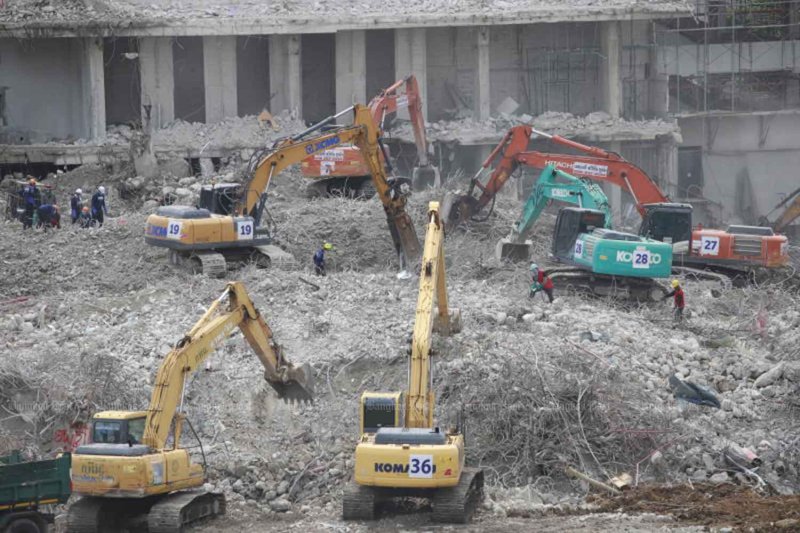
Site clearance takes place in April 2025 at the site of the State Audit Office building that collapsed during the earthquake that struck Bangkok on March 28, 2025, leading to the deaths of 95 workers. (Photo: Pattarapong Chatpattarasill)

The government is developing a disaster insurance scheme in partnership with private insurers to provide faster and more substantial compensation to disaster victims while reducing pressure on the state budget.

Deputy Prime Minister Pakorn Nilprapunt said the government had been monitoring the increasing frequency and severity of natural disasters and exploring ways to strengthen assistance for affected communities.

The cabinet has instructed the Interior Ministry to study alternatives to direct state compensation, with the aim of increasing the level of financial support available to people affected by natural disasters.

The ministry has been working with the Finance Ministry, the Office of the Insurance Commission and the Thai General Insurance Association to examine a disaster insurance model broadly based on Japan's system for earthquakes, floods and windstorms.

Mr Pakorn said the proposed scheme would allow private insurers to share responsibility for compensation payments, reducing the government's fiscal burden. Claims could also be processed more quickly than under the current state compensation system.

He said private insurers had expressed interest in participating, while disaster victims would benefit from faster payouts and higher levels of compensation.

Mr Pakorn said the government provides compensation of about 9,000 baht for certain types of damage, an amount that is often insufficient to cover home repair costs. At the same time, he said, it would not be realistic for the government to shoulder the full financial burden.

Under Japan's model, insurance companies make prompt payments to victims following natural disasters, with premiums determined according to risk levels in each area.

"Disbursing government funds is often a complicated process and can sometimes be delayed, leaving disaster victims facing hardship while receiving only limited assistance because state payments are designed to cover everyone," Mr Pakorn said.

"With an insurance-based system, compensation would be paid according to clearly defined coverage limits. If losses exceed the insured amount, the government could consider providing additional assistance, but the fiscal burden would be much smaller."

Sign up to read this article
Read news from 100's of titles, curated specifically for you.
Already a member? Sign in here
Related Stories
Top stories on inkl right now
One subscription that gives you access to news from hundreds of sites
Already a member? Sign in here
Our Picks
Fourteen days free
Download the app
One app. One membership.
100+ trusted global sources.