
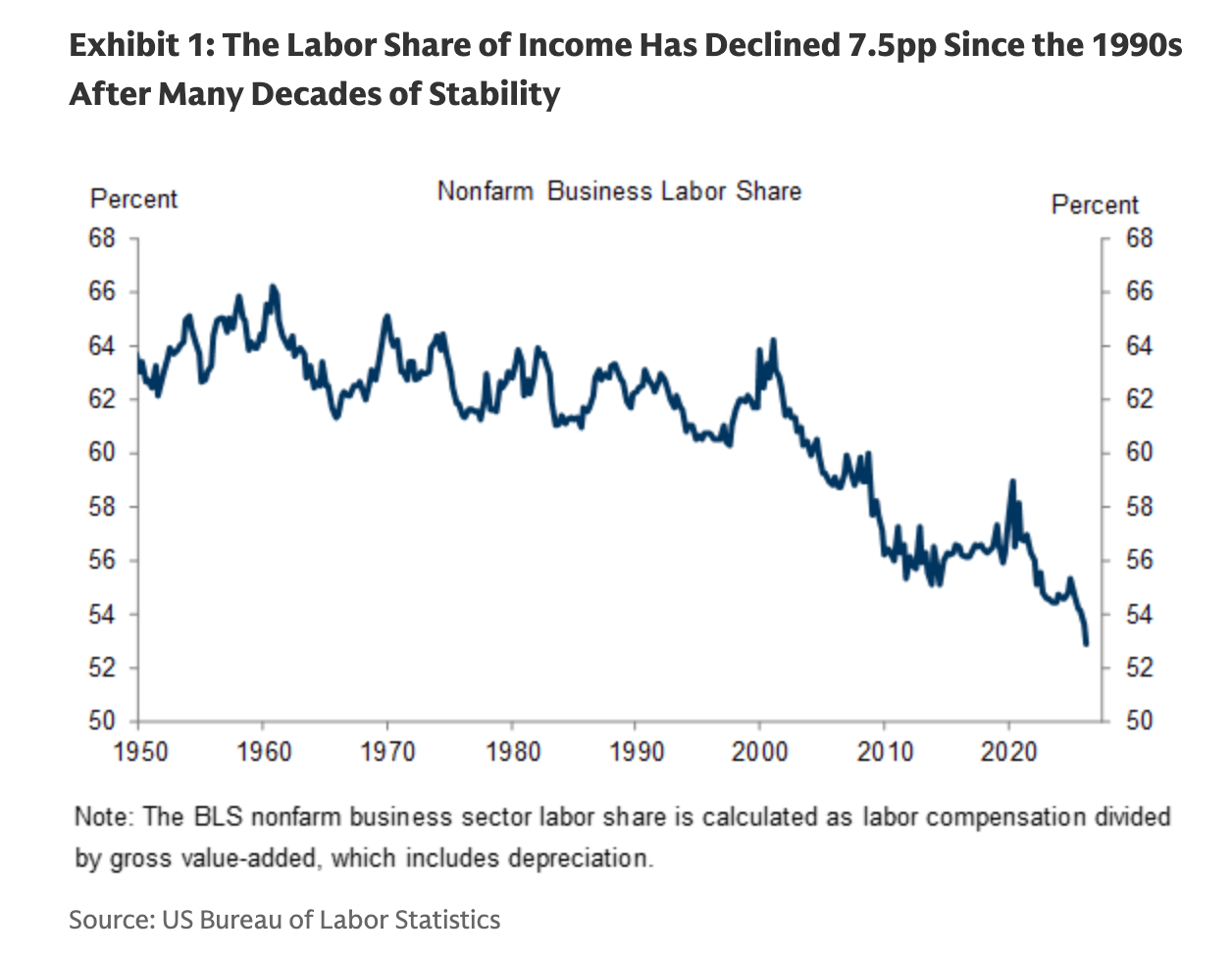
Workers have been taking home a shrinking slice of the American economy for more than three decades, and the headline number is stark: the labor share of income in the nonfarm business sector has fallen roughly 7.5 percentage points since the 1990s, according to Bureau of Labor Statistics data cited in a September 15 Goldman Sachs research note. That decline has accelerated into record territory this year — BLS data released in early September put labor’s share of nonfarm business output at just 52.8% to 52.9% in the second quarter of 2026, the lowest reading since the agency began tracking the measure in 1947.
But according to Goldman economist Abhay Duggirala, much of that decline is not what it appears to be. In a report titled “What Explains the Decline in the Labor Share of Income?,” Duggirala estimates that roughly 40% of the 7.5-point drop reflects measurement quirks in how the government counts wages and profits — not an actual transfer of income from workers to capital owners. The remaining 60%, or about 4.5 percentage points, is real, Goldman concludes, and it traces mostly to rising corporate markups, automation and the decades-long erosion of workers’ bargaining power.