Get all your news in one place.
100’s of premium titles.
One app.
Start reading
Sports Illustrated
Sports Illustrated
Michael Rosenberg

Gold Hair, Gold Dress, Gold Medal: Alysa Liu Radiates Joy As Olympic Champion

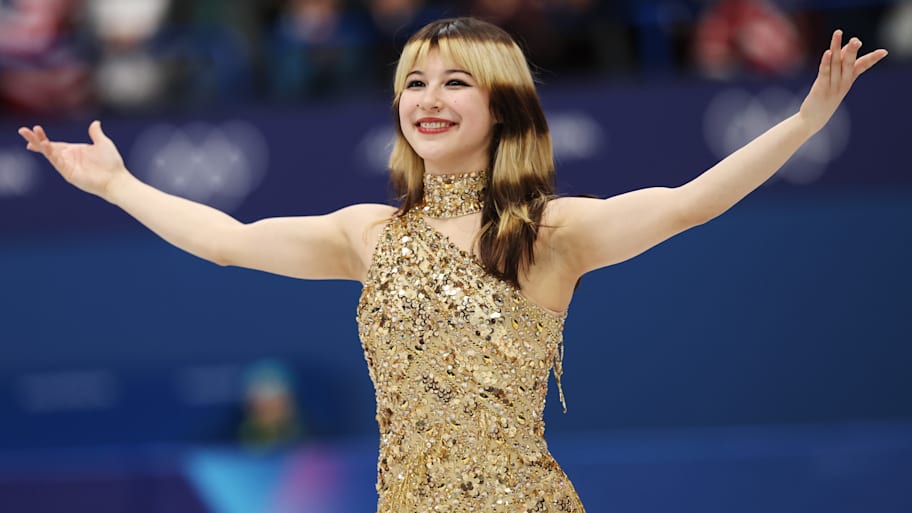
MILAN — Winning an Olympic gold medal in figure skating is easy. All you have to do is win a national championship at age 13, burn out and retire at 16, come back, dismiss your scores like they’re spam e-mails, return to the Olympics, nail your short program and then console your friend who didn’t, relax with late-night dinners with your siblings and friends … and then, with the world watching, put on a gold dress that could light a cave and take the words “free skate” as literally as anybody ever has.

Alysa Liu is the eighth American woman to win the individual gold medal and the first to do so unintentionally. If she leaned into joy any harder, the j would touch the y.

“I don’t need this,” Liu said. “What I needed was the stage, and I got it. So I was all good no matter what. If I fell on every jump, I would still be wearing this dress.”

The closer Liu got to winning, the less she seemed to care about it. After placing third in the short program, she seemed more concerned about her friend Amber Glenn, who had bailed on a jump and finished 13th.

“She was in there [to] comfort me,” Glenn said. “So kind.”

Glenn is the kind of Olympian who really wanted to medal. In other words: an Olympian. She knew that vaulting from 13th to the podium was a quintuple axel-sized leap. She is also 26, which means she will be 30 at the next Olympics, which means she will be a spectator. She had a lot to process between the short program and the long. She reminded herself that even when you have a disappointing Olympics, you are still at the Olympics, and she delivered a free skate that was close enough to perfect to place her in the lead for most of the night.

“It’s conflicting,” Glenn said, “because you want to stay there, but you also don’t want to wish mistakes on others.”

Liu was so happy for Glenn that as her own turn arrived, she was still giving Glenn the thumbs-up.

“I’m like, ‘Go skate!’ ” Glenn said. “She stresses me out sometimes.”

Alysa Liu with her gold medal
Liu will take two gold medals home from Milan after winning in the team event and individual event. | Matthew Stockman/Getty Images

Stress? At an Olympic event? How weird that must sound to Liu right now. She delivered the cleanest and happiest free skate of the night. By the time she finished, there were only two ways she could lose. One was if the judges penalized her for smiling too much. The other was if either of the last two skaters, Japan’s Kaori Sakamoto and Ami Nakai, performed even more magnificently.

Sakamoto was terrific, but not quite terrific enough to top Liu. One skater left. Nakai’s program was ambitious, but her skating did not quite match it.

This was the moment when we would find out if Liu was really as medal-agnostic as she claimed. Was it all a mental game she played on herself to stay loose?

Nakai won bronze and was giddy.

Sakamoto won silver and sobbed.

Liu won gold and hugged Nakai. She lifted her off the ground. The great thing about leaning into joy is that joy never pushes back.

Most Olympians place outsized importance on medals, and then later—sometimes, years later—they realize that medals are really just hard-earned souvenirs. Medals are impressive achievements. They don’t sustain a life.

Liu has set herself up to invert that arc. She placed so little emphasis on medals that someday, she will probably look at that gold medal and appreciate the impressiveness of the achievement.

For now, the medal matched her dress.

And the dress?

“It matches my hair,” Liu said.

There are three days left in these Olympics, and so far, they have been defined, in a fundamental way, by pressure. Mikaela Shiffrin arrived with it, succumbed to it, and then overcame it. Ilia Malinin underestimated it, thought he had a handle on it and then caved under it. Jordan Stolz kept it at arm’s length, but always in sight, so it could never surprise him. The U.S. women’s hockey team seemed impervious to it, seemed to feel it for most of the gold medal game, then finally rose above it.

Alysa Liu in the short program
Liu finished third in the short program on Tuesday to set her up for Thursday’s finale. | Erick W. Rasco/Sports Illustrated

Today’s athletes have access to sports psychologists and mental coaches and therapists, but they often feel like everyone in the world has access to them. After the free skate, Glenn sounded proud of her performance and disappointed by how little it mattered. But mostly, she seemed drained. She had seen what the world thought of her; and of Liu, who is only 20; and of teammate Isabeau Levito, who is 18. 

“Ex-skaters can kind of relate, but no one else knows would like to be at this level in this time,” Glenn said. “There were some really disturbing things when it comes to all three of us online. It's hard to not see that stuff. It’s something I had to ignore, because it just filled me with so much rage.”

That is the environment in which Alysa Liu just won an oh-gee-look-at-me gold medal.

In a world where trolls lurk around every corner, Liu built her entire performance around connecting with people. As she skated, she looked at her siblings and friends in the stands. She saw the people who brought her joy and nobody else. That is her defining achievement. But the souvenir is pretty nice, too.


More Winter Olympics on Sports Illustrated


This article was originally published on www.si.com as Gold Hair, Gold Dress, Gold Medal: Alysa Liu Radiates Joy As Olympic Champion.

Sign up to read this article
Read news from 100’s of titles, curated specifically for you.
Already a member? Sign in here
Related Stories
Top stories on inkl right now
One subscription that gives you access to news from hundreds of sites
Already a member? Sign in here
Our Picks
Fourteen days free
Download the app
One app. One membership.
100+ trusted global sources.