
Get all your news in one place.
100’s of premium titles.
One app.
Start reading
Digital Camera World
Matthew Richards

Godox iT32 & X5 review: an ingenious cross-brand flash and trigger kit that’s more than the sum of its parts

Godox iT32 & X5 product shot.

Godox has earned an excellent reputation for its flashguns, studio and portable flash heads, wireless triggers and wide-ranging accessories. In terms of flashguns, there’s plenty to choose from, starting with tiny, universal units like the Godox iM20 and Godox iM22, right up to the powerful and sophisticated Godox Ving V860III and Godox V100, featuring rectangular and round-head flash tubes respectively.

This iT32 & X5 kit is something rather different, and a bit of a game-changer when it comes to flashguns. The iT32 is the flash side of the equation but unusually, it has no mounting foot. You therefore can’t slot it directly into your camera’s hot-shoe. That’s taken care of by the X5, which connects to the flash with a simple push fit and is held in place by magnetic attraction. The X5 also serves as an RF wireless trigger that’s compatible with the full range of Godox X-system flashes. The kit is a really clever bit of design, the components of which work together with the aim of being one of the best flashguns on the market.

Alternative X5 hot-shoe bases and triggers enables dedication with a variety of different camera brands, while the iT32 flash module has a neat color touchscreen around the back. (Image credit: Matthew Richards)

Godox iT32 & X5: Specifications

Dedication (X5)

Canon, Nikon, Sony, Fujifilm, OM System

Max output (Gn, ISO 100, m / ft)

18 / 59

Bounce

0 to 90 degrees vertical
270 degrees lateral

Manual Power Settings

1/1 to 1/128

Auto flash exposure

Yes, TTL

Batteries

Rechargeable Li-ion

Full power flashes

510

Wireless master/slave

RF master/slave
Optical slave dual mode

Dimensions
(WxHxD)

iT32: 56x101x39mm
X5: 12.6x10.6x12.6mm

Weight (inc battery)

iT32: 169g / 6oz
X5: 23g / 0.8oz

Godox iT32 & X5: Price

Own-brand flashguns from camera manufacturers tend to be notoriously expensive, but Godox has a reputation for manufacturing top-end equivalents at much more affordable prices. Even so, the sophisticated and powerful Godox Ving V860III costs around $229 / £220 / AU$400, and the Godox V100 lists for about $349 / £330 / AU$600. They’re certainly not ‘cheap’.

The complete kit of Godox iT32 flash with your choice of X5 hot-shoe mount/trigger is very keenly priced at just $99 / £89 / AU$179. Separate/additional components are also available, with the iT32 flash unit costing $79 /£71 / AU$143 and the various dedicated versions of the X5 costing $19 / £22 / AU$57. The Sony versions of the complete kit and separates are slightly more expensive.

Godox iT32 & X5: Design & Handling

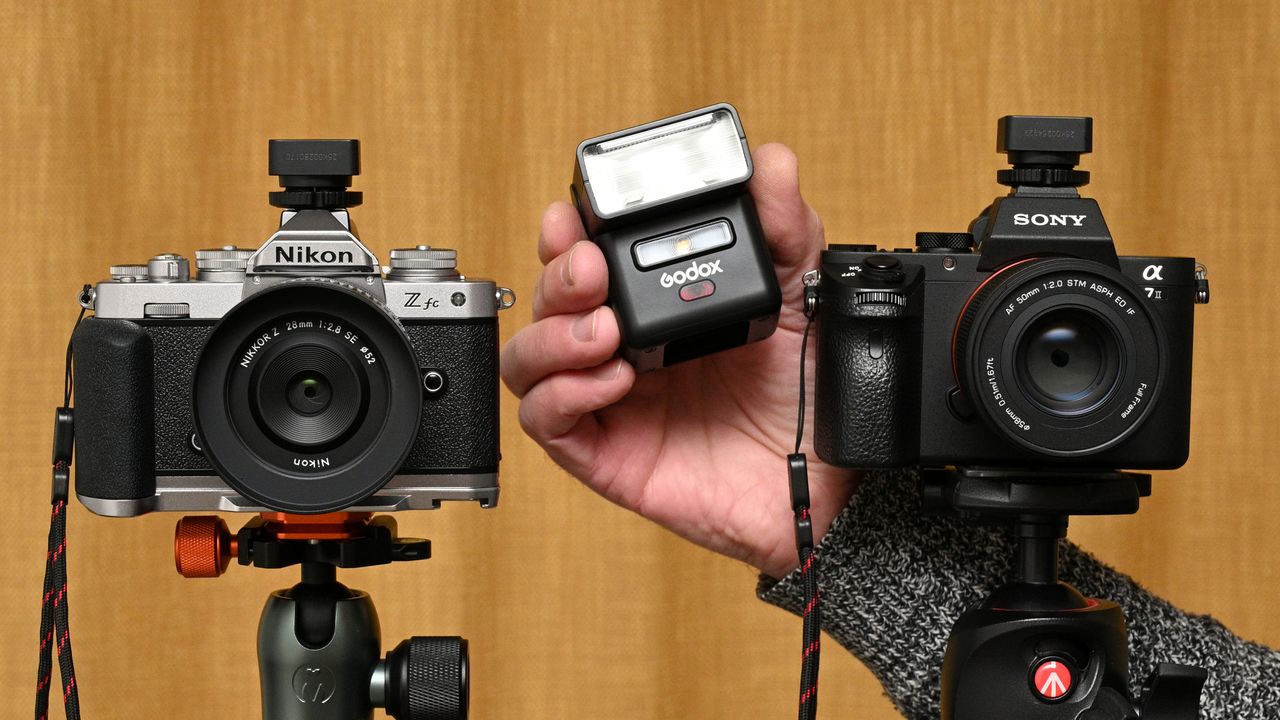
This flashgun kit is different by design. Picture this… you’re doing a shoot with two different brands of camera, probably with different types of lenses, swapping between them as necessary on a shot by shot basis. Normally, you’d need a separate, dedicated flashgun for each camera. Not so with this kit. The iT32 flash is pretty much universal yet enables full dedication with TTL flash metering. That’s thanks to the separate X5 hot-shoe mounting module that’s available in Canon, Nikon, Sony, Fujifilm and OM System options. The iT32 flash is a simple push fit for the X5, the two locking together magnetically. You can therefore buy the requisite dedicated X5 modules for your different cameras, mount them in the hot-shoes, and simply move the iT32 back and forth as you please.

Being able to have X5 base units mounted in different types of camera and swap the flash unit between them can be a real saver of time and effort. (Image credit: Matthew Richards)

Okay, I concede that most people aren’t like me and probably only shoot with one make of camera. Even so, the iT32 & X5 still have a lot to offer in this scenario. That’s because the X5 isn’t just a hot-shoe mount, but is also a dedicated TTL wireless flash trigger in its own right. This makes it equally quick and easy to join the two components together for on-camera flash, or separate them for using the iT32 off-camera, for more creative lighting effects. Now that’s what I call versatile.

It’s quick and easy to pull the head off the base, at which point the X5 automatically reconfigures itself as a wireless trigger. (Image credit: Matthew Richards)

The dedication doesn’t just cater to TTL flash metering. It also includes front- and rear-curtain flash and high-speed sync, typically up to 1/8000th of a second but including 1/80,000th of a second for Sony cameras that feature a global shutter. There’s also programmable strobe/multi flash on the menu, for firing multiple flashes during a long exposure. And as well as magnet-mounted connectivity and remote RF wireless, there’s also the option of using a sync cable with a regular 2.5mm jack plug.

Further sync options include a 2.5mm socket for cable connection to your camera. It’s shown in this image just next to the USB-C charging socket. (Image credit: Matthew Richards)

Most of what I’d expect to find in a regular dedicated flashgun is present and correct. It has a bounce and swivel head, onboard controls, and an LED modelling lamp. However, these are implemented with varying degrees of completeness. Talking of ‘degrees’, the bounce facility is -7 degrees (slightly downwards) to 90 degrees (vertical), so there’s no ability to flip it up and over for a slightly rear-facing orientation, unless you also employ the lateral swivel facility. This itself offers a full 180 degrees to the right, but only 90 degrees to the left. I’m more than able to forgive the relatively limited range of movement in bounce and swivel, because the iT32 is so quick and simple to swap to off-camera flash, where you can naturally point the flash in any direction you wish.

The range of movement isn’t overly generous for bounce and swivel, when the head unit is mounted in the X5 base but it’s super-quick to swap to off-camera flash. (Image credit: Matthew Richards)

Taking a leaf out of the Godox V100’s interface, as well as that of the companion Godox X3 (Xnano) and Godox X3 Pro wireless triggers, the iT32 has a color touchscreen interface, rather than a more conventional array of pushbuttons. Suffice it to say that if you’re a typical C21st human with a smartphone, you’ll feel right at home with the tap and swipe control system of this flashgun. Even so, I’m pleased that Godox has also built a rotary control dial into the right hand side of the flash, which enables precise scrolling through power adjustments and menu options without an overload of tapping and swiping of the touchscreen.

Typical of some of the latest flashguns and other gadgets, the iT32 has an intuitive color touchscreen interface. (Image credit: Matthew Richards)

Let’s talk of power. The stated Guide number for maximum output is Gn 18 / 59 (ISO 100, m /ft). That’s a lot more powerful than a pop-up flash if and where featured in a camera body, and beats most on-camera mini-flashes. Even so, it looks a fair way short of most ‘proper’ flashguns, which tend to be anywhere between around Gn 40 / 130 and Gn 60 / 200. But that’s not quite the whole story. Most serious flashguns have a motorized zoom head that stretches to a maximum focal length of between 105mm and 200mm, in full-frame terms. The maximum Guide number is generally stated at the long end of the zoom range, where the narrowed beam of light is at its most intense. With no zoom head, the iT32 is fixed at its most wide-angle setting, where its maximum power is more similar to that of other flashguns. On the plus side, I don’t feel I’m missing much with the lack of a zoom head in this case, as I’ll come to later.

Unless I need to react instantly to changing shooting conditions, I generally prefer manual flash power settings to TTL, and they’re quick and easy to adjust with the iT32’s touchscreen. There’s also a neat rotary control dial to the right, mounted on the side of the flash. (Image credit: Matthew Richards)

The other side of the power equation is the batteries that run the kit. In keeping with modern designs, rechargeable Li-ion power packs are used in preference to AA or AAA batteries. As such, the iT32 features a 7.4V / 900mAh battery and the X5 has s smaller 3.8V / 100mAh. The upshot is that the flash has sufficient stamina for around 510 full-power flashes, many more at lower power settings. The other main plus point of Li-ion batteries is that recycle speeds tend to be a lot quicker, in this case equating to 1.5 seconds after a full-power flash. The X5’s battery lasts for around 16 hours and takes about 3 hours to fully charge when connected to the iT32.

The LED modelling lamp not only enables you to preview lighting effects, but also works as an autofocus aid for mirrorless cameras, and comes with a generous range of output power adjustment. (Image credit: Matthew Richards)

As I’ve mentioned, the flash tube isn’t the only light output from the iT32. It also has an LED modelling light. That’s something I really like, as it enables you to preview the lighting effect and how it falls on the subject, especially when you’re using the flash off-camera. The other benefit is that, unlike DSLRs, mirrorless cameras can’t use the red autofocus-assist beam from old-school flashguns, so the modelling LED lamp also helps with autofocus under very low ambient lighting conditions.

There’s a generous range of accessories supplied in the kit and more items are available to buy separately as optional extras. (Image credit: Matthew Richards)

I’d be content with just a modular flash and hot-shoe base / wireless trigger, but this kit also includes some smart extras as part of the retail package. The iT32 comes complete with a diffusion dome for softening the light, two color correction filters, a magnetic stand for off-camera use, a USB-C charging cable and a carrying pouch. Optional extras include a wider range of color filters, a wide-angle diffusion panel and additional, mix and match X5 bases / triggers. However, if you buy additional X5 units on their own, they’re not supplied with a carrying pouch or case.

Godox iT32 & X5: Performance

Flash is often called ‘the most available light’. If I’m in situations where I’m using a flashgun as the main or supplemental source of light, time is often of the essence. For weddings, events and other scenarios where you have to capture the action as it unfolds, you don’t have time to mess around with settings, and you generally have to get things right first time.

A critical performance factor of the iT32 and X5 is that they’re incredibly quick and easy to set up. Everything just ‘works’, whether you’re using the flash on-camera or off-camera, with amazingly fast switching between the two. On top of that, the color touchscreen interface makes it equally speedy and painless to make adjustments on the fly, so you can be confident of not missing crucial shots.

On-camera direct flash (Image credit: Matthew Richards)

For comparison, I took three sample shots of a motorcycle model (7 inches in length) on a sheet of white paper. For the first shot, shown above, I used direct on-camera flash, with the inevitable results of a rather flat, 2-dimensional look and dark shadows.

On-camera bounce flash (Image credit: Matthew Richards)

For the second shot, again shown above, I used the flash on-camera again but bounced the flash off the ceiling, which gives a much softer lighting effect, along with a more 3-dimensional appearance. Notice how bounce flash has also banished those dark shadows from beneath the bike, compared with direct on-camera flash.

Although the maximum power output is very respectable for a ‘mini-flash’, I found that it’s only equivalent to using a quarter of the available flash power from my full-sized Godox Ving V860III at the latter’s 24mm zoom setting. The upshot is that when using bounce flash with relatively high ceilings or at greater distances, you’re more likely to need to bump up your camera’s ISO setting.

Off-camera remote flash (Image credit: Matthew Richards)

For the third and final shot, shown above, I separated the iT32 flash from the X5 and used the latter as a wireless trigger. Using off-camera, remote flash, I positioned the flash low down and to the right hand side of the model, to give a dramatic lighting effect.

With no motorized nor manual zoom head, the maximum power output looks a little underwhelming. However, the wider, fixed beam angle gives a good spread of light and delivers a softer effect when bouncing the flash off adjacent walls or ceilings. I always bounce my flash whenever possible, as it delivers an effectively larger source of light than using a zoomed, narrow beam directly. Bounced flash typically gives a much better, 3D look to images, and off-camera remote flash is so readily available that the lack of a zoom head is of even less consequence.

For greater control over light output, the flash features a pull-out catchlight card flip-down diffusion panel, despite its small physical size. (Image credit: Matthew Richards)

There’s also the possibility of removing the flash from its X5 base and physically moving it nearer the subject for direct flash, in lieu of a zoom facility. Ultimately, I found the power of the flashgun sufficient for indoor use, and the high-speed sync comes in handy for applying fill-in flash under a glaring sun. I found TTL flash metering pretty accurate and consistent when using all of my Nikon and Sony cameras.

Stamina from a fully charged pair of batteries for the iT32 and X5 lived up to expectations in my tests, as did the fast recycle speeds between even full-power flashes. At lower power settings, recycling speeds are pretty much instantaneous, and there’s also a programmable strobe / multi-flash option which you can set at up to 100 flashes at 100Hz.

The color touchscreen interface makes it easy to program strobe / multi-flash effects, with options for output power, frequency and the total number of flashes. (Image credit: Matthew Richards)

Sometimes more is better. Multiple flashguns or studio flashes enable more exotic, creative lighting effects, so I’m happy that the X5 makes for easy triggering not only of the iT32 but also for other flashes in the Godox X system 2.4GHz RF wireless family, like my pair of Godox Ving V860III flashguns and the Godox AD200 Pro II and Godox AD600Pro II studio/portable flash heads.

There is a caveat though. While disengaging the X5 from the iT32 enables seamless switching to wireless triggering, without the need to manually pair the two, the wireless range shrinks from 80m to 20m. The X5 also has no onboard display screen, so for effectively controlling and triggering multiple flashes across the Godox X system, you really need to have the iT32 plugged into the X5, so you can make use of all the options enabled by its touchscreen control panel. That’s no big deal as far as I’m concerned and if it is for you, you can always get an additional standalone trigger like the conventional Godox XPro TTL/HSS or touchscreen-controlled Godox X3 (Xnano) or Godox X3 Pro.

Standalone control options for the X5 are relatively limited when it’s detached from the flash head, as it features just two buttons and no display screen (Image credit: Matthew Richards)

Godox iT32 & X5: Lab Results

We test all available features for each flashgun that goes through out labs. To test power output, we use a Sekonic flash meter placed at a distance of one meter from each flashgun. We check the complete range of manual power settings, in one-stop increments. Based on a sensitivity of ISO 100, the figures correlate directly with the Gn (Guide number) in meters. The results are double-checked by taking shots of a gray card with the appropriate lens apertures and using the camera’s histogram display in playback mode. We also use the gray card to test the accuracy and consistency of Auto and Auto TTL flash metering, where featured.

We check the speed with which each flashgun can recycle to a state of readiness, throughout its range of power settings, culminating in a full-power flash. We use freshly charged Ni-MH rechargeable batteries for this, or the supplied rechargeable Li-ion battery pack where featured in some flashguns.

The table below shows both the power output (Gn, ISO 100, meters) at each full EV step through the complete power range, from minimum to maximum output. The recycle speed in seconds is shown for the same settings.

Power setting

Output, Gn (ISO 100, meters)

Recycle speed, seconds

1/128 (min)

Gn 1.2

0s

1/64

Gn 1.7

0s

1/32

Gn 2.4

0s

1/16

Gn 3.3

0s

1/8

Gn 4.8

0s

1/4

Gn 6.7

0.1s

1/2

Gn .5

0.7s

1/1 (max)

Gn 13

1.5s

The maximum power output is fairly generous for a ‘mini-flash’ but only equivalent to about one quarter power output from most full-sized flashguns, at their 24mm zoom setting. Recycling speeds are fast, being virtually instantaneous at most power settings and dropping to a still quick 1.5 seconds after a full-power flash.

Godox iT32 & X5: Verdict

I’ve often been frustrated by the time and effort that it takes to switch between on-camera flash and off-camera remote flash, for different lighting effects. For the latter, you generally need to use a curly connection cable which is restrictive and inconvenient, or set up a wireless trigger and put your flashgun into receiver mode, which can be a bit long-winded. To my mind, the killer feature of the iT32 and X5 kit is that you can simply pull them apart for off-camera flash, and everything sets itself up automatically, then snap them back together again for on-camera flash. It really couldn’t be any more quick and easy.

I also like being able to use the same flash with additional X5 triggers to swap between Canon, Nikon, Sony, Fujifilm and OM System camera systems, rather than needing to buy complete flashguns for each type of camera. Sure, the iT32 isn’t the most powerful flashgun around and lacks a zoom head, but it has a smart range of features and intuitive handling based on a color touchscreen interface. The X5 module isn’t as fully featured as high-end wireless flash triggers but the iT32 and X5 combine to make an excellent kit, at a very competitive price.

Features

★★★★☆

There are wide-ranging flash modes and RF wireless communication, but no zoom facility and limited standalone functions for the X5.

Design

★★★★★

The design is something of a masterpiece, with quick and easy on/off-camera switching and a neat color touchscreen interface.

Performance

★★★★☆

It’s great overall but maximum power output is a little limited, compared with most up-market flashguns with a zoom head.

Value

★★★★★

For such a versatile and innovative flashgun with so many clever features, it’s incredible value for money at the price.

(Image credit: Matthew Richards)

Alternatives

Sign up to read this article
Read news from 100’s of titles, curated specifically for you.
Already a member? Sign in here
Related Stories
Top stories on inkl right now
One subscription that gives you access to news from hundreds of sites
Already a member? Sign in here
Our Picks
Fourteen days free
Download the app
One app. One membership.
100+ trusted global sources.