
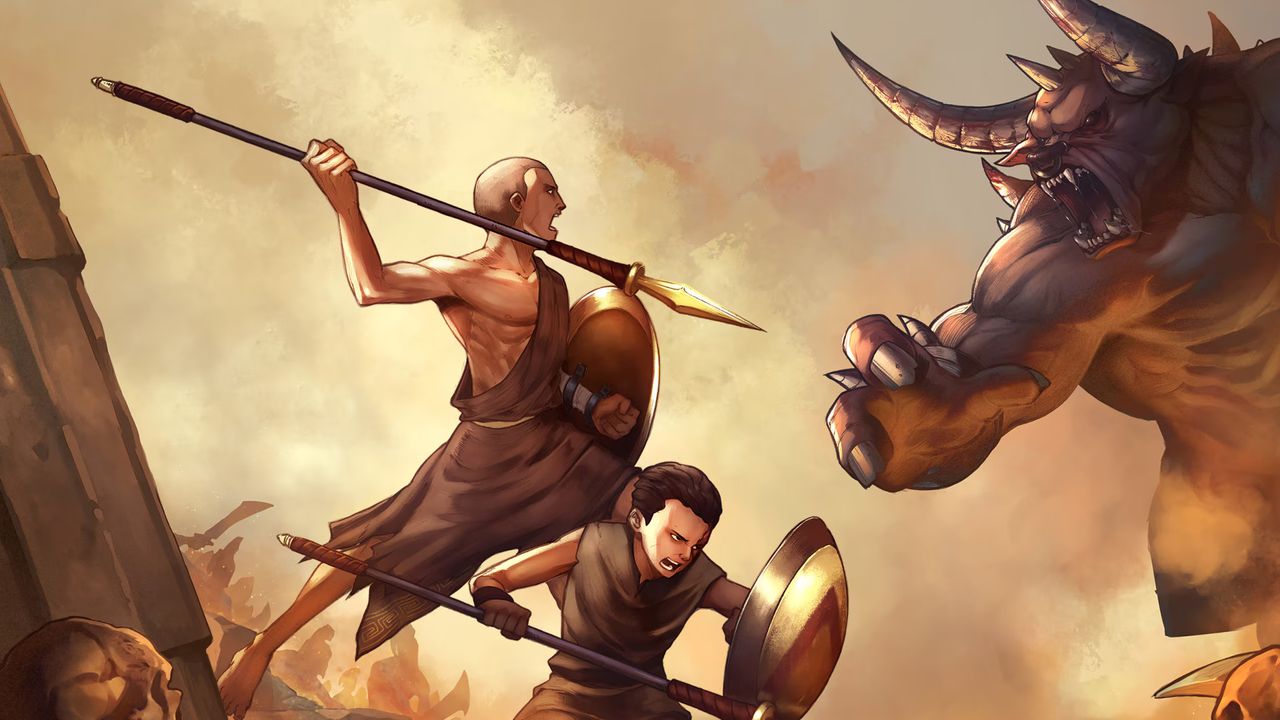
God of War Sons of Sparta's take on Kratos might not be the muscled master we know and love, but the major beats of this prequel adventure show that developer Mega Cat Studios at least knows which boxes to mark off to ensure the mythical flavor remains intact. The problem is, these ticks are messy at best. Within seconds, young boy Kratos is going spear-to-eye with a massive cyclops, with his brother Deimos coming in clutch to assist, but the combat is floaty and slow, and player and enemy animations are clunky and ugly. When the cyclops keels over, I'm left shrugging instead of filled with the bombast and adrenaline God of War usually leaves me with.
In some ways, this makes sense. Barely in double-digit age, Kratos and Deimos have only just earned the Spartan right to travel outside of the city to prove themselves. Each map pleasingly flags interconnected pathways as they spiral out from Sparta at the center. This God of War's stakes are far lower than the grandiose ones in the main series. It's more Hardy Boys in tone, with Kratos the bratty Spartan rules nerd who nevertheless knows how to leverage its warrior teachings to justify whatever action he wants to take, while Deimos is headstrong, passionate, and ready to run off to follow what his heart tells him is right (often literally, giving a reason for Kratos to explore solo before they reunite at cutscenes). Though Kratos irritates, it's not a bad narrative premise, but can all too often feel like an extensive anti-bullying PSA.

Kratovania

Release date: February 13, 2025
Platform(s): PS5
Developer: Santa Monica Studio, Mega Cat Studio
Publisher: Sony
That doesn't mean jumping around God of War Sons of Sparta's Metroidvania-style areas has to feel as unsatisfying as it does. Each screen is so large that the action can get lost when it happens, not that blocking or rolling to evade damage before mashing out attacks requires too much attention. When complexity is added, it's all through testing color-based knowledge. Red attacks you can't block, you have to dodge. Blue attacks you can't dodge, you have to block. Yellow attacks you must time with a parry. Purple attacks you must completely avoid. Enemy aura shields meanwhile, can glow specific colors you can negate with either spirit or magic attacks. It can feel a bit exhausting, feeling like a rote test of matching responses rather than any real natural sense of combat flow.
At least on normal difficulty it's not particularly hard, so the color matching won't make you sweat too much. As the game gets harder, most enemies simply get bigger health bars that are more tedious to reduce, still just grumbling and barely reacting before inelegantly flopping to the floor.
A stun meter can be filled up to allow Kratos to deliver finishing moves the game calls 'brutal kills', but while this does result in gory blood splatter, the animations are dull, tame, and weightless. I can't help but think of the constant gory executions you can perform in Blasphemous or The Last Faith, and it feels like God of War Sons of Sparta is gunning for a similar rhythm, but completely stumbles when it comes to having any sense of impact. Finishers here aren't just repetitive, but uninspired, Kratos simply swatting a foe using the tool he has in his hand and leaving some colorful particle effects briefly behind – there's no sense of impact to these whatsoever. It's actually a bit shocking considering brutal finishers are what the original God of War is best known for on PS2, and feels like an oversight.

Even boss fights can feel a bit limp, and not up to God of War's usual standards. Mostly, these are fairly standard clashes (though one specific blood-powered boss did get my pulse racing, I admit). Larger, set-piece bosses invoke God of War's usual energy but fall down trying to evoke it, with the sea serpent from the trailer letting me down the most, just being a sequence of platforms as the boss repeats a handful of attacks while Deimos constantly repeats the same warning voice line over and over again.
Mechanically, there are some nice ideas. Objects in the environment can be flung around, like punting some pottery on an enemy to deal some damage and stun build-up, but it doesn't feel particularly integral. Likewise, the constant orb drops from foes (color coded, naturally, between red currency, blue magic, yellow spirit, and green health) can be nudged based on the skills you use. Spirit attacks, for instance, generate more stun but less damage, and also drop health on hit. Though, the orb drop amounts feel so nominal that I've yet to feel as if keeping this in mind has been make or break in any encounters – it's far from cementing a Doom-style resource loop. As often seems to be the case in God of War Sons of Sparta, it's often best to just mash away while dodging.

The same goes for Kratos' unlockable gear and skills, presented similarly to those found in, say, God of Ragnarok. Most aren't very exciting, and I found myself sticking with early equipment to increase critical chance to reduce time spent depleting tedious health bars, and beyond a handful of abilities on the skill tree I mostly kept unlocking more to have something to do rather than really noticing the difference.
Bigger upgrades come from temples, which also house fast travel points. Each time you find one, Kratos acquires a new powerup that doubles as a weapon in combat and also a way to navigate obstacles and open up new paths. A sling, for instance, can hit switches from afar, or bonk enemies on the noggin. Likewise, a flaming branch can both set enemies alight, or burn away pesky thorns blocking passages. Optional challenge gauntlets that have you bash away at enemies give you gifts for the gods, which can then be brought back to temples to, say, boost Kratos' spear attack damage, or increase magic. It's simple stuff, but as always in the Metroidvania genre there's some satisfaction to be had in unpicking paths through maps to get your mitts on goodies to tick off upgrades.

A lack of definition goes some way to explaining why combat feels a bit lifeless.
God of War Sons of Sparta guns for a retro aesthetic. But the result can be quite ugly. While the dense, detailed backgrounds can work well, they often miss the awe inspiring vistas of something like Blasphemous, Hollow Knight Silksong, or Death's Gambit. Only a smattering of areas, like one early quest through a Dionysian temple that's become overwhelmed by thick strands and bubbles of blood where wine should flow, really stand out. Others, from lush forests to caves and icy mountains are serviceable, but can blur together by the end, most locations lacking a real sense of unique space.
Player and enemy models on the other hand are just kind of ugly, which beyond being unappealing feel like they can muddy the action. More Nintendo DS-core than evoking the glory days of SNES or PS1 Metroidvania classics, they're constantly in movement in a way that creates a fuzz of color and silhouette. Clashing visual techniques just feel like they end up distorted, which don't look good in motion to me, nor do they feel good to interact with. A lack of definition goes some way to explaining why combat feels a bit lifeless.
God of War Sons of Sparta definitely isn't a bad game, but it is disappointing. The main God of War series has set a high bar when it comes to satisfying, crunchy action, and its absence in this prequel is a let-down. It's especially rough when others in the busy Soulslike-flavored Metroidvania genre have been able to deliver exactly that throughout adventures that are much more gripping. God of War Sons of Sparta is simply perfectly serviceable, which, as part of such a monumental series, and in a genre with so many all-timer bangers, makes this a swing, a miss, and a tumble right off the colossus.
God of War Sons of Sparta was reviewed on PS5, with a code provided by the publisher.
If God of War Sons of Sparta has you wanting to play more like this, there's a whole heap of the best Metroidvania games that you might want to consider instead. Take a look at our games like God of War list for more adventures that channel a bit of Kratos' energy.