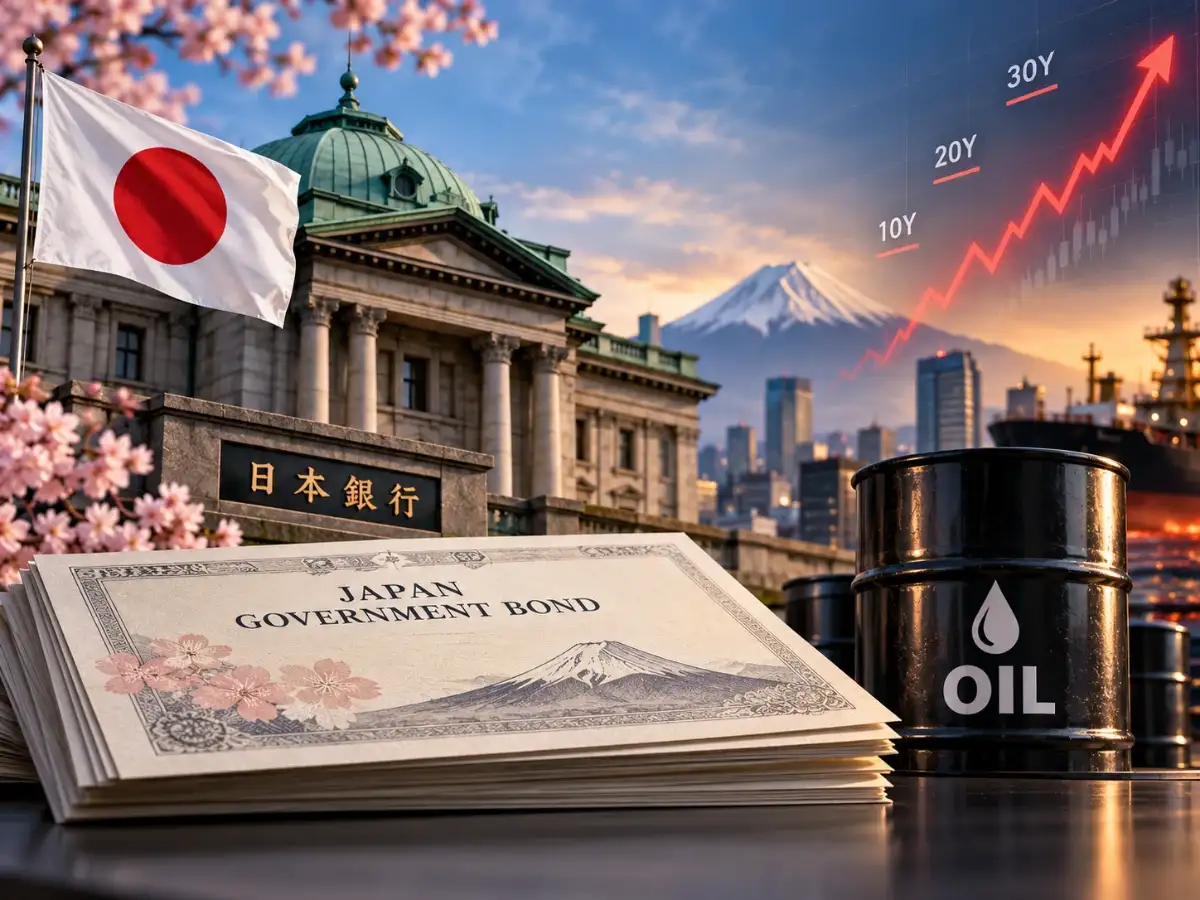
Japanese government bond yields extended their recent rise on Wednesday as higher oil prices and escalating tensions in the Middle East heightened concerns over inflation, while investors awaited the US Federal Reserve's interest-rate decision.
The benchmark 10-year Japanese government bond yield rose 0.5 basis points to 3.035%, after touching a fresh 30-year high on Tuesday. The 20-year yield climbed 4 basis points to 3.925%, while the 30-year yield also advanced 4 basis points to 4.190%.

Read more: Global Market Today: Asian stocks steady as traders await Fed decision
Oil Prices Add to Inflation Concerns
Rising crude oil prices have added to concerns about inflation in Japan and other major economies. Oil prices remained around the mid-$100-a-barrel range after disruptions to crude shipments from Saudi Arabia's Red Sea export hub of Yanbu.
Reuters reported that shipping industry sources said crude loadings at Yanbu had been suspended, while Saudi Arabia had cancelled some cargo deliveries to European customers.
Higher energy costs can put additional pressure on inflation by increasing transportation and production expenses, adding to uncertainty over the outlook for monetary policy.
Read more: Global Market: KOSPI climbs as chip stocks lead gains before Fed outcome
US Treasury Yields Keep Pressure on Global Bond Markets
The rise in Japanese bond yields also came as US Treasury yields moved higher ahead of the Federal Reserve's policy announcement.
The US 10-year Treasury yield climbed above 5% overnight, reaching 5.004% after touching 5.041%, its highest level since July 2007.
The Fed was scheduled to announce its policy decision at 2 p.m. EDT (1800 GMT) on Wednesday following its two-day meeting. Financial markets were pricing in a 25-basis-point increase in the US benchmark interest rate to a 3.75%-4% range, along with the possibility of further tightening.
Japan's Fiscal Policy in Focus
Domestic Japanese policy developments are also influencing the bond market. Investors are watching a planned cabinet reshuffle and whether Minoru Kiuchi will remain as minister in charge of economic revitalisation.
Reuters reported that markets have been assessing Kiuchi's position for clues about the government's approach to fiscal spending. Concerns over increased government expenditure have contributed to pressure on Japanese government bonds as investors assess the country's borrowing requirements and inflation outlook.
The continued rise in longer-dated JGB yields highlights the growing sensitivity of Japan's bond market to both domestic fiscal policy and global interest-rate developments.
With the Federal Reserve decision due later on Wednesday and the Bank of Japan also under scrutiny over its monetary-policy direction, investors are closely watching developments in oil prices, inflation and global bond yields for signals on the path of interest rates.
(Disclaimer: Recommendations, suggestions, views, and opinions given by experts are their own. These do not represent the views of The Economic Times.)