
Get all your news in one place.
100’s of premium titles.
One app.
Start reading
LiveScience
LiveScience
Joanna Thompson

Giant rotating string of galaxies is 'probably the largest spinning object' in the known universe

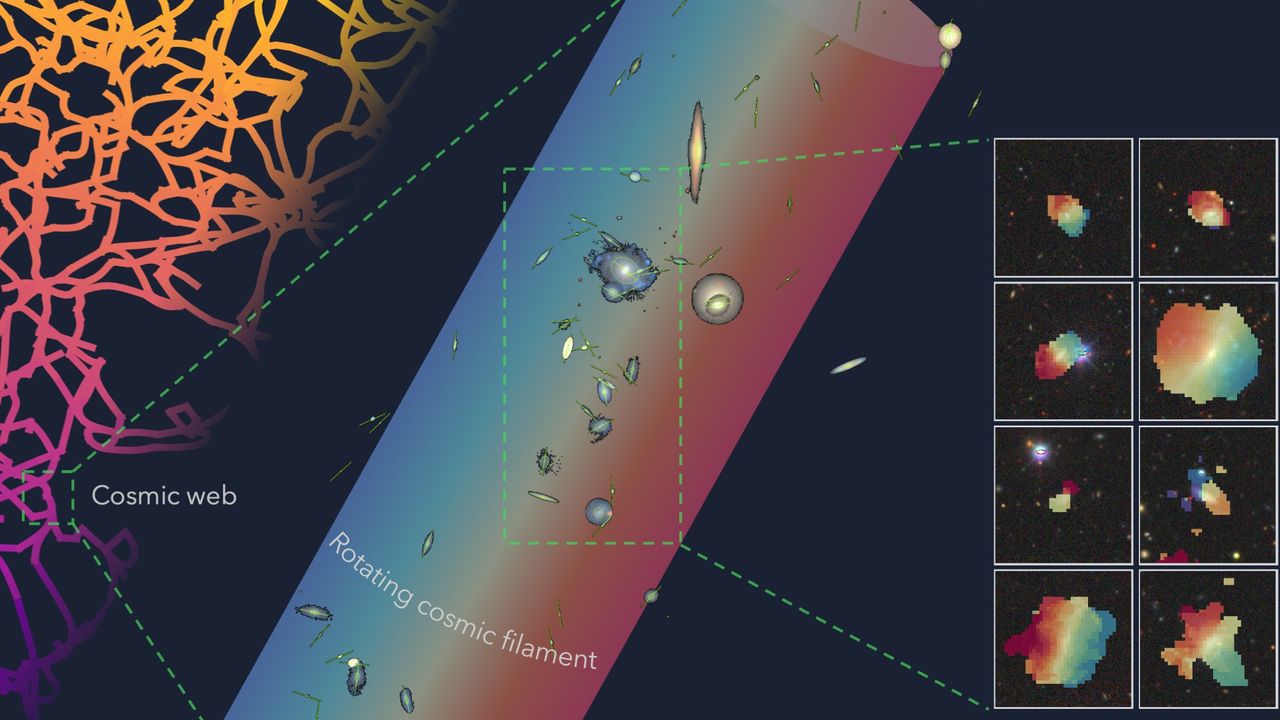
A graphic showing a colorful cosmic filament holding 14 galaxies within it.

Astronomers have spotted what is likely the "largest spinning object" ever discovered, and its rotation could hold important clues about how galaxies develop.

The whirling structure, located 140 million light-years from Earth, is a long, threadlike string of gas that's about 5.5 million light-years long and 117,000 light-years wide — wider than our Milky Way galaxy. The cosmic filament has 14 hydrogen-rich galaxies linked to it in a chain, like charms on a bracelet. These galaxies were what gave away the filament's existence, the researchers explained in a paper published today (Dec. 3) in the journal the Monthly Notices of the Royal Astronomical Society.

"The initial discovery itself was a surprise," study co-lead author Lyla Jung, an astronomer at the University of Oxford, told Live Science in an email. "We noticed a striking alignment of galaxies glowing at the same distance." Jung and her colleagues were using MeerKAT, an array of 64 connected radio telescopes in South Africa, when they made the unusual find.

After taking measurements, the researchers found that the filament itself appears to be rotating at around 68 miles per second (110 kilometers per second). What's more, the galaxies around it are rotating as well — most in the same direction as the gaseous thread. This suggests that structures like this one may play a key role in galaxy formation by influencing the speed and direction of a star cluster's spin.

The filament represents "probably the largest spinning object" astronomers have discovered to date, Madalina Tudorache, an astronomer at the University of Oxford who is also part of the research team, told Live Science. Such structures have long been predicted in simulations, but until recently, we lacked telescopes sensitive enough to directly detect them, she added.

A figure showing the rotation of neutral hydrogen (right) in galaxies spotted in a giant filament of the cosmic web (middle) (Image credit: Lyla Jung)

The team suspects that similar rotating filaments will be discovered in the near future as researchers continue to ever-deeper reaches of the cosmos with next generation telescopes. Many such filaments link to each other in a vast cosmic web that funnels matter throughout the universe, forming large, interlinked clusters of galaxies.

This observation was collected as part of the MIGHTEE (MeerKAT International GHz Tiered Extragalactic Exploration) survey, which is spearheaded by Oxford physicist Matt Jarvis and is currently ongoing. Future MIGHTEE data may shed further light on the filament's behavior or facilitate the discovery of other rotating cosmic threads. The find may also help to inform forthcoming surveys from new instruments, like the Vera C. Rubin Observatory in Chile.

"I think it's really helping us understand the universe," Tudorache said.

Sign up to read this article
Read news from 100’s of titles, curated specifically for you.
Already a member? Sign in here
Related Stories
Top stories on inkl right now
One subscription that gives you access to news from hundreds of sites
Already a member? Sign in here
Our Picks
Fourteen days free
Download the app
One app. One membership.
100+ trusted global sources.