
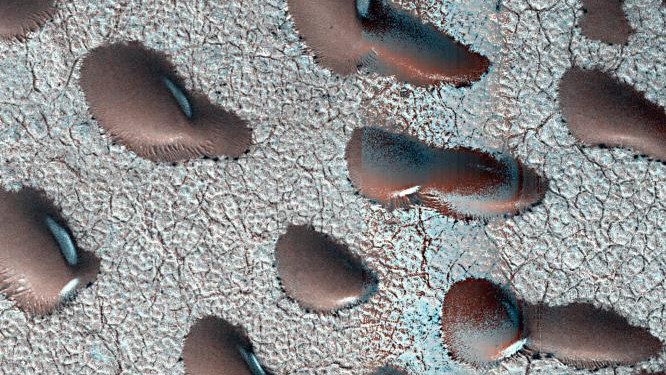
These Martian "kidney beans" aren't safe to eat: they're actually frozen sand dunes in Mars' northern hemisphere. A recently released photo by NASA's Mars Reconnaissance Orbiter (MRO) shows a top-down view of the frosty legume lookalikes, taken to help scientists determine if conditions on the Red Planet could have sustained life a long time ago.
In the photo, taken in Sept. 2022 and publicly released in Dec. 2024, the dunes appear surprisingly motionless. Dunes on both Mars and Earth usually migrate as wind picks up grains of sand from one side of a dune and drops them off at another, making deserts look like slow-motion seas. However, the dunes in the photo are covered in a layer of carbon dioxide frost during the northern hemisphere winter on Mars. The frost stops wind from scooping up sand, preventing the dunes from migrating until the spring thaw comes.