
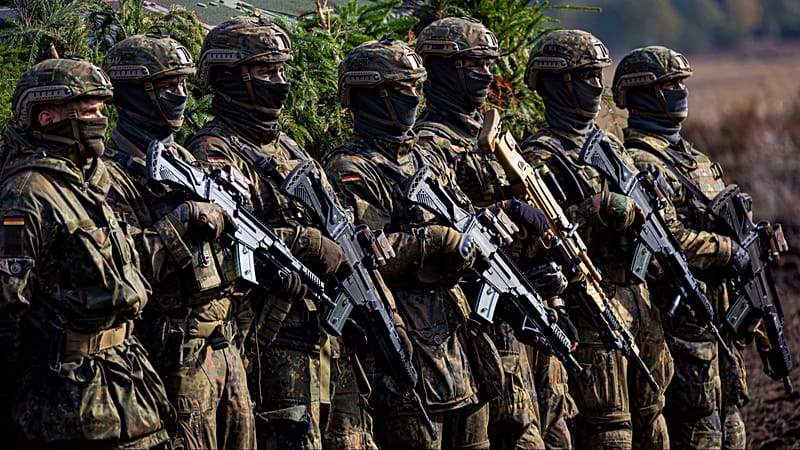
Germany's military intelligence has heightened vigilance after Iran designated the Bundeswehr and other EU armed forces as "terrorist groups" in response to the European Union placing Iran's Islamic Revolutionary Guard Corps (IRGC) on its terror list.
The Iranian move, which Tehran framed as a countermeasure, creates a new threat environment for German military facilities and personnel, according lawmakers and experts who spoke to Euronews.

Meanwhile, Germany's Military Counter-Intelligence Service (MAD) continues to view Iranian intelligence agencies as "one of the main actors carrying out espionage activities against the Bundeswehr."
A spokesperson for the MAD told Euronews that alongside real-world threats, "a significant risk from cyber-espionage must also be assumed".
The agency is therefore placing a strong emphasis on preventive measures. These include briefings, advisory sessions and information material designed to raise awareness among soldiers about the risks of espionage and the methods used by foreign intelligence services.
According to the spokesperson, the aim is to detect and repel intelligence operations "as early as possible".
Units and offices considered to be particularly exposed to foreign intelligence activity receive targeted support from the MAD. As a result, staff tend to be more alert and are quicker to report suspicious incidents.
Iran's intelligence activities
Iran has been suspected of carrying out espionage operations in Germany for years, not only since the EU moved to put the Revolutionary Guards on its terror list.
Germany's domestic intelligence agency, the Office for the Protection of the Constitution, told Deutsche Welle that Iranian intelligence services are "very active" in the country.
Politically active Iranian exiles, journalists and opposition figures are seen as particularly vulnerable. They are reportedly monitored, intimidated and smeared, and in some cases even threatened with violence in an effort to stifle dissent.
Authorities warn that such surveillance can also be used to prepare more serious crimes, including abduction or even murder.

One of the most high-profile cases is that of German-Iranian opposition activist Jamshid Sharmahd, who was abducted in 2020. He was taken to Iran and accused of involvement in a 2008 bombing. His family and human rights groups reject the allegations, describing them as politically motivated.
He was later sentenced to death but, according to the Iranian authorities, died before the execution could be carried out. These claims could not be independently verified.
As with military targets, cyber surveillance plays a key role alongside traditional espionage. Email and social media accounts are reportedly hacked to map networks and track people’s movements and contacts.
Spying and risk of attack
Iranian activities are not directed solely at dissidents, but also at Israeli and Jewish organisations in Germany.
Konstantin von Notz, chairman of the Parliamentary Oversight Committee, told Euronews that Iranian intelligence operations in Germany intensified in the wake of the Hamas-led terrorist attack on southern Israel on 7 October 2023.
In July last year, a 53-year-old Danish national of Afghan origin was alleged to have carried out surveillance on Jewish institutions, individuals and locations connected to Israel in Berlin on behalf of an Iranian intelligence service.
According to the Federal Prosecutor's Office, the information gathered may have been used to prepare possible attacks.
The operation was allegedly directed by the Quds Force, the overseas arm of the IRGC.
In light of this, Von Notz has called on the German government "to take all necessary security measures to effectively curb Iran’s intelligence activities in Germany and to ensure the safety of everyone living here – including, and especially, our soldiers, but also Jewish institutions."