
Get all your news in one place.
100’s of premium titles.
One app.
Start reading
Homes & Gardens
Homes & Gardens
Helen Cross

Garden Designers Reveal the Secrets to Creating A Whimsical Yard – For a Dreamy, Low-Maintenance Outdoor Space

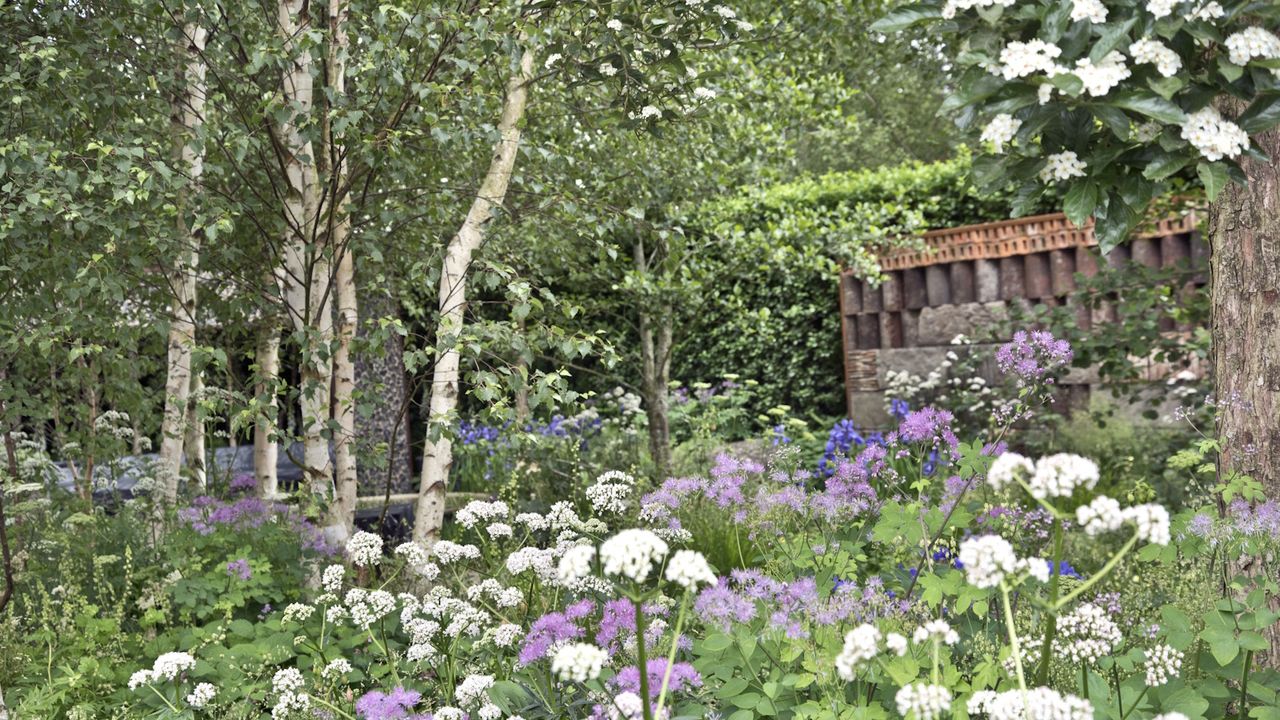
Silver birch trees with white and lilac frothy flowers in the foreground.

What do we mean by a whimsical garden? We're not talking wishing wells, and ornamental fairies but something that feels more wistful and dreamy. A space that will sweep you up and transport you to another world. It's about creating a garden that feels playful and magical, but also naturalistic.

We don't want strict symmetrical lines or formal landscaping. Instead we want to lean into creativity and charm, through carefully selecting the right whimsical umbellifer perennials, that provide structure, texture, playful pops of bold colors and scent, as well as incorporating water and rustic arches that look well established.

It doesn't have to be complicated. There is no rulebook and less is often more. Plus naturalistic planting, which allows plants to spill over the edges onto pathways, is also ideal if you want to create a stunning low-maintenance backyard. I spoke to expert garden designers to gain an insight into how we can get on board with the burgeoning whimsical garden trend.

Naturalistic grasses which move in the wind, and provide architectural interest all year round are an essential cornerstone when designing a whimsical yard (Image credit: Future/EdwardBowring)

1. Follow the Mantra of Less is More

Aquilegias are not only delicate and add a touch of romance and mystery but they are also great self seeders, which will effortlessly make their way around your yard with little to no effort (Image credit: Sandra Matic / Alamy Stock Photo)

For Camellia Taylor, the award winning landscape architect and designer, creating a whimsical garden is all about restraint, knowing when to step back and let the plants surprise you.

Her own back yard was originally all lawn. Rather than imposing hard routes, she introduced simple mown paths that meander through the planting, encouraging you to wander.

Edges are kept soft, materials minimal, and the planting has been allowed to find its own rhythm. Foxgloves and aquilegias self seed and melica catches the light in late spring, while asters lean and drift in autumn, and seed heads and grasses carry movement into winter. Camellia tells me: 'It's these moments of looseness where the garden feels most alive.'

She continues: 'That same sensibility shaped the garden I designed for Aspens at the RHS Chelsea Flower Show in 2023. Although whimsical in character, the garden was carefully held, with winding paths, curved walls, planting that revealed itself gradually and a water feature designed to be seen, heard and touched.

'A whimsical garden, for me, isn’t about novelty or nostalgia, but about creating spaces that feel generous and quietly permissive, relaxed, sensory and welcoming, allowing both plants and people to find their own way.'

2. Harness The Art of Storytelling in a Garden

Jewel toned colors add depth and a sense of luxury to a planting design (Image credit: Alamy/ P Tomlins)

The art of storytelling and transporting people somewhere that is beyond the everyday is key when creating a whimsical design according to Catherine MacDonald, Principal Designer at Landform Consultants Ltd.

Catherine explains to me, 'I’ve always loved history and craftsmanship, so being able to weave those elements into my designs is a real pleasure.

'It’s vital to strike a sense of balance in the garden, and the juxtaposition of bold structure with softer, more subtle elements works beautifully to create that sense of wonder.'

Catherine continues: 'The same principle applies to planting: clipped yew hedges and topiary provide weight and definition, while layered planting brings movement, texture and a more naturalistic feel. It’s this interplay between formality and looseness that gives a garden its character and sense of quiet magic.'

In The Boodles Garden that she is creating for the RHS Chelsea Flower Show this year, Catherine says, 'I’ve deliberately selected plants with strong, contrasting shapes, then worked with subtle tonal variations within the reds and purples to create depth and visual interest.

'The result is planting that feels luxurious yet playful; structured enough to feel intentional, but soft and expressive enough to spark curiosity, imagination and a sense of discovery.'

3. Stage Setting is Vital

A place to retreat to in your yard for contemplation, often overlooked but vital. (Image credit: Jacky Hobbs/Future)

A whimsical yard is also about injecting your own personality into a design, creating something which is original, expressive and layered with stories with an element of surprise, according to garden writer, designer and educator Rochelle Greayer who is the author of Cultivating Garden Style, available from Amazon.

Incorporating structures into your yard also helps create a whimsical feel. Rochelle believes, 'Whimsy suggests a life lived outward, a little restless, a little curious. There is a chapter in my book titled Enchanted Bohemian, which incorporates the idea of wanderlust made physical.'

Rochelle continues, 'Depth and age also matter. Whimsy gets credibility from things that look like they’ve been there a while. Gnarly old trees, a willow tunnel that insists you walk through it, an epic hedgerow that compresses space before releasing you into light.

She adds: 'It's also a good idea to consider timings. A white or pale garden that comes alive at dusk. Flowers that glow, release scent, or simply feel more present at night. Encourage fireflies with your design. There’s something kind of magical about a garden that saves part of itself for after dark.'

4. Make Color Bold and Rebellious

Bold and bright colors should be embraced, when creating a whimsical garden, adding elements of surprise through color. (Image credit: Getty Images/Johnat APW)

A whimsical garden shouldn't be tightly controlled like the reins of a horse, but rather as the award winning garden designer Ann-Marie Powell explains: 'A whimsy garden is spontaneity made visible. It's surprise, delight, those moments that make you smile without quite knowing why. It's that feeling when you walk into a garden and something shifts. Suddenly you never want to leave.'

Anne Marie embraces the idea that everything comes together when you stop trying to exert control.

She adds, 'When Verbena bonariensis seeds itself exactly where it's perfect. When a climbing rose finds its own way through an apple tree and you think, I couldn't have planned that if I'd tried. Let paths meander rather than march in straight lines – gravel paths are brilliant for this, softening at the edges where plants can self-seed into them.

'Plant grasses where they'll catch that last bit of afternoon sun – the sort that stops you mid-trudge to the compost bin because the light's doing something extraordinary. And bulbs – everywhere, always, in great drifts. Tulips that return year after year if you choose the right varieties, narcissus naturalised through grass, Crocus tommasinianus scattered like a purple haze.'

In a whimsical garden, every month should stop you in your tracks and of course if there is one thing that Ann-Marie is adamant about is that none of us should be afraid of color, something she has embraced in her new book A Year of Colour, available at Amazon.

5. Create a Sense of Discovery

Adding plants of different heights through your borders adds rhythm and interest. (Image credit: Future/Jacky Hobbs )

There is no need for novelty or decoration when it comes to whimsical design but rather, as garden designer Neil McCullough believes, you create a whimsical feel from a balance of intention and looseness, what I often describe as organized chaos.

The most engaging yards avoid rigid patterns and predictable repetition, instead allow for variation, surprise, and moments that feel slightly unplanned.

Plants appear where you don’t quite expect them, edges blur rather than stop, and the garden reveals itself gradually as you move through it. That sense of discovery is where true whimsy lives.

Neil tells me: 'My plant selection quietly supports this approach. I tend to favor species that have presence without heaviness and that contribute to movement and seasonal surprise. Plants like Baptisia alba and Amsonia hubrichtii create a soft, open framework, while finer-textured ornamental grasses such as Molinia add motion and rhythm.

'Planters are another quiet way to introduce whimsy, particularly on a seasonal level. Because they’re flexible and temporary, they allow for experimentation, unexpected combinations, and subtle shifts through the year without committing permanently to the garden,' he adds.

6. Small is Beautiful

Dr Libby Webb's woodland inspired city garden encapsulates all the vital ingredients to create a whimsical back yard. (Image credit: Future)

You don't have to have a huge yard to create a whimsical feel. In fact some of the most imaginative spaces are the small layout ideas, packed full of character and personality that give the illusion of being much bigger.

Dr Libby Webb has done exactly this in her own back yard. The garden, at only 7x14m, presented Libby with an incredible opportunity to experiment with the boundaries of illusion and what might be achievable in a relatively small space.

She explains: 'It was my hope to recreate the effect of a woodland forest garden into a city garden, and a number of techniques have made this incredibly successful.

'I’ve had a lot of fun challenging the sense of scale, planting trees in the foreground of the small garden, to triangulate along a curved path.

'The asymmetry of the trees and path, the variety of planting beneath and the very deliberate use of plants that spill over the paths creates whimsy and irregularity to mimic a natural scene more closely,' she adds.

7. Build An Edible Landscape

Whimsical gardens can also involve delicious edible fruit and vegetables. (Image credit: Getty/Debby Lewis-Harrison)

Katie Oglesby is a Kitchen Garden Designer and at the heart of her ethos when it comes to design is that people should be able to live in their rather than just admire them from a distance.

According to Katie, 'The most memorable outdoor spaces invite us to move, pause, harvest, gather, and return again throughout the day.'

'Beyond kitchen gardens, meadow-style orchards and perennial plantings offer another way to create spaces meant for strolling and lingering. Fruit trees layered with perennial beds beneath can replace open lawn with something you walk through rather than mow.

'Whether the path is grass for a softer feel or stone that ties back to the architecture of the home, it guides movement and shapes experience. Thoughtful lighting along those paths allows the garden to remain active into the evening, extending its use while highlighting bloom, texture, and seasonal change.'


Seven different interpretations, but a common theme that runs through each set of ideas is that to take a step back is okay.

Less is more. The more natural and established the planting and the design is, the more whimsical and enchanting your yard will feel.

Sign up to read this article
Read news from 100’s of titles, curated specifically for you.
Already a member? Sign in here
Related Stories
Top stories on inkl right now
One subscription that gives you access to news from hundreds of sites
Already a member? Sign in here
Our Picks
Fourteen days free
Download the app
One app. One membership.
100+ trusted global sources.