Get all your news in one place.
100’s of premium titles.
One app.
Start reading
The Guardian - AU
The Guardian - AU
National
Joe Hinchliffe and Andrew Messenger

‘From the river to the sea’ is being outlawed in Queensland. How will the slogan’s ban work, and will it be challenged?

Protesters are seen during a pro-Palestine rally in Brisbane.
Protesters are seen during a pro-Palestine rally in Brisbane. Laws banning phrases such as ‘from the river to the sea’ and ‘globalise the intifada’ have been passed by the Queensland parliament. Photograph: Darren England/AAP

Queenslanders who use the phrase “from the river to the sea” face up to two years’ imprisonment after the state became the first in Australia to outlaw the slogan frequently chanted by pro-Palestinian demonstrators.

“Globalise the intifada” has also been classified a “proscribed phrase”, which – if said in a way that could cause “menace, harassment or offence” – is prohibited under the new law passed by the Liberal National party government of David Crisafulli on Thursday.
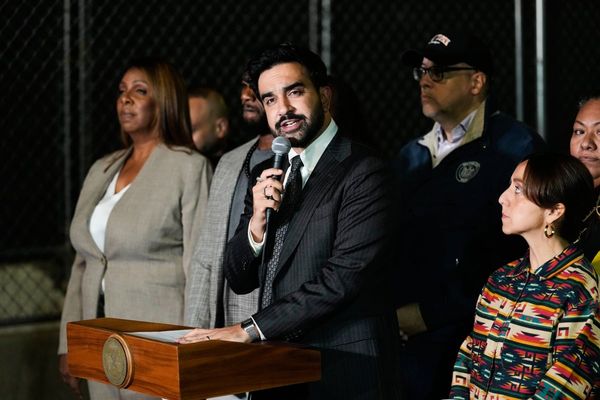
The move has been welcomed as a bid to stamp out antisemitism by its proponents – and blasted as an “Orwellian” crackdown on free speech by its critics.

Here’s what we know about the new law.

Why are these pro-Palestinian phrases being banned?

The phrases were outlawed after Australia’s deadliest terror attack on 14 December – when 15 people were killed and 40 injured during a beachside Hanukah celebration at Bondi beach – under a sweeping bill officially called: Fighting Antisemitism and Keeping Guns Out of the Hands of Terrorists and Criminals Amendment Bill 2026.

The bill was passed after being watered down at the 11th hour. As initially proposed, the attorney general would have had the power to ban other expressions she deemed hateful – a proposal that drew criticism from across the political spectrum, including from the rightwing thinktank, the Institute of Public Affairs (IPA).

Crisafulli has said the bill was about “drawing a clear line” and “stamping out the embers of hatred that were allowed to burn unchecked for too long”.

How will the ban work? 

Those using the slogans in Facebook posts, chants, banners and online publishing potentially face two years’ imprisonment, given the laws ban the “public distribution, publication, public display or public recitation” of the two phrases.

But not just any use of the phrases would be illegal. The ban applies to using them in a way that menaces, harasses or offends – to a real or hypothetical member of the public. Which could prove to be a high bar.

Anne Twomey, a professor of constitutional law, said there was a key question a court would have to determine. “In the context of a peaceful public rally, the question would be whether the chanting or display of the expression ‘might reasonably be expected’ to have that effect upon ‘a member of the public’,” she said.

Sign up: AU Breaking News email

“Yes, a court would likely read the term ‘offence’ at a high level of harm.

“But given the visceral objection to these expressions shown by some groups in the community, a court might well make such a finding, depending on the circumstances.”

Will the bans be challenged and will they stop the chants?

Despite the NSW premier, Chris Minns, being vocal about his personal disdain for the two phrases, his government ultimately deemed a blanket ban on “from the river to the sea” was legally and constitutionally unfeasible.

A NSW parliamentary inquiry did recommend banning the phrase “globalise the intifada” – when used to incite hatred, harassment, intimidation or violence.

In Queensland, Justice for Palestine spokesperson and former Greens candidate, Remah Naji, said a legal challenge was “certainly on the table”.

“History tells us that attempts to curtail free speech never succeed,” she said. “So these laws are going to be defeated – one way or another”.

The Queensland Council for Civil Liberties’ (QCCL) president, Michael Cope, warned the offence would be “difficult and costly to detect, investigate and prosecute”.

“Given that it is not just the prohibited expression but also phrases ‘likely to be confused with or mistaken for that expression,’ that are to be criminalised, there is a real and substantial potential for allegations to arise from ‘mis-hearings’ which would further impact police resources,” Cope said.

The first major test of the laws could possibly come on Wednesday, when a national student strike for Palestine will see protesters descend on parliament house.

Students For Palestine Queensland convener, Ella Gutteridge, said the strike would highlight “fierce opposition to the new laws” that were intended to have a “chilling effect on those voicing their opposition to Israel’s genocide”.

“I wouldn’t be surprised if people want to chant ‘from the river to the sea’,” she said. “It’s a call for freedom and end to apartheid in Palestine from the Jordan River to the Mediterranean Sea, and something that tens of thousands of people in Queensland have chanted for years.”

What has been the response to the new laws?

The Queensland Jewish Board of Deputies’ president, Jason Steinberg, said the reforms will make his community feel safer, more protected and confident after two and a half years of “unprecedented levels of hate, intimidation and fear”.

That board says the slogan has been used by terrorist leaders to call for the annihilation of the state of Israel and its Jewish population.

Not all Jewish Queenslanders support the bill.

Two other Jewish groups made submissions to that argued against banning the phrases, saying it risked increasing and entrenching racism and antisemitism by targeting Arabic language and Palestinian political expression and ignoring hate speech affecting other communities.

The Jewish Council of Australia also said it risked associating Jewish people with “crackdowns on democratic freedoms”.

The QCCL was not only concerned about suppression of free speech. Cope also condemned linking the phrases “to people being murdered at Bondi” as “not only unsupported by any evidence but as tending to undermine the moral responsibility of the bigots who perpetrated the mass murder at Bondi”.

Naji also said that link had been “manufactured” by a government she accused of being “reckless and irresponsible” in attempting to further marginalise a community that “calls for nothing but end of violence and end of violations of international law”.

“The link that exists and deserves our attention is the link between our very own government and the genocide and atrocities that continue to occur in Palestine through weapons exports,” she said.

Sign up to read this article
Read news from 100’s of titles, curated specifically for you.
Already a member? Sign in here
Related Stories
Top stories on inkl right now
One subscription that gives you access to news from hundreds of sites
Already a member? Sign in here
Our Picks
Fourteen days free
Download the app
One app. One membership.
100+ trusted global sources.