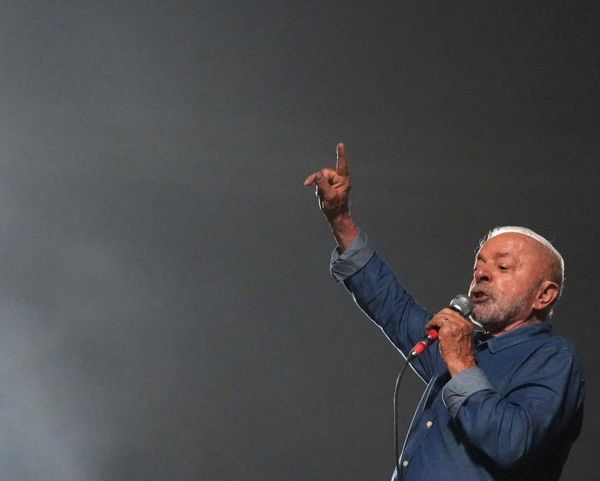
There are so many ways to begin telling the story of Tāme Iti, arguably New Zealand’s most recognisable Māori rights activist, who was once branded a terrorist by the state and is now considered by many a national treasure.
You could begin with his formative school years at the foot of Te Urewera ranges, where he was made to write the lines “I will not speak Māori” as punishment for speaking his language – lines that have since become a prominent feature of his art and activism.

Or the time he pitched a tent outside parliament, his hair long, his face not yet lined with his distinctive full-face tattoo, and pronounced it “the Māori embassy”, making front page news.
You could start with his part in organising the famous 1975 Māori Land March that contributed to the creation of the Waitangi Tribunal – a landmark institution set up to investigate breaches of the Treaty of Waitangi, the country’s founding document signed in 1840 between Māori tribes and the British Crown.
Or the time he was arrested in the infamous 2007 Te Urewera raids, during which police raided the Tūhoe people, under the mistaken belief that Iti was building a domestic terrorist network. The police later apologised to Tūhoe.
Iti – who was this year a finalist in the New Zealander of the Year awards – has been making headlines for more than five decades. Now, he is telling the story of his own beginnings.
His memoir, Mana, is peppered with photographs of Iti sporting his distinctive bowler hat, alongside images of his art and the people who have fought for Indigenous justice alongside him. It is a personal story, as much as a history of the Māori cultural and political renaissance.
“This book isn’t really about me: Tāme Iti,” he tells the Guardian over the phone, while parked up on a road somewhere between Auckland and his home on the East Coast, Whakatāne.
“The book is about us during that period of time, my generation.”
At times, Mana reads like a rallying cry for the protection of Indigenous rights.
“It’s time for an overhaul, it’s time to dismantle the whole infrastructure, down to its very foundation,” Iti writes in his final chapter. “It’s time for new relationships. Our own in the name of our whenua [land] – not someone else’s God, King and Country.”
In other moments, the book feels like a thriller – there are art heists, run-ins with speed boats, protests that result in burning cars and flags being shot. But much of it is a deeply personal account of a man trying to make sense of, and ultimately reshape, the society around him.
Iti’s commitment to Māori rights and expression, and forcing the country to reckon with its colonial history, took root early in his life. He was born in 1952 on a moving train and has “been on the move ever since”, he says. From the age of two, he was raised by an older couple as a “whāngai” child – a customary care arrangement – in Ruatoki, an economically poor and culturally rich area, near the East Coast of the North Island.
As a child he listened to adults discussing the history of his iwi (tribe), Tūhoe, the waves of settler violence against his people, and the confiscation of iwi land.
“Those conversations stuck in the back of mind and the rest is history,” he says.
At school, he was prevented from speaking his language, and when, aged 16 he moved to Christchurch to take up an interior decorator apprenticeship, he experienced overt racism. Before then, he “never knew that people don’t like you because of the colour of your skin”.
Soon, protests against the Vietnam war, and later South Africa’s apartheid, erupted in New Zealand. Iti soon joined the newly formed group Ngā Tamatoa – a Māori youth activist group set up to promote Māori rights, fight racism, and confront government policies.
One of Iti’s first actions was establishing the “Māori embassy” on parliament’s lawns in 1972 – the sort of symbolic and theatrical protest action synonymous with Iti’s style, but which older generations, including his birth father, often found difficult to stomach.
“My father’s generation was traumatised,” Iti says. “Everything was geared to: ‘how to be a Pākehā [European New Zealander]. God, King and country’.”
But that mood changed, as the movement – led by groups like Ngā Tamatoa – gained prominence and started to push the dial on the recognition of Māori rights.
Iti’s push to advance Māori rights has – and will remain – influential for generations to come, says Annette Sykes, a Māori rights activist and lawyer who has represented Iti.
“He … led the Māori renaissance for land restoration and rights, but was part of the revolution for modern art and reclamation of art forms like tā moko [traditional tattoo],” Sykes tells the Guardian.
She says his politics are fundamentally about caring for humanity. “Even though he is a small man, he is a giant in our world.”
The final chapter of Iti’s book covers the historic 2024 hīkoi that became the largest ever protest march for Māori rights, and the 2024 Waitangi Day event, which saw record crowds descend on the treaty grounds to confront the government.
Since taking office, the coalition government has said it wants to end “race-based policies”. It has ushered in sweeping rollbacks to policies that are designed to improve health, wellbeing and representation outcomes for Māori.
During these events, hundreds of protesters wore T-shirts emblazoned with the words“ I will not speak Māori” – lines imbued with new potency, since Iti was forced to write them seven decades earlier.
“The present coalition government – they are saboteurs … trying to create chaos out of their own paranoia,” he says, referencing the government’s policies to wind back the use of Māori in public services.
“But I don’t care what they think,” he adds. “They are only here for a short period of time; we are here for ever.”
Mana by Tāme Iti. Published by Allen & Unwin Aotearoa New Zealand. RRP $49.99. Out now.