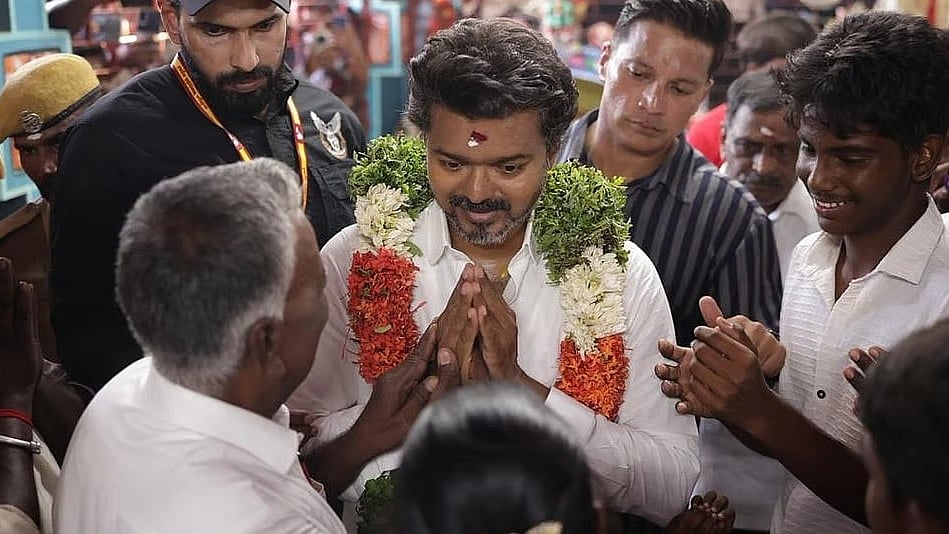
The 2026 Tamil Nadu Assembly election has fundamentally altered the state’s political landscape. Tamilaga Vettri Kazhagam (TVK), the two-year-old party led by actor-turned-politician C Joseph Vijay has done what several political formations failed to achieve over the last three decades: break the near six-decade dominance of the Dravidian duopoly. For the first time in Tamil Nadu’s contemporary political history, both the Dravida Munnetra Kazhagam (DMK) and the All India Anna Dravida Munnetra Kazhagam (AIADMK) find themselves sharing opposition space rather than alternating power.
TVK’s rise is significant not merely because it won power, but because it did so by departing from conventional modes of political mobilisation. Unlike established parties, TVK did not build momentum through sustained street-level agitation, protest politics, cadre expansion, or anti-incumbency campaigns. Instead, it relied heavily on digital mobilisation, Vijay’s cinematic charisma, and a carefully curated anti-establishment narrative. In many constituencies, voters backed TVK with little to no knowledge of local candidates, indicating that the election was less about constituency-level political organisation and more about a presidential-style endorsement of Vijay himself.