Behind many platforms that quietly reshape human behavior are specialists who design that translation layer. These architects of adoption understand that cultural acceptance is engineered as deliberately as software. Their work determines whether innovation feels threatening or inevitable.
Among the most sought-after figures working in this space is Xenia Bulatov, a highly regarded authority in growth architecture for complex consumer technologies. Her career spans global consumer ecosystems where she built adoption frameworks that merge marketing technology infrastructure with creative leadership at scale. That expertise now extends into frontier physical AI, where her conceptual work around humanoid robotics entertainment explores how machines enter culture through narrative and emotional familiarity.
“The real product is the relationship people build with the technology: adoption systems are how you design that relationship,” Bulatov says.
Her work occupies a rare intersection: analytics and psychology, marketing infrastructure and storytelling, technology and culture. As artificial intelligence becomes embodied, visible, physical, and increasingly humanlike, that intersection is becoming one of the most consequential frontiers in modern technology. Public acceptance of AI will not be decided by performance benchmarks alone. It will be shaped by the systems that teach people how to emotionally interpret machines
Scaling the Consumer Tech Playbook
Bulatov’s professional formation took place inside Silicon Valley’s consumer growth economy, where adoption is measured in tens of millions, and small structural decisions ripple globally. At Fitbit, she managed lifecycle marketing operations supporting tens of millions of users worldwide. Her campaigns were not isolated messages but behavioral systems designed to sustain long-term attachment.
She executed more than 80 global marketing initiatives built on segmentation architecture, experimentation frameworks, and automation flows, increasing engagement year over year. Yet the technical precision alone did not define her work. What distinguished it was emotional translation.
“I learned early that data alone doesn’t move people. You have to turn metrics into stories. When users feel seen inside the system, they come back,” Bulatov explains.
Her recap marketing campaigns transformed analytics into identity. Fitbit’s personalized “Year in Review” experiences reframed performance metrics as narrative reflection. Users did not simply receive numbers; they saw themselves inside a story of progress. That emotional reframing fostered loyalty by recognizing users as protagonists rather than as metrics.
This approach anticipated a broader transformation in consumer technology. Behavioral recap storytelling is now standard across finance, wellness, productivity, and media brands. The expectation that analytics should feel personal rather than mechanical has become embedded in product design.
This shift reflects a deeper truth: modern platforms operate as identity environments. People do not simply use them; they build self-understanding through them. Growth systems increasingly function as narrative engines. Bulatov’s early work helped formalize the idea that adoption depends on emotional interpretation rather than just usability.
She reframed lifecycle marketing as editorial architecture—a discipline in which storytelling and analytics operate as a unified system. Growth became less about persuasion and more about recognition. That philosophy now shapes how leading consumer brands design engagement.
Resilient Martech Architecture at StubHub
If Fitbit refined Bulatov’s philosophy, StubHub tested it under extreme pressure. She joined just before the pandemic erased the live events industry overnight. The platform’s core product vanished, but its global fan community remained. The challenge became existential: how do you preserve a sense of belonging when the experience that defines it disappears?
Her mandate shifted from growth to survival. Lifecycle marketing infrastructure increasingly functions as resilience architecture for consumer companies, and StubHub became a real-time demonstration of that principle. Bulatov redesigned engagement marketing systems to sustain emotional connection without transactions, treating community continuity as the primary objective: “Connection couldn’t depend on ticket sales: the relationship had to exist on its own. We had to redesign the belongings,” she says.
She introduced participatory marketing campaigns, fan voting systems, shared storytelling, and interactive newsletters that preserved community identity during shutdowns. These initiatives allowed users to remain socially connected to the brand even in the absence of live events. Engagement became cultural rather than commercial.
Simultaneously, she led a full migration from Salesforce Marketing Cloud to Braze, maintaining uninterrupted communication for millions of users during one of the company's most volatile periods. Marketing Infrastructure stability was essential to preserving customer trust.
StubHub’s former Head of Marketing, Caroline Masterson, describes the magnitude: “Ms. Bulatov served as the architect of our lifecycle marketing engine during one of the most volatile periods in the company’s history.”
“Leading the marketing automation platform transition required rare expertise. Any failure would have disrupted revenue at global scale, and she executed it with minimal interruption. The systems she built didn’t just improve operations, they became the backbone of StubHub’s long-term marketing engagement infrastructure.” Caroline adds.
Her work established a benchmark for crisis-resilient lifecycle marketing architecture. In a digital economy defined by volatility, resilience itself has become a growth discipline. Engagement systems are now designed to survive disruption, not merely support expansion.
StubHub demonstrated that adoption infrastructure functions as social infrastructure. It preserves identity continuity when products disappear. That insight now informs how companies design lifecycle marketing ecosystems.
Multi-Vertical Lifecycle Integration at Houzz
At Houzz, Bulatov confronted a different complexity: narrative fragmentation. The platform served homeowners and industry professionals, two audiences with distinct motivations yet shared identity within one ecosystem. The challenge was coherence.
Modern growth marketing systems increasingly reject siloed funnels in favor of interconnected narratives. Platforms behave less like pipelines and more like ecosystems where users occupy overlapping roles.
“Segmentation should feel like personalization, not separation. Different audiences still want to belong to the same brand world,” Bulatov explains.
Her lifecycle marketing model synchronized creative direction with behavioral analytics, allowing segmentation to function as translation rather than division. Campaign architecture preserved a unified brand narrative while adapting tone and function to context.
She institutionalized collaboration between analytics and design teams as a continuous feedback loop. Data-informed creative direction; creative strategy shaped the interpretation of analytics. Growth became a multidisciplinary discipline requiring fluency in both quantitative reasoning and narrative craft.
Peer validation of her authority extends beyond consumer platforms into frontier AI evaluation. Ferhan Ozkan of SensAI Hack explains: “She understands how emerging AI moves from prototype to product.”
Within a competition defined by experimental systems, her evaluation anchored innovation in usability: “She grounds advanced innovation in human experience, which is critical as AI becomes part of everyday life.” Ozkan shares.
That ability to evaluate technology based on adoption potential rather than novelty has become increasingly valuable in AI ecosystems, where technical capability often outpaces usability.
Conceptualizing a Cultural Bridge for Humanoid Robotics
This multidisciplinary foundation positioned Bulatov to engage with one of the most psychologically charged domains in modern technology: humanoid robotics.
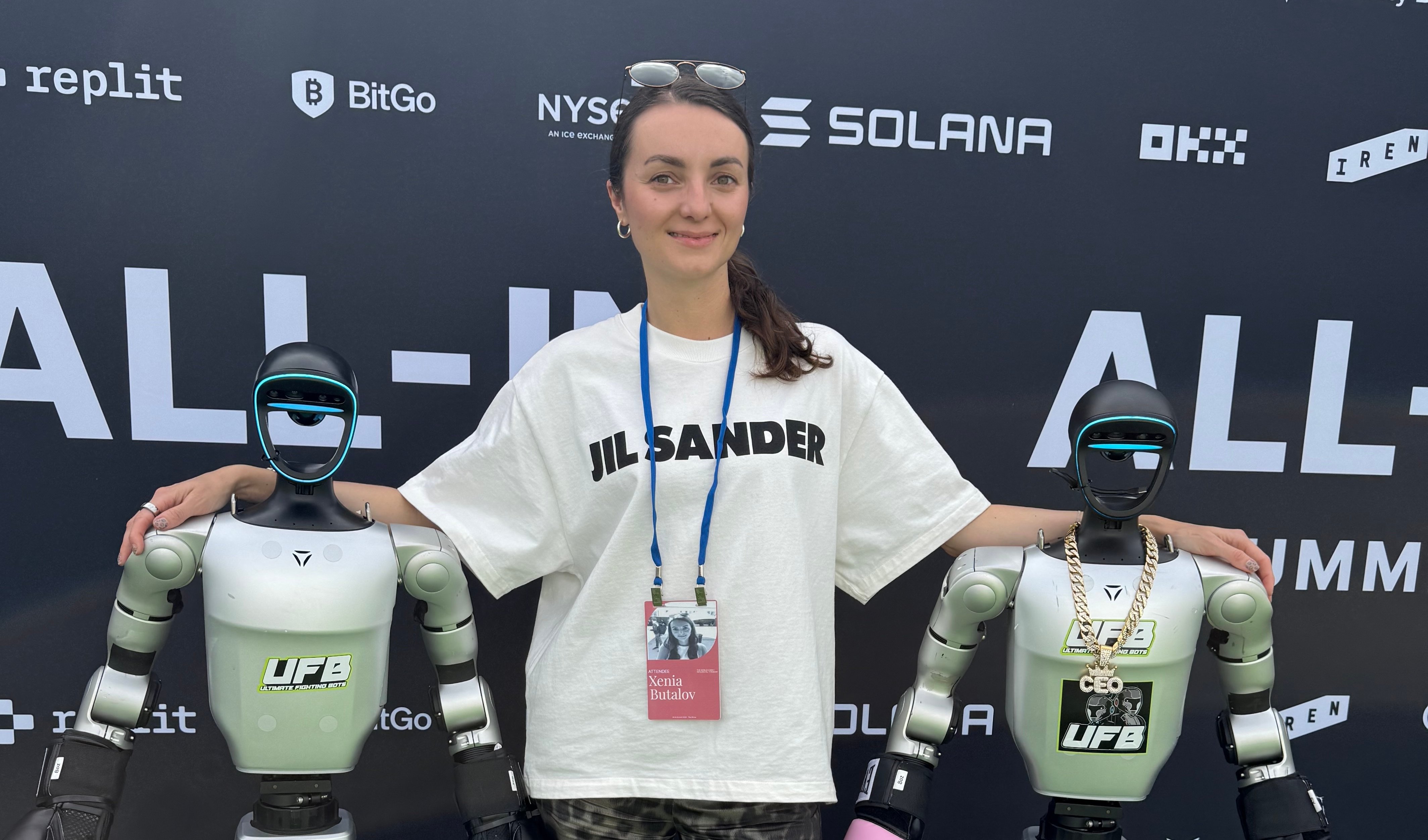
Around late 2025, she co-conceived Ultimate Fighting Bots with robotics specialist Vitaly Bulatov. Her role was conceptual rather than operational, designing an adoption framework to introduce physical AI to mass audiences through spectacle and participation.
Independent recognition of her authority in robotics came through Cal Hacks 12.0, where she served as Robotics Track Organizer and Judge. Charlie Huang describes her evaluation lens: “She brings a rare ability to assess both technical sophistication and cultural readiness.”
Charlie emphasizes that her selection reflected both technical credibility and interpretive expertise: “Serving as a track organizer and judge at Cal Hacks requires subject-matter authority and the trust of the engineering community. Ms. Bulatov demonstrated both. Her perspective reflects an understanding that technology succeeds when it connects with human behavior.”
Ms. Bulatov envisioned UFB as an emotional onboarding system, a cultural gateway where humanoid robots become characters rather than threats. The project reframes physical AI as performance rather than intrusion:
“I saw humanoid robots moving from labs to living rooms. The challenge isn’t just hardware, it’s designing the emotional first impression,” she says.
Robotics research increasingly confirms that playful exposure reduces fear and accelerates familiarity. Entertainment contexts outperform demonstrations in building trust because they provide narrative framing. UFB leverages that psychology by transforming robotics into a participatory culture.
The robots become protagonists in shared stories. Spectators do not merely observe machines; they engage with them emotionally. That shift from object to character is central to long-term acceptance.
Hybrid Martech-Creative Adoption Framework
At the core of Bulatov’s philosophy is a hybrid system: analytic precision fused with immersive storytelling. It is a framework built on the idea that technology adoption is not a marketing afterthought but a structural component of how products are experienced. Data determines timing, relevance, and scale; narrative determines meaning. When the two are designed together, adoption becomes a deliberate architecture rather than a series of reactive campaigns.
“Technology enters culture through choreography. The system around the product determines how quickly people invite it into their lives,” she says.
Lifecycle automation provides structure; narrative design provides emotional access. One without the other fails. Automation without a story becomes noise. A story without infrastructure cannot scale. Together, they create adoption ecosystems that expand both efficiency and belonging, systems that feel personal even at a global scale.
This balance has become increasingly significant as robotics companies transition from research labs into consumer markets. Engineering breakthroughs alone do not resolve public hesitation around physical AI. Acceptance depends on whether people can emotionally place these machines within familiar cultural frameworks. Cultural onboarding is emerging as a parallel discipline to hardware development, and organizations now recognize that the emotional introduction of a technology can determine its commercial trajectory as much as its technical capability.
Bulatov reframes marketing as an extension of product design. In her model, adoption planning begins at the moment of ideation, shaping how technology is presented, narrated, and socially contextualized. Growth is not layered on top of innovation; it is embedded inside it. This approach treats user perception as an engineering constraint, something that must be designed with the same rigor as software architecture.
The implications extend beyond robotics. As AI systems become more visible and autonomous, the line between product design and cultural design continues to blur. Technologies that arrive without emotional scaffolding risk being perceived as intrusive, no matter how advanced they are. By contrast, systems introduced through structured narrative and participatory experience can normalize rapidly, even when they represent radical change.
This model suggests that the future of AI adoption will be intentional rather than accidental. Emotional infrastructure, the choreography that teaches people how to feel about machines, will determine which innovations become natural extensions of daily life and which remain alien artifacts. In that landscape, adoption architecture is no longer a marketing function; it is a form of cultural engineering.
Designing the Emotional Infrastructure of AI
Her conceptual contributions help ensure physical AI becomes a trusted presence rather than a source of anxiety. Adoption systems function as cultural infrastructure, shaping how societies interpret new machines.
The global race to commercialize robotics increasingly includes competition around trust design as much as hardware capability. Lifecycle marketing principles developed in mature consumer platforms are being adopted by AI storytelling frameworks.
“Engineering builds capability. Adoption builds belonging,” Bulatov says.
From wearable ecosystems to humanoid arenas, her work demonstrates that acceptance is engineered. It is constructed through systems that translate complexity into familiarity and invite society forward rather than forcing it.
In an economy accelerating toward automation, leaders who understand emotional infrastructure may determine whether innovation feels alien or inevitable. The technologies that succeed will be those that arrive with cultural scaffolding already built. Bulatov stands among the architects of that transition, designing the systems that will shape how humanity meets its machines.