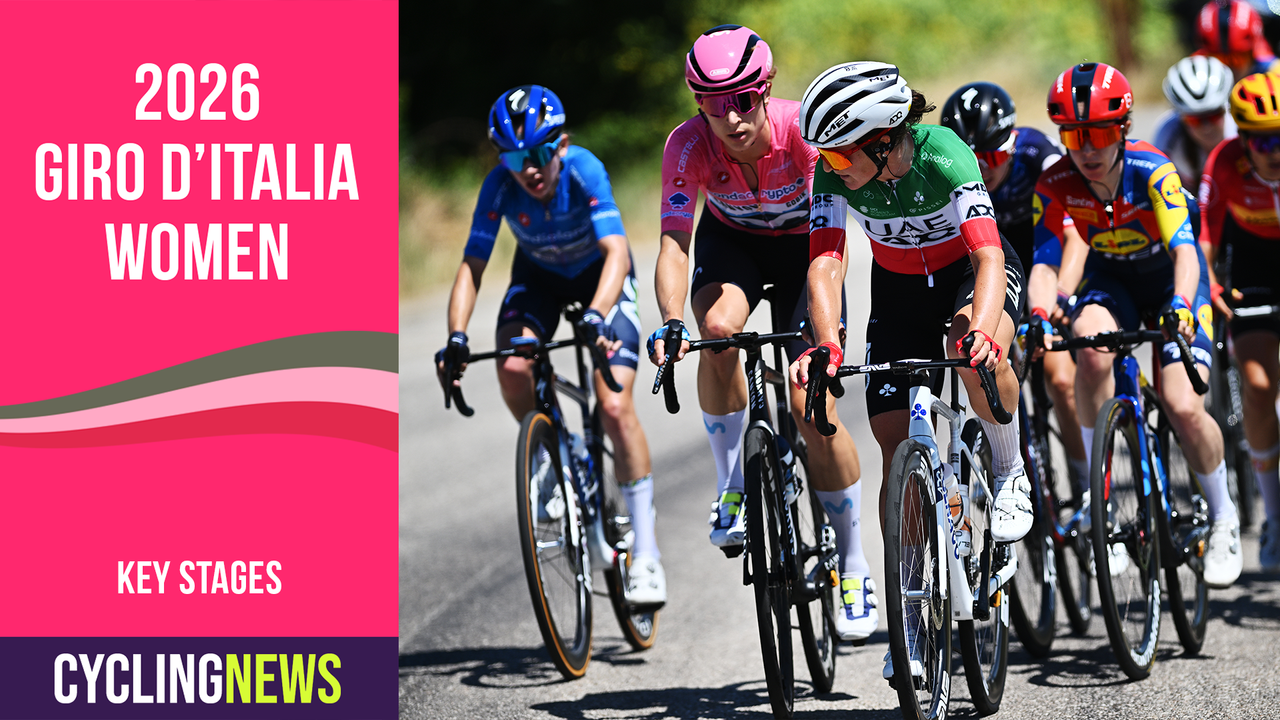
The first Grand Tour of the racing season is in the history books as La Vuelta Femenina concluded earlier this month with Paula Blasi soaring to overall victory on the Alto de L'Angliru.
Now, attention turns to the season's second Grand Tour, the Giro d'Italia Women, where a host of contenders, including Demi Vollering, Anna van der Breggen, Elisa Longo Borghini, and Marlen Reusser, will be battling for glory.

The route of the 2026 Giro Women will see the riders do battle over nine days of racing featuring 1,177km and 12,000 metres of elevation, with several tough stages among the highlights.
As part of our countdown to the Grande Partenza in Cesenatico on Saturday, we've taken a look at three key stages which could decide the destination of the maglia rosa.
Stage 4: Belluno - Nevegal (12.7km)
The opening trio of stages winding around the north-east of Italy look set to end in sprint finishes. Should the GC contenders all make it through those hectic finishes in Ravenna, Caorle, and Buja, the stage 4 mountain time trial will be their first chance to show off what they can do.
Readers with good memories will recall that this stage is a carbon copy of the stage 16 time trial at the 2011 edition of the men's Giro, where race leader Alberto Contador extended his lead with a 34-second triumph over Vincenzo Nibali.
Looking even further back, the rarely visited mountain hosted a finish of the 2001 Giro d'Italia Femminile. Eventual race winner Nicole Brändli triumphed at the end of a 130km stage the day after anti-doping raids swept through the peloton.
The day out in the Dolomites is a short but sharp one, with the major climbing starting after an initial 5.35km of flat and false flat roads from Belluno.
Following the initial time check at Calepo lies a 4.4km section averaging a 10.3km gradient before things get easier in the final 3km. There's a maximum of 14% along the way, while the final kilometres average 6.4% and 1.6%.
With a major climbing stage coming the next day and the Giro's queen stage lying later in the race, the mountain time trial – the only TT of the race – shouldn't prove decisive in the grand scheme of things, but the climb will certainly highlight the in-form riders.
Stage 5: Longarone - Santo Stefano di Cadore (146km)
The Giro remains in the Dolomites for stage 5 and another challenging day on the bike featuring four major climbs and 3,400 metres of elevation.
There's barely a kilometre of flat road on the 146km run from Longarone to Santo Stefano di Cadore near the Austrian border, which concludes with two laps of a circuit featuring the third-category climb of Costa (4km at 9.1%).
A pair of first-category climbs lie in wait before then, however, with the Passo Tre Croci (7.9km at 7.2%), the first obstacle of the day peaking after 56km of racing.
The road quickly tilts uphill again, following a long descent into Auronzo di Cadore for the longest climb of the stage, the Passo di Sant'Antonio (8.3km at 7.5%) after 92km of racing.
The pair of climbs up Costa rounds out the day, with the riders cresting the final ascent 16.3km from the finish, which comes after a quick descent.
Stage 5 might not come with a fearsome summit finish, but the stage features the most climbing metres of any in the race. With the longest climbs coming earlier in the day, there's every chance that some of the overall favourites will look to go hard with their team early and test the legs of other contenders.
Of course, a lot will depend on the state of the race and energy reserves after the previous day's exertions. However, the race to Nevegal is a short one, and so if any contenders sense a weakness in their rivals, there are plenty of opportunities to make moves here.
Stage 8: Rivoli - Sestriere (105km)
This is the big one – the Queen stage of the race and the toughest test of the nine days of the Giro. The famed slopes of the Colle delle Finestre are on the menu for the first time in the women's race.
There's more climbing to come on the final day in Saluzzo, including the race's final first-category ascent early in the stage, but the race to Sestriere looks highly likely to be the GC decider.
Stage 8 starts out simply enough, with 54km of flat roads towards Susa letting the peloton ease their legs into the day before the big challenges later on. From then, onwards though, it's either uphill or downhill all the way to the finish with no let-up.
The peloton will be faced with 18.5km of climbing at an average of 9.2% when they hit the Finestre, and the climb of course poses another challenge in the form of the gravel road which covers the final 8km to the top.
The mountain is the longest and hardest of the entire race, and if a maglia rosa-seizing move is to be made, then the Finestre provides the best opportunity to do so.
The climb has featured five times in the men's Giro since its introduction in 2005. Back then, Paolo Savoldelli memorably defended his overall lead against attacks from Gilberto Simoni and José Rujano, while the Finestre hosted last-gasp turnarounds in 2018 and 2025 as Chris Froome and Simon Yates soared into the pink jersey.
Two summers ago, the women's peloton paid a visit, too, with Marion Bunel soloing to victory to win stage 3 of the Tour de l'Avenir Femmes by almost two minutes. The French talent, third at the recent Vuelta, leads Visma-Lease a Bike here and will be one to watch again on stage 8.
But the stage doesn't end with the Finestre, of course. There's an 11km descent to contend with before the 16.2km climb towards Sestriere to finish things off.
The third-category closer isn't the toughest in the world, averaging just 3.8%, but with 27km of racing remaining after the top of the Finestre, any riders making solo moves will have to be brave and hold something in reserve for the finale.s
Subscribe to Cyclingnews for unlimited access to our Giro d'Italia Women coverage. Don't miss any of the breaking news, reports, and analysis from one of the biggest women's stage races of the season. Find out more.