Photograph: APAImages/Shutterstock
Good morning. The Rafah crossing, a fragile lifeline for Gaza, has reopened.
But movement in and out of Gaza remains tightly controlled, with Israel determining who is permitted to leave or return. Of the roughly 4,000 patients with official referrals for medical treatment abroad, only a small fraction have been allowed to cross. Fewer still have been allowed back. Meanwhile, airstrikes continue, and more than 556 Palestinians have been killed since the ceasefire was signed last October.
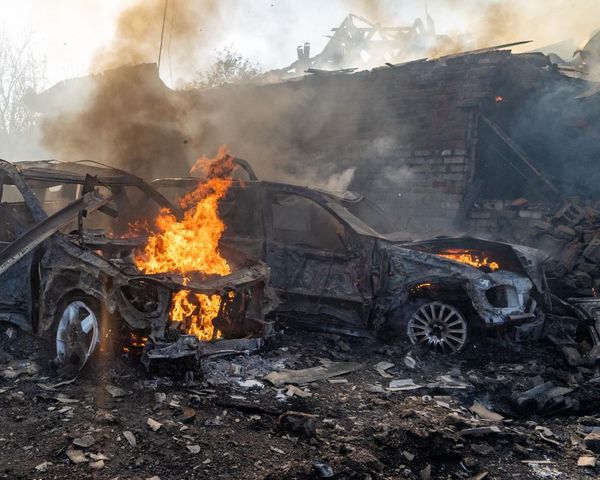
In the West Bank, mass displacement of Palestinians is gathering pace, and the UN, along with Israeli soldiers and activists, warn that the Israeli army is increasingly entangled with settler violence, with reserve units drawn from settlements accused of operating as vigilante militias.
These are the day to day realities of Israel’s occupation of the Palestinian territories, now in its 58th year. Last week, prime minister Benjamin Netanyahu said Israel’s “security control” from the Jordan River to the Mediterranean would remain indefinitely.
For a growing number of legal experts, that amounts to apartheid. To understand that argument, I spoke to Jerusalem-based journalist Nathan Thrall, author of the Pulitzer Prize winning A Day in the Life of Abed Salama. That’s after the headlines.
Five big stories
UK politics | Downing Street has defied calls to remove Keir Starmer’s most senior aide, insisting Morgan McSweeney retains the prime minister’s confidence, as frustration grows over a wait for documents on Peter Mandelson.
Business | Bank of England keeps interest rates at 3.75% as inflation concerns persist.
US news | The US military on Thursday said it killed two alleged drug traffickers in a strike on a boat in the eastern Pacific, bringing the death toll from Washington’s campaign to at least 128.
Ukraine | Ukraine and Russia agreed to a reciprocal prisoner exchange but there were no major breakthroughs on day two of the peace talks in Abu Dhabi.
Neurodiversity | People with attention deficit hyperactivity disorder (ADHD), anxiety and autism will be prevented from using fast-lane disability queueing passes at Alton Towers during a trial over the February half-term holidays.
In depth: ‘This not stopping, it’s accelerating. It’s going on at the fastest pace ever’
When Israel declared statehood in 1948, it did so without formally defining its borders. After the 1967 war, Israel took control of more territory, occupying East Jerusalem, the West Bank and Gaza.
Across the world, these occupied territories are treated as the basis of a future Palestinian state, with Israel understood to exist within its pre-1967 borders.
But for the past 15 years, Nathan Thrall has sought to puncture what he sees as the central fiction produced by that framework: that Israel exists separately from East Jerusalem, Gaza and the occupied West Bank.
Thrall’s arguments have drawn sharp criticism from the Israeli right, which accuses him of misrepresenting Israel’s security needs and delegitimising the state. In 2023, an Israeli diplomat sought to persuade Bard College, where Thrall has taught, to cancel a course examining whether Israel practices apartheid in the Palestinian territories. The college declined.
But Thrall, who previously spent a decade at the International Crisis Group, as director of the Arab-Israeli Project says: “There is one sovereign state, it’s the state of Israel.” And that state, he argues, is practising apartheid.
***
What is apartheid?
Before we get into the system behind the Israeli occupation of the Palestinian territories, it’s worth spelling out exactly what the term apartheid means.
Apartheid in international law refers to a system in which one racial group seeks to maintain dominance over another through systematic oppression and inhumane practices. Racial apartheid became a crime under international law in 1973, in response to South Africa’s regime of enforced racial separation, under which a white minority ruled over and restricted the rights of the Black majority from 1948 until the early 1990s.
“That definition of apartheid is clearly met in the case of Israeli Jewish domination over Palestinians,” Thrall argues. Between the Jordan river and the Mediterranean live roughly 7.5 million Jewish Israelis, who enjoy full rights wherever they live, and 7.5 million Palestinians, who Thrall says, are subjected to varying degrees of discrimination. The difference in who gets to pass freely through the territories, and what treatment they are subject to, is central to his argument.
Thrall says the apartheid charge is now widely accepted across international human rights and legal communities. Human rights organisations B’Tselem and Human Rights Watch made the accusation in 2021, with Amnesty International following suit in 2022.
Successive Israeli governments have strongly rejected that label, arguing it is antisemitic and long warned that it could encourage boycotts against the country or open the door to legal action under international law. Those who reject the apartheid label say that the situation is a temporary, security-driven military occupation arising from a national conflict, not a system of racial domination. They point to the existence of Palestinian citizens within Israel proper with civil rights as evidence.
But a growing number of Israelis disagree, including former head of the Mossad Tamir Pardo. He joins the former speaker of the Israeli parliament Avraham Burg and historian Benny Morris. Even Benjamin Pogrund, a South African anti-apartheid activist who previously defended Israel against the label for the Guardian in 2012 and again in 2015, made a dramatic shift in 2023 when he described the charge as accurate, citing the actions of Netanyahu’s government.
And in July 2024, the International Court of Justice delivered a landmark advisory opinion, declaring Israel’s occupation of Gaza and the West Bank (including East Jerusalem) unlawful. The historic, albeit non-binding, opinion found multiple breaches of international law by Israel, including activities that amounted to apartheid.
***
The permit system
One of the clearest expressions of what Thrall and other critics calls an apartheid system, is the permit regime governing Palestinian movement. Leaving Gaza, studying elsewhere in the occupied territories, receiving medical care, praying in Jerusalem or working inside Israel all require permits that are rarely granted. It is also embedded in the legal system.
In the West Bank, Thrall adds, Palestinians can discover they are banned from travel without warning, sometimes when they arrive at a border crossing. Hundreds of thousands are thought to be affected by such bans.
“It’s two entirely different legal systems for Israeli Jews and Palestinians living in the same piece of land,” Thrall says. “You could literally have an Israeli Jew commit the very same crime at the same location on the same date as a Palestinian, and the Israeli Jew will be prosecuted in an Israeli normal civilian court with all the protections of Israeli civil law. The Palestinian would be sent to an Israeli military court where there is a 99% conviction rate.”
The separation is also embedded in physical infrastructure. “There is a segregated road system,” Thrall says. Settlers travel on new, multi-lane highways that cut directly through Palestinian land, while Palestinians are often barred from accessing those same roads. Palestinians are instead diverted on to long, indirect routes that are mostly single-lane, congested, and poorly maintained, often passing under or around settler highways. Israeli authorities refer to these routes as “fabric of life” roads, Thrall explains, while the highways above them are designated for settlers.
It is worth watching this video by the Guardian Middle East correspondent Emma Graham-Harrison on the new road project described by critics as an “apartheid road”.
When I asked Thrall what he says to those citing the 7 October massacre to justify the continued occupation, he stresses the attacks are horrific. He also views the attacks as part of a cycle of violence in the region, linked to the ongoing occupation and restrictions on Palestinians.
***
The future is now
On the ground in Israel, Thrall sees little reason to believe change will come from within. “When you walk around Tel Aviv or in West Jerusalem, you see the total normalcy, the total ease with which the voters of this country can live with that situation.”
At the same time, the reality for Palestinians is moving in the opposite direction, he adds. Settlement expansion, displacement, and home demolitions continue apace, he says, adding that entire communities are disappearing. Recent reporting by the Guardian’s Graham-Harrison shows the extent of the ethnic cleansing taking place in the West Bank.
“Not only is this not stopping, it’s accelerating. It’s going on at the fastest pace that’s ever happened before,” he says.
Thrall argues that outside pressure is essential. “We in the west have the power to change their perceptions and to change their priorities. And we can do it with very simple things like suspending the EU-Israel Association Agreement and halting arms sales to Israel.
“Imagine a future in which there are two states, or there is one state with equal rights. How will historians describe this period now? It would be a period of apartheid.”
What else we’ve been reading
Andy Bull shares his tips of 10 things to look out for at the Milano Cortina 2026 Winter Olympics, which has its opening ceremony tonight. Martin
I fell into sumo last year and never climbed out. Justin McCurry’s interview with a Ukrainian refugee who is close to becoming Japan’s first grand champion is moving, whether you love sumo or not. Aamna
The Epstein files have dominated headlines all week – including this newsletter. Jim Waterson had this different angle, looking at the convicted child sexual abuse offender’s property ambitions in London. Martin
The Grand Egyptian Museum opened last November with a lavish ceremony. But behind the spectacle, Neal Spencer writes for the London Review of Books, is a space stripped of human thought and experience. Aamna
Catherine Anne Davies, who records as the Anchoress, writes on the increasingly unsustainable costs for musicians of not just touring but also recording. Martin
Sport
Rugby union | France launched the defence of their Six Nations title in emphatic fashion, sweeping Ireland aside 36-14 at the Stade de France.
Football | The EFL are set to rebuff any attempt by Manchester City to clear Marc Guéhi to play in the Carabao Cup final against Arsenal.
Winter Olympics | “Penis injection” doping claims in Winter Olympics ski jumping investigated by Wada.
Something for the weekend
Our critics’ roundup of the best things to watch, read, play and listen to right now
Film
Hamlet | ★★★★☆
The setting of this adaptation is modern London’s world of shady family business and family dysfunction, wedding parties, blandly scheming associates and SUVs speeding through the night-time streets. Hamlet (played by Riz Ahmed) looks here like no one as much as Kendall Roy from Succession. Overall, this is an intelligent and focused account and one which, at least at first, allows you to ask the question: what if Claudius, however unscrupulous and predatory, is in fact innocent of murdering the prince’s father? What if the ghost and his accusation is Hamlet’s hallucinatory delusion, a psychosexual projection of his own disgust? There’s a rigorous chill to this Hamlet. Peter Bradshaw
TV
Michael Jackson: The Trial | ★★★★☆
Over four episodes, the series charts the events leading up to and surrounding Jackson’s 2005 trial, at which he was accused of molesting 13-year-old Gavin Arvizo (he was later found not guilty on all 10 counts). The Trial leans hard on discussion of and archive footage from Leaving Neverland in its conclusion – perhaps to justify its own existence, or perhaps to salute that documentary for having the impact it did. Really, though, this series makes its own points, and makes them well. “I don’t know why I get so protective,” videographer Christian Robinson says towards the end, as he continues to defend his former employer, before turning the question back to the faceless interviewer, and – by extension – us at home. “Do you think he’s innocent, after everything you’ve seen?” Hannah J Davies
Music
Mandy, Indiana: Urgh | ★★★★★
This Manchester and Berlin-based band’s distinctiveness comes from their limber rhythms. Powered by drummer Alex Macdougall’s incredible versatility and vocalist Valentine Caulfield’s staccato delivery, many of their songs are alive with an addictively free, bodily lope, which is often stalled by squalling winds and thrashing noise: threat lurking around every corner. Urgh has a few obvious differences from their debut album, but the main evolution is into a harder, thicker sound, a contrast of extreme physicality and hyper-detailing that feels like getting dragged under by a strong wave and marvelling at the flotsam caught up in its swell. Laura Snapes
Book
The Colour of Home by Sajid Javid
This portrait of the former home secretary feels less like a nostalgic political origin story and more like an urgent warning about the Britain that comes next. Javid, cheerfully now in the “Big House”, can at times sound like an Uncle Tom: his narrative minimises structural barriers and suggests minorities simply need to work harder in order to succeed. His decision to concentrate on his early years and write little about his rise through the Tory party represents a serious omission. Surely he has much to tell about the inner workings of the now imploded Conservatives. But perhaps he’s saving that for another volume. It would be fun to read if he can be as honest about that as he is about his childhood. Hanif Kureishi
The front pages
“Starmer in appeal to Labour MPs as pressure grows for No 10 reset” is top story at the Guardian. The Mirror sees it as “Keir and present danger”, the i paper says “Labour ‘women in grey suits’ may be sent to No 10 to tell PM to resign” and the Times has “PM labelled ‘gullible and weak’ over Mandelson”. The Mail splashes on “Rayner: I’m ready to go”, in reference to potential No 10 moves, while the Telegraph leads on “Rayner tilt at No 10 hit by tax inquiry”. The FT says “Starmer apologises to Epstein victims as crisis over Mandleson ties deepens”. Over at the Sun, it’s “On me red, son”, with a story about Wayne Rooney’s son being offered a deal at Manchester United.
Today in Focus
Bad Bunny goes to the Super Bowl
The journalist Jen Ortiz charts the rise of Bad Bunny – the Puerto Rican superstar musician and ICE critic – before his performance at the Super Bowl on Sunday.
Cartoon of the day | Ben Jennings
The Upside
A bit of good news to remind you that the world’s not all bad
In Ramsgate, “hope and relief” filled the air after the seaside town’s last youth centre was saved from closure. The charity Pie Factory Music has been based there for 13 years, offering counselling, employment advice, life-skills and creative projects for 8- to 25-year-olds. Thanks to a £535,000 grant from the Pride in Place strategy, Pie has been able to buy the freehold of the building.
“Knowing our future in the building is secure fills us with hope and relief,” said its chief executive, Zoë Carassik. “We should never have had to campaign to save Ramsgate youth centre. Youth provision should not depend on charities like us alone.”
Brian Horton, interim chair of the Ramsgate Neighbourhood Board, said: “We are committed to providing safe, positive spaces for the next generations to thrive.”
Sign up here for a weekly roundup of The Upside, sent to you every Sunday
Bored at work?
And finally, the Guardian’s puzzles are here to keep you entertained throughout the day. Until tomorrow.