Get all your news in one place.
100's of premium titles.
One app.
Start reading
The Guardian - UK
The Guardian - UK
World
Martin Belam

Friday briefing: Can the left mobilise itself to outmarch the momentum of the far right?

People on Westminster Bridge as they take part in a Palestine Solidarity Campaign march in central London.
People are more accustomed to protesting en masse since the start of the conflict in Gaza. Photograph: Yui Mok/PA

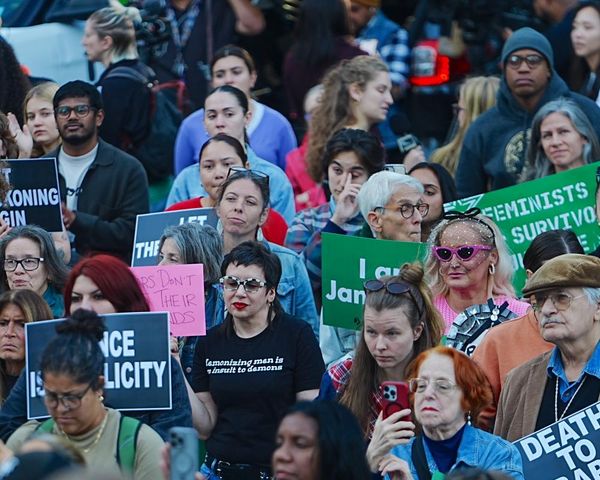
Good morning. Tomorrow the streets of London will host the Together Alliance march, the coming together of a vast array of groups to protest against the rise of the far right in the UK. Trade unions, campaign groups, politicians and a long list of cultural figures spanning music, comedy and film will be there.

From musicians including Brian Eno and Self Esteem to actors including Christopher Eccleston and Maxine Peake, the support reflects a familiar pattern in British protest movements – moments when politics spills into culture, and vice versa, and a chance for people to demonstrate their progressive values.

For today’s newsletter, I spoke to my colleague Robyn Vinter, who will be reporting from the march, about who is behind it, what organisers hope to achieve – and whether it signals a turning point in the response to the far right. That’s all after the headlines.

Five big stories

  1. Middle East crisis | Donald Trump has extended his deadline for Iran to open the strait of Hormuz by 10 days to 6 April after saying talks are “going very well”.

  2. Andrew Tate | A police force under investigation over its handling of sexual abuse claims against the self-professed misogynist Andrew Tate has reopened an inquiry into allegations against him.

  3. Lucy Letby | The police force that conducted the investigation into the nurse Lucy Letby made “egregious” failures and did not follow official guidance or best professional practice, David Davis has said in parliament.

  4. UK news | Keir Starmer has written to the chief executive of Travelodge to press the hotel chain to “seriously engage” with MPs raising concerns about its protocols after a woman was sexually assaulted by a man who was given her room number and a keycard by staff.

  5. Gender | The International Olympic Committee has banned transgender women and DSD athletes from the female category of events at the 2028 Los Angeles Olympics and future Games.

In depth: ‘It feels like there’s something for everyone on the progressive side’

“There’s always a sense of unpredictability with these events. We don’t really know what the turnout will be, but my instinct is that it’s going to be very big,” Robyn Vinter tells me.

She is a veteran of covering demonstrations, strikes, and even riots. “Hopefully this one doesn’t end up in that last category,” she jokes. “I do enjoy covering them. I like anything that involves talking to people on the street – people can really surprise you, and once you get chatting, they’re often far more interesting than you might expect.”

***

What is happening on Saturday?

The march is set to see thousands head through the city towards a rally in Trafalgar Square. Organisers say the route has been agreed in advance with the Metropolitan police, with stewards and volunteer marshals in place to manage the crowd and ensure the procession moves safely.

The political support spans a broad alliance of the progressive left, with Your Party’s Zarah Sultana and former Labour leader Jeremy Corbyn, the Green party’s Zack Polanski, representatives from the Lib Dems, SNP and Plaid Cymru, and Labour left figures such as Rebecca Long-Bailey and Dawn Butler being among the list of those signed up. Notably absent are any members of the Conservatives, Reform UK, or the Labour frontbenches.

The event will culminate in speeches and performances from campaigners, union leaders and high-profile supporters, alongside a visible presence from affiliated organisations marching under their own banners.

“There’s also a kind of festival element, with things happening in Trafalgar Square, and that will attract people,” Robyn says, adding “The weather helps. And there are a lot of well-known figures involved – Paloma Faith, Jessie Ware, politicians like Andy Burnham. It feels like there’s something for everyone on the progressive side.”

***

Why now?

Organisers say the march is a direct response to a growing tide of far right activity, including large demonstrations and anti-migrant unrest in recent years. They argue that racist narratives are increasingly being used to scapegoat migrants and asylum seekers for wider social and economic pressures.

For many groups involved, the mobilisation is intended as a visible counterweight – a way to demonstrate that opposition to those ideas is both widespread and organised. Backers also frame it as a wider call for solidarity across communities, making support for a more tolerant, multicultural society more visible.

“Broadly, I think people on the progressive left have been a bit politically adrift for a while,” says Robyn. “During the Corbyn era, it felt like something was building, and since then there hasn’t really been a clear movement for those kinds of politics. Now it feels like something might be coalescing again, and this march is part of that.”

She also cites the regular marches and demonstrations over Gaza and Palestine, saying the last couple of years of protest activity “have built networks that didn’t exist before”.

“You’ve got more than 100 organisations involved here – trade unions, environmental groups, all sorts – and they’ve brought in people who might not previously have seen themselves as activists. So there’s a bigger base to draw on.”

***

Where does this fit historically?

I am old enough to remember Red Wedge back in the 1980s, campaigning to try to boost Neil Kinnock’s hopes of ousting Margaret Thatcher. Indeed, figures like Paul Weller and Billy Bragg, who are backing Saturday’s march, were involved in that back in the day.

Robyn tells me that she has seen the march being relentlessly pushed by the algorithms on Instagram. “Even if it hasn’t had huge traditional media coverage, that kind of reach really matters now. I think it’s going to be big.”

Last year a reported 110,000 people attended a far-right protest in London organised by Tommy Robinson. Billed as a “festival of free speech”, the rally saw the spread of racist conspiracy theories and anti-Muslim rhetoric, and a contribution from Elon Musk. The scale of the crowd exceeded expectations and led to clashes with police, leaving at least 25 people arrested and 26 officers injured, as bottles, flares and other projectiles were thrown.

This time around, Robyn tells me she thinks there is “an element of fear” driving the organisation. “People saw the riots the summer before last, and the big far right demonstrations. It worried people, and I think it made a lot of them feel they needed to do something. A lot of people feel powerless watching politics and the rise of the far right, especially if they’re not party political or already involved in activism. This march gives them an outlet. It’s a way of saying: ‘we’re here too’.”

Whether Saturday’s march marks a moment of consolidation for the progressive left coalition or simply another chapter in a long-running cycle of protest and counter-protest may not be clear immediately. But its expected scale – and the breadth of support behind it – tallies with a sense in British politics right now that people are more easily prepared to come together to act against a possible outcome rather than for a specific cause.

What else we’ve been reading

  • Giles Richards has a fantastic tale about why Max Verstappen sent him out of a press conference. Patrick

  • Tonight’s friendly with England brings the hugely popular Elland Road legend Marcelo Bielsa back to the UK. Jonathan Wilson analyses his Uruguay tenure as Bielsa heads towards his third World Cup. Martin

  • American singer-songwriter Leon Thomas III began his career as a child actor on Broadway. Aged 32, he is the next big thing in R&B. Leon speaks to Kate Hutchinson about his rise. Patrick

  • Ageing has its advantages, and Paul Daley here compares it to the boiling frog metaphor – “You’re in it, you can’t escape it, but you don’t always notice it” – as he comes to terms with repeatedly being offered seats on the bus. Martin

  • Looking for some fancy Easter treats but want to avoid chocolate eggs? Annalisa Barbieri has a list of delicious suggestions. Patrick

Sport

Football | Wales’ World Cup dream was ended by defeat on penalties as Bosnia and Herzegovina set up a playoff final against Italy after coming from behind in Cardiff, while Italy beat Northern Ireland 2-0 to close in on a World Cup spot.

Olympics | The IOC’s shift in position on trans women in elite sports is seismic, but new president Kirsty Coventry is reflecting a changed political climate, writes Sean Ingle.

Football | Robert Lewandowski helped Poland scrape past Albania 2-1, while Kosovo are on the brink of a first appearance at any major tournament after a wild 4-3 win in Slovakia: It’s all here in the World Cup playoffs wrap.

Something for the weekend

Our critics’ roundup of the best things to watch, read, play and listen to right now

TV
Boom Box: Beats and Betrayal | ★★★★★

The UK launch of HBO Max has brought with it some major US series (no more waiting for The Pitt!). More unexpectedly, perhaps, its launch slate also includes this distinctly British true-crime docudrama about a record shop/recording studio in Edmonton, north London. Teens involved in petty crime came to Boom Box to keep off the streets – only to find that the studio itself was a hotbed of gang-related activity. It’s an astonishing tale which is told fantastically here, in a series that hopefully heralds HBO Max as a platform that will champion British (as well as American) TV. Hannah J Davies

Film
Orwell: 2+2=5
| ★★★☆☆
Raoul Peck’s documentary about George Orwell and his enduring relevance takes as its keynote the heretical masterpiece Nineteen Eighty-Four and its famous scene about the state compelling people to believe whatever it says is the truth: that two and two make five. That Orwellian anti-arithmetic of tyranny has become a political meme often repeated in social media debates about gender politics, although these are not mentioned here, perhaps because they are not considered sufficiently important. This is a serious and worthwhile film, though one that tells you what you know already, and yet somehow perhaps doesn’t tell you enough. Peter Bradshaw

Music
Fcukers: Ö | ★★★★☆
Those who suggest the era of the hyped artist is over – a victim of declining interest in the music press – might consider the case of New York’s Fcukers. Such was the buzz generated by the electroclash-adjacent duo’s early singles that they ended up touring five continents within barely a year of their first live show. But listening to their debut album, you wonder if the reasons for the rapidity of Fcukers’ rise might be more straightforward than vogueishness. Everything sounds as if it’s happening in the small hours, whether on a packed dancefloor or elsewhere, and the airy quality of Wise’s voice suggests not calm but someone who’s taken a shortcut to a state of beatific insouciance and might pass out in the not-too-distant future. Alexis Petridis

Dance
A Mirrored Monet:
London | ★★★☆☆
As its title suggests, this musical about Claude Monet is full of reflections – fittingly so given the artist’s preoccupation with light. In 1916, while struggling to complete The Water Lilies with cataracts, the ageing painter (Jeff Shankley) retreats into memories of his early career. Like Monet’s, this musical’s ambition sometimes comes at a cost, but it still lands in a place of beauty and deep feeling. Lucinda Everett

The front pages

“Trump extends Hormuz deadline claiming Iran talks ‘going very well’’ is the Guardian top story. The i Paper says “UK faces triple shock of inflation, weak growth and energy crunch”, the Mail has “Reeves is the real petrol profiteer”, and the FT headlines on “Energy shock to hurt UK growth most among G20 economies, OECD warns”. The Times splashes on “Trump gives Iranians ten more days to open Strait”. The Telegraph leads on “NS&I boss fired amid cover-up claims”, while the Mirror runs “One hour of screen a day” and the Sun says “1 hour is your lot, tots”.

Today in Focus

Spring break: Culture worth catching this season

Critics Catherine Shoard, Alexis Petridis and Hannah J Davies on what to watch and listen to this season.

Cartoon of the day | Rebecca Hendin

The Upside

A bit of good news to remind you that the world’s not all bad

Many of us harbour unfulfilled dreams of pursuing musical talents. Are you a bathroom Madonna? Always fancied yourself as the next Jimi Hendrix? It is never too late to start. Sarah Phillips has spoken with musicians from around the country for tips on how to live a more musical life – however old you are. From finding a teacher to learning how to follow your instincts with songwriting, Sarah has complied ten brilliant tips.

Sign up here for a weekly roundup of The Upside, sent to you every Sunday

Bored at work?

And finally, the Guardian’s puzzles are here to keep you entertained throughout the day. Until tomorrow.

Sign up to read this article
Read news from 100's of titles, curated specifically for you.
Already a member? Sign in here
Related Stories
Top stories on inkl right now
One subscription that gives you access to news from hundreds of sites
Already a member? Sign in here
Our Picks
Fourteen days free
Download the app
One app. One membership.
100+ trusted global sources.