Get all your news in one place.
100’s of premium titles.
One app.
Start reading
LiveScience
LiveScience
Elizabeth Howell

Fresh look at Apollo moon rocks solves decades-old mystery about the moon's magnetic field

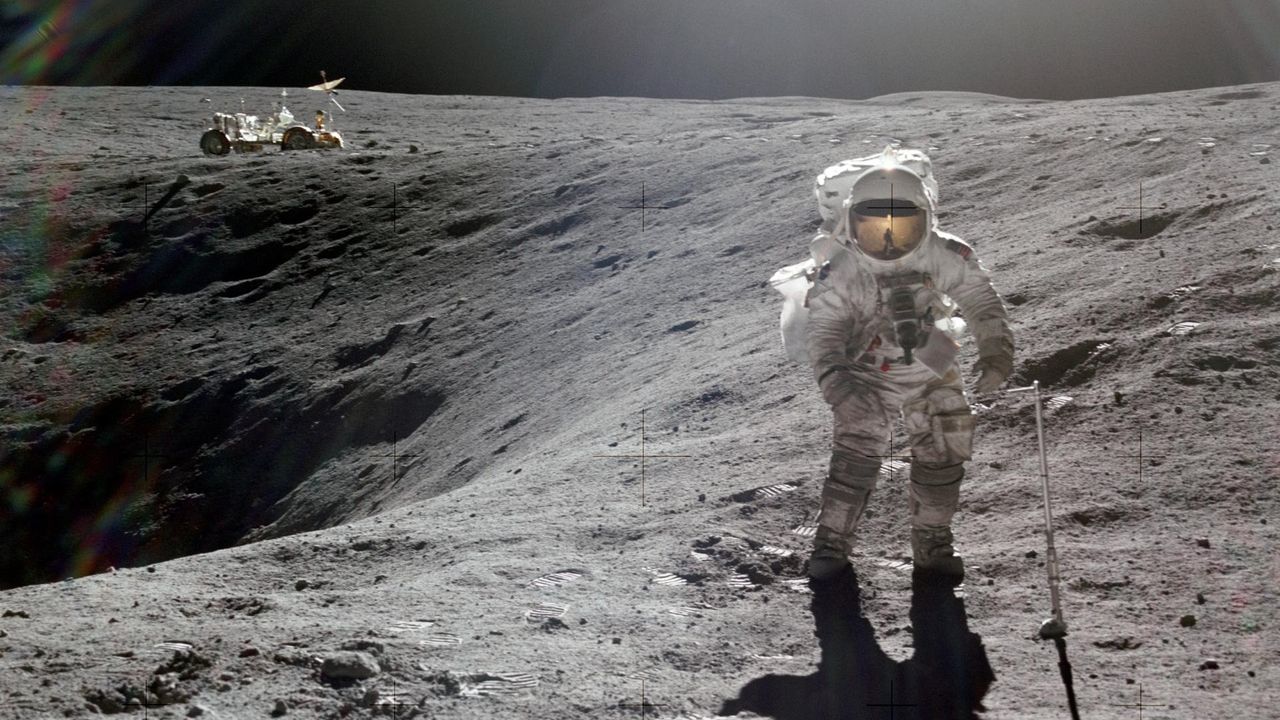
Astronaut Charles M. Duke Jr., lunar module pilot, is photographed collecting lunar samples at Station No. 1, during the first Apollo 16 extravehicular activity (EVA), at the Descartes landing site.

For decades, a debate has raged about whether the moon ever had a strong magnetic field, or if it was always weak. Now, a new analysis of Apollo-era moon rocks suggests the moon's magnetic field might be mostly weak, despite brief outbursts of strong activity — potentially solving the mystery for good.

The research, published Thursday (Feb. 26) in the journal Nature Geoscience, shows that the moon's magnetic field amped up for brief periods in its early history, roughly 3.5 billion to 4 billion years ago, but for most of the moon's 4.5 billion-year-old history, the magnetic field was weak.

"For very short periods of time — no more than 5,000 years, but possibly as short as a few decades — melting of titanium-rich rocks at the moon's core-mantle boundary resulted in the generation of a very strong field," lead author Claire Nichols, an associate professor of the geology of planetary processes at the University of Oxford, said in a statement.

A long debate

The debate about the moon's magnetic field stems from a limited sample of lunar rocks. Six Apollo missions landed on the moon between 1969 and 1972, in zones roughly around the lunar equator. These missions landed in about the same spot, in zones with similar types of rocks, the researchers said.

It was easiest for the astronauts to land their small craft on large, flat basaltic areas called maria, which are old lava plains formed after ancient meteorite crashes that melted the original rock there. These Apollo landing areas are rich in titanium basalts.

An Apollo 12 astronaut collects lunar samples while his fellow crew member takes a photo. (Image credit: NASA)

The new research charted the amount of titanium content in lunar samples against how strongly magnetized the rocks were. The scientists found that rock samples that were less than 6% titanium had weak magnetic fields and that the magnetic fields were stronger in rocks with higher titanium concentrations.

This suggests the formation of high-titanium rocks and the generation of a strong lunar magnetic field are connected, according to the statement. The researchers think both were caused by the melting of titanium-rich material deep inside the moon, which temporarily generated a very strong magnetic field.

A limited sample

Apollo samples, like this rock collected during the Apollo 12 landing mission, account for a majority of the lunar samples on Earth. (Image credit: AccuSoft Inc. / NASA)

Apollo moon rocks form a substantial part of Earth's lunar inventory. The auction house Christie's suggests that about 1,433 pounds (650 kilograms) of moon rocks on our planet comes from meteorites. Of that inventory, the Apollo archive constitutes roughly 842 pounds (382 kg), according to NASA.

Many of the titanium-rich Apollo rocks nevertheless have been analyzed by scientists, creating the perception that strong magnetism was present on the moon for a long time, according to the Oxford statement. But that appeared strange to other scientists, who argued that the small size of the moon's core — only one-seventh of its radius — could not allow the moon to create a strong field for long periods of its history.

The researchers confirmed the sampling bias by running models, which showed a random set of moon samples analyzed by scientists would have only few rocks containing a strong magnetic field. The hope is that the NASA-led Artemis astronaut missions will land in a larger variety of spots, gathering samples that show a range of the moon's 4.5 billion-year history.

"If we were aliens exploring the Earth, and had landed here just six times, we would probably have a similar sampling bias — especially if we were selecting a flat surface to land on," study co-author Jon Wade, an associate professor of planetary materials at Oxford, said in the statement. "It was only by chance that the Apollo missions focussed so much on the mare region of the moon — if they landed somewhere else, we would likely have concluded that the Moon only ever had a weak magnetic field and missed this important part of early lunar history entirely."

Sign up to read this article
Read news from 100’s of titles, curated specifically for you.
Already a member? Sign in here
Related Stories
Top stories on inkl right now
One subscription that gives you access to news from hundreds of sites
Already a member? Sign in here
Our Picks
Fourteen days free
Download the app
One app. One membership.
100+ trusted global sources.