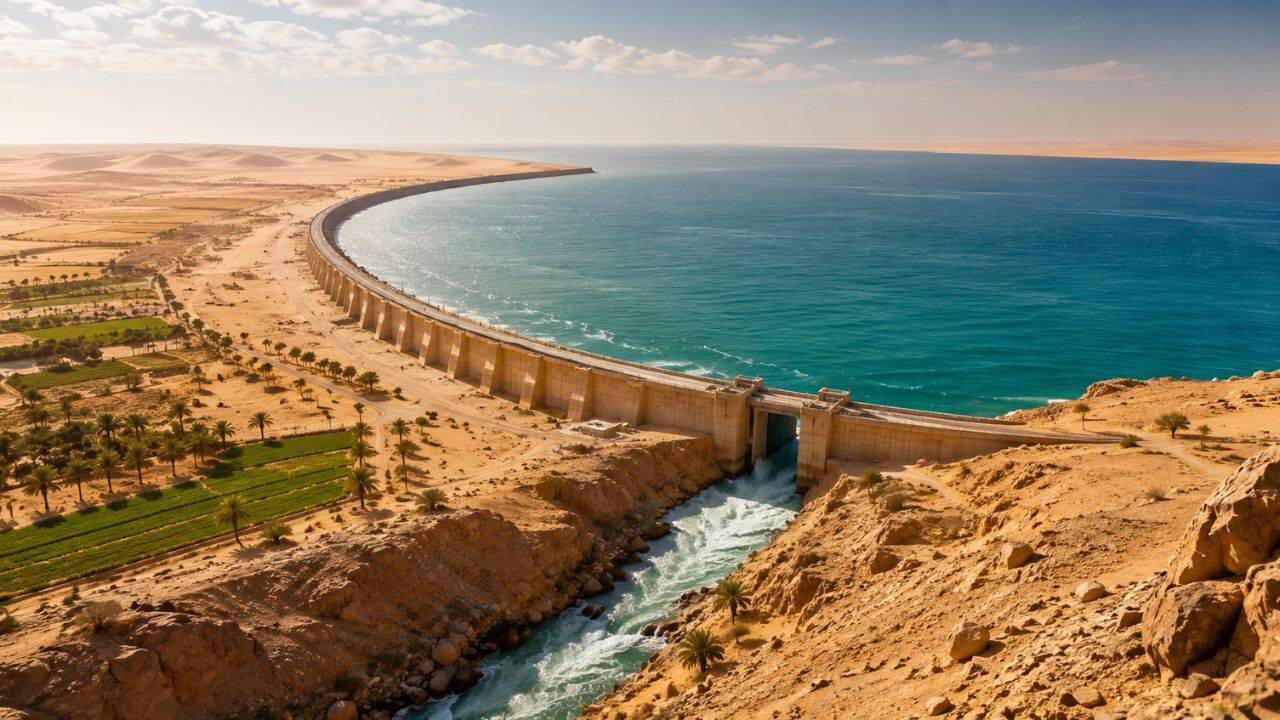
The Sahara is often thought of as a landscape beyond human control, stretching across North Africa with vast expanses of sand, rocky plateaus and some of the driest conditions on Earth. Yet, during the late nineteenth century, a handful of engineers and explorers believed the desert itself could be transformed. Rather than bringing water through irrigation alone, they imagined introducing an entire sea. The proposal was based on the belief that flooding low-lying areas with seawater would soften the surrounding climate, encourage rainfall and make nearby land more productive. The idea never moved beyond the planning stage, but for several decades it attracted serious discussion in engineering and political circles, reflecting an era when ambitious schemes to remake landscapes were viewed as achievable. Supporters argued that creating a vast inland sea could also stimulate trade, improve navigation and reshape regional economies. Although later scientific assessments questioned its environmental benefits and highlighted significant risks, the proposal remains one of history's most remarkable examples of large-scale climate engineering ambitions.
Get breaking news anytime, anywhere. Download the TOI app now!

The Sahara Sea project: The plan to bring Mediterranean seawater into the Sahara Desert
The idea is often associated with François Élie Roudaire, a French army officer who promoted the project during the 1870s. According to WorldAtlas , Roudaire worked with French diplomat and engineer Ferdinand de Lesseps to develop a proposal centred on the Chott el Fejej basin in southern Tunisia.
Their plan involved cutting a canal from the Gulf of Gabès on the Mediterranean coast so seawater could flow into the basin. They believed the resulting inland sea would alter local weather conditions by increasing moisture in the air, with the hope that surrounding regions would become more suitable for farming. The estimated cost of the project was around 30 million dollars, making it one of the most ambitious engineering concepts of its time.
Donald Mackenzie's forgotten plan to create a Sahara Sea with Atlantic water
Although Roudaire became closely linked with the concept, he was not the first to suggest creating a sea within the Sahara. According to WorldAtlas, British engineer Donald Mackenzie had outlined a similar proposal in 1877, a year before the French plan gained attention.
Mackenzie focused on the El Djouf Basin, a depression extending across parts of present-day Mauritania and Mali. He proposed directing Atlantic water inland through a channel beginning near Cape Juby in Morocco. His design envisioned an artificial sea covering roughly 60,000 square miles, with another channel eventually connecting the new body of water to the Niger River. At the time, some geologists believed the basin had once been connected naturally to the Atlantic Ocean, lending support to the proposal.
Why the Sahara Sea project was abandoned before construction began
As surveys became more detailed, enthusiasm for the project began to fade. According to WorldAtlas, critics questioned whether creating an inland sea would actually produce the environmental changes its supporters expected. Instead of increasing rainfall, some argued that the flooded basin might simply become an extensive marsh, creating conditions favourable for insects and disease.
The French government commissioned further investigations into the Tunisian basin. Surveyors found that parts of the proposed flooding area were not entirely below sea level, making the engineering challenge much greater than originally assumed. Without confidence that the expected benefits would materialise, financial support was refused and the project stalled.
The concept briefly resurfaced around 1910, when French professor Etchegoyen proposed a larger and deeper canal to achieve the same goal. He also suggested that an inland sea could support French colonial development in North Africa. Once again, however, the government chose not to proceed.
How the Sahara Sea project inspired later mega-engineering proposals
The notion of creating a desert sea did not disappear entirely after the early twentieth century. During the Cold War, the United States examined a variety of large-scale engineering schemes through Operation Plowshare, a programme intended to explore peaceful uses for nuclear explosions.
According to WorldAtlas, one proposal considered using nuclear detonations to help flood Egypt's Qattara Depression, while another revisited the possibility of filling Tunisia's chotts with Mediterranean water. These plans remained theoretical, and international agreements restricting peaceful nuclear explosions prevented them from advancing.
The Sahara Sea also inspired similar ideas elsewhere. According to WorldAtlas, engineers once discussed connecting Lake Eyre in Australia's interior to the ocean through a long canal. In the United States, the Salton Sea in California emerged by accident in 1905, when water from the Colorado River escaped an irrigation canal and filled a dry basin, creating the state's largest lake.