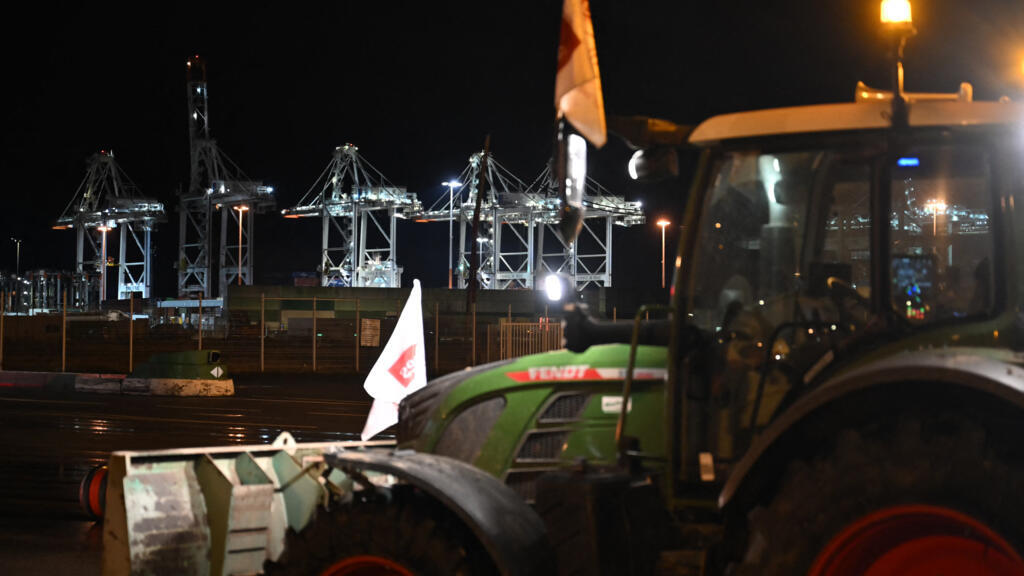
French farmers have pressed on with protests on Monday, as Brussels confirmed that EU Commission chief Ursula von der Leyen will sign the long-awaited EU trade deal with Mercosur next weekend.
The European Commission announced on Sunday that the agreement with the South American Mercosur bloc will be signed in Paraguay on 17 January, after EU member states gave the green light on Friday despite objections from several countries, most vocally France.
Supporters of the deal say it is vital for boosting exports, shoring up Europe’s economy and strengthening diplomatic ties at a time of global uncertainty.
On the ground, however, the mood among farmers remains combative. Across France, agricultural unions and informal groups have stepped up actions aimed at ports, roads and key logistics hubs, arguing that the treaty would open the door to cheaper imports – especially beef – that they say do not meet the standards imposed on European producers.
EU countries green-light Mercosur trade deal despite France's opposition
Farmers tighten the pressure
Monday began with fresh blockades in the south-west. Near La Rochelle, around 30 tractors and 60 protesters set up a barricade of straw bales outside oil facilities at the industrial port of La Pallice, answering a call from the local branch of the Coordination Rurale union.
Further south, farmers moved to block the Maïsica grain site in the port of Bayonne, an action led by the Confédération paysanne, Modef and the Basque union ELB, despite a prefectural ban on gatherings.
“About thirty tractors are blocking the entrances. The activists are arriving on site,” Modef said in a statement.
A separate blockade on the A63 motorway near Bayonne was lifted overnight after negotiations with the prefecture.
Around a hundred farmers had occupied the road since Friday, dubbing themselves the “Ultras of the A63”.
After late-night talks lasting until around 1.30am Monday morning, they agreed to clear the road without incident, allowing traffic between France and Spain to resume in both directions.
Farmers descend on Brussels to protest EU Mercosur trade deal
Wider European mobilisation
Elsewhere, pressure has continued to mount. In Le Havre, some 150 farmers used tractors to slow activity at the port, inspecting lorries and removing food products they said failed to comply with European standards, while stopping short of a full blockade.
In northern France, dozens of farmers maintained a roadblock on the A1 motorway between Lille and Paris, the country’s busiest road.
Coordination Rurale said the action would last “at least until Wednesday”.
“We have a huge number of people,” said Damien Salomon, co-president of the union in the Pas-de-Calais department. “We are now well capable of holding out for several days.”
Protests have not been limited to France. Demonstrations have also taken place in Italy, Poland and Ireland against the treaty, which would create one of the world’s largest free trade areas, covering more than 700 million consumers across Argentina, Brazil, Paraguay and Uruguay.
For critics, the deal risks destabilising European agriculture by exposing it to competition from imports produced under looser rules and controls.
(With newswires)