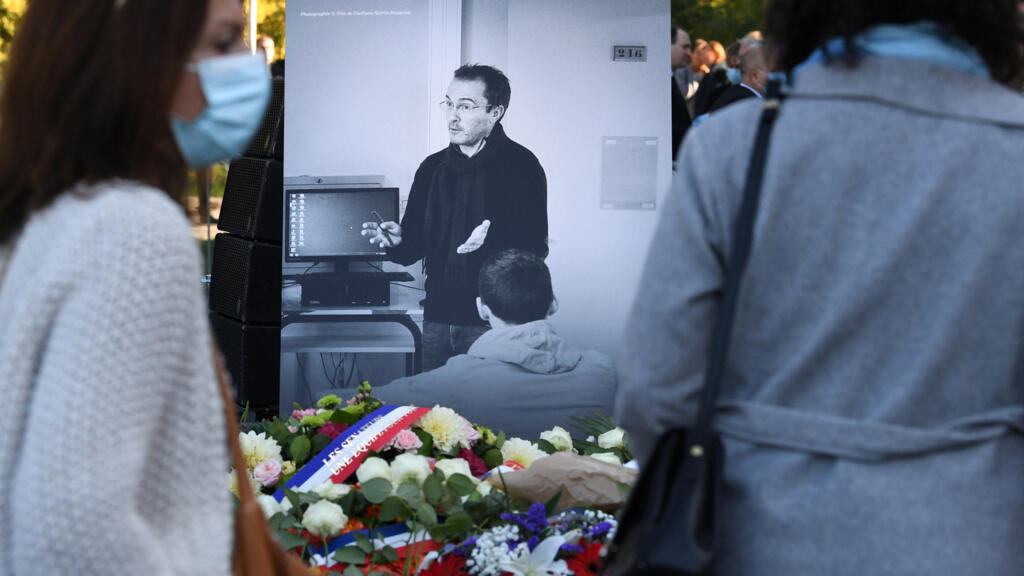
A French appeal court upheld one jail term and reduced three others over the chain of events that led to the beheading of teacher Samuel Paty by a Chechen jihadist in October 2020.
Paty’s killer, Abdoullakh Anzorov, was shot dead by police after the attack outside the Bois-d'Aulne secondary school in Conflans-Sainte-Honorine, west of Paris, where Paty taught history and geography.
At the end of the initial trial in December 2024, 66-year-old Islamist preacher Abdelhakim Sefrioui was sentenced to 15 years for criminal association with a terrorist group. His sentence was upheld after a five-week appeal hearing in Paris.
After the ruling, Sefrioui’s lawyers said they would appeal to the Court of Cassation.
Reduced sentences
Brahim Chnina, 54, the father of a pupil in Paty’s class, had his 13-year sentence reduced to 10 years for instigating an online hate campaign against the teacher.
The 16-year terms handed to Naïm Boudaoud, 24, and Azim Epsirkhanov, 25, were cut to six and seven years. They were convicted of criminal conspiracy, without any terrorist element being taken into account.
They had been accused of driving Anzorov and helping him obtain weapons. Prosecutors had pursued them for complicity in murder.
The events began with a lie told by a 13-year-old pupil, Chnina’s daughter. She accused Paty of discriminating against Muslim students during a lesson on freedom of expression in which he showed a satirical cartoon of the prophet Muhammad.
She had not attended the class. Her claims were shared widely on social media by her father and Sefrioui.
'Shock still raw', French teachers fearful, five years after Samuel Paty killing
Online campaign
After several days of a virulent online campaign targeting the 47-year-old teacher, Anzorov stabbed and beheaded him.
In their original verdict, judges said Chnina and Sefrioui did not know the attacker.
However, they added: "The two defendants knowingly took the risk, despite the danger and threats to Samuel Paty, that a violent and radicalised third party, who became their armed wing, would deliberately harm him physically."
During the appeal hearing, Chnina’s lawyers Franck Berton and Louise Tort asked the court to put their client’s actions into perspective. "He never participated in any terrorist activity," they told the appeal court.
As for Boudaoud and Epsirkhanov, trial judges said they were aware of their friend’s dangerous nature but still helped him, especially in his search for weapons.
Boudaoud’s lawyers, Hiba Rizkallah and Martin Méchin, challenged the case against their client. "Our client was convicted on the basis of fragile and hazardous interpretations, without any evidence of criminal intent," they told the appeal court.
They urged judges not to give in to emotion or media pressure.
(with newswires)