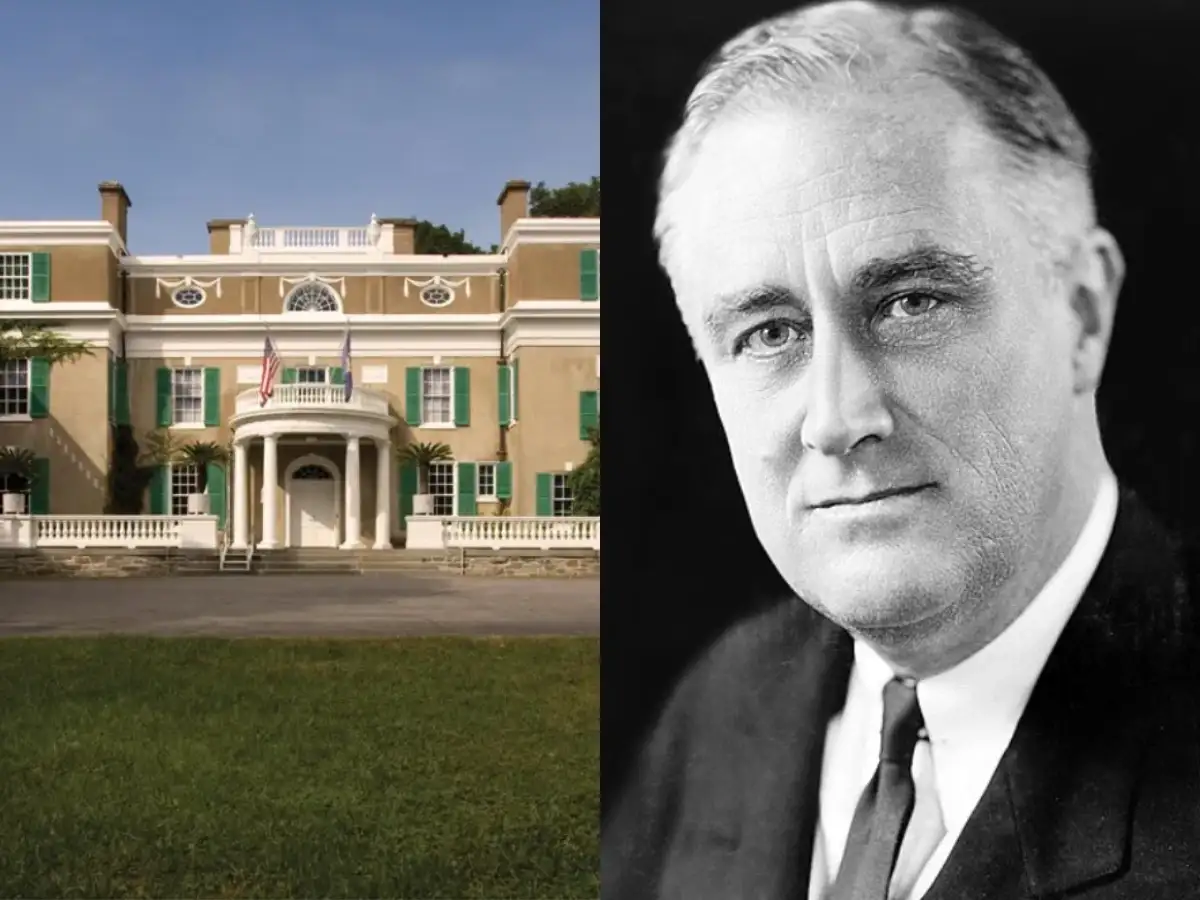
Franklin D. Roosevelt’s connection to Hyde Park, New York, began before he was born. In 1867, his father, James Roosevelt, bought a 110-acre property for $40,000, including a 17-room Italianate-style house that he renamed Springwood.
Over the decades, the Roosevelt family expanded both the house and the surrounding estate. By the time Franklin D. Roosevelt died in 1945, the property had grown to nearly 1,600 acres and included about 18 buildings, gardens, a working farm and the first Presidential Library and Museum. The National Park Service now preserves the site as the Home of Franklin D. Roosevelt National Historic Site.

How Roosevelt’s Hyde Park estate began
James Roosevelt purchased the property after his earlier country home, Mount Hope, was destroyed by fire. The 1867 purchase included the Wheeler Place, which contained the house that would become Springwood.
According to the National Park Service, James Roosevelt subsequently expanded his landholdings by purchasing adjoining properties. In 1868, he acquired a 116-acre tract across the Post Road, which became the family’s Home Farm. In 1871, he also purchased the Bellefield farm.
The estate gradually developed into a substantial country property, with farmland, barns, stables, gardens and other facilities supporting the Roosevelt family’s life in Hyde Park.
Springwood became Franklin D. Roosevelt’s birthplace
Franklin Delano Roosevelt was born at Springwood on January 30, 1882. The National Park Service says his childhood experiences at the estate had a profound influence on his character, interests and later public policies.
Roosevelt married Eleanor Roosevelt in 1905, and as the family grew, Springwood was expanded. In 1915, the house was enlarged to 35 rooms, with a third floor and wings added to the north and south. The work transformed the property into a Colonial Revival-style residence.
Roosevelt’s 35-room home became a political retreat
Springwood was not simply a family residence. As Roosevelt's political career developed, the Hyde Park estate became a place where he could escape some of the demands of public life while continuing to meet political figures and conduct government business.
The National Park Service records that Roosevelt made about 137 visits to Hyde Park during his 12 years in office. At Springwood, he met political associates, labour organisers, royalty and world leaders.
The wider property also continued to evolve. Roosevelt purchased additional land during his lifetime, including the Tompkins farm in 1924 and the Rohan farm in 1937. The estate eventually reached nearly 1,600 acres.
The estate expanded to nearly 1,600 acres
By the time Roosevelt died in 1945, his family estate stretched east from the Hudson River and covered nearly 1,600 acres. It included Springwood, Val-Kill, Top Cottage, gardens, a working farm and numerous other buildings.
The National Park Service says the original family estate covered about 1,522 acres. Today, the NPS preserves 898 acres of the original estate across the Home of Franklin D. Roosevelt National Historic Site and the Eleanor Roosevelt National Historic Site at Val-Kill. The Franklin D. Roosevelt Presidential Library and Museum occupies a separate 16-acre tract that Roosevelt had subdivided from the estate.
Roosevelt planned to preserve Springwood
Roosevelt had already begun making arrangements for the future preservation of his Hyde Park home. According to the National Park Service, he began the process of deeding the property to the government in 1943, ensuring that Springwood would be available to future generations.
After his death in 1945, Eleanor Roosevelt and the Roosevelt children waived their life interests in the property and transferred full title to the United States government.
The Home of Franklin D. Roosevelt National Historic Site opened to the public on April 12, 1946, exactly one year after the president's death. Springwood remains both his birthplace and final resting place.
'My heart has always been here'
Roosevelt had a lifelong attachment to Springwood and the surrounding Hudson Valley landscape. The National Park Service records his words: “My heart has always been here. It always will be.”
Inputs from TOI