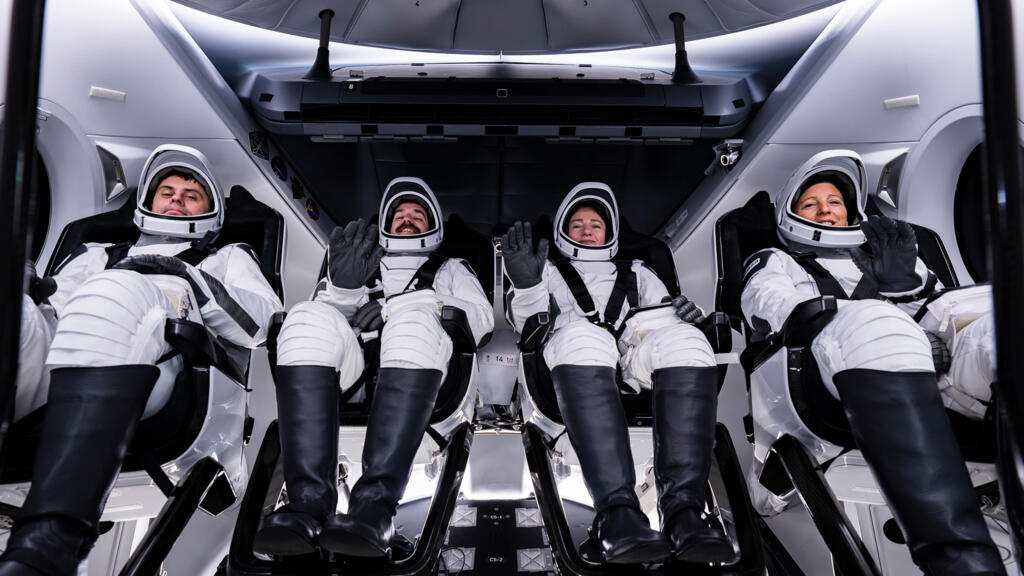
NASA’s SpaceX Crew-12 mission launched to the International Space Station on Friday, sending four astronauts, including France’s Sophie Adenot, to replace a crew evacuated early because of a medical issue.
The US space agency NASA launched the Crew-12 mission aboard a SpaceX Falcon 9 rocket at 5:15am EST from Cape Canaveral Space Force Station in Florida.

The pre-dawn launch was delayed by two days because of adverse weather forecasts across the US East Coast, including high winds that could have complicated emergency manoeuvres.
The astronauts are expected to arrive at the orbiting ISS at about 3:15 pm on Saturday. They will spend nine months there.
Crew-12 is composed of Americans Jessica Meir, the mission commander, and Jack Hathaway, the pilot, along with French astronaut Sophie Adenot and Russian cosmonaut Andrey Fedyaev, a mission specialist.
They will replace Crew-11, which returned to Earth in January one month earlier than planned in the first medical evacuation in the space station’s history.
The ISS, a scientific laboratory orbiting 400 kilometres above Earth, has since been staffed by a skeleton crew of three.
NASA declined to disclose details about the health issue that cut the mission short.
All systems are go as France zeros in on space ambitions
'One day that will be me'
Once the astronauts arrive, they will be among the last crews to live aboard the football field-sized space station.
Continuously inhabited for the last quarter century, the ageing ISS is scheduled to be pushed into Earth’s orbit before crashing into an isolated area of the Pacific Ocean in 2030.
Adenot, an astronaut at the European Space Agency, will become the second French woman to fly to space, following in the footsteps of Claudie Haignere, who spent time on the Mir space station.
France's second woman in space prepares for launch after 30-year wait
When Adenot saw Haigneré’s mission launch, she was 14 years old.
“It was a revelation,” the helicopter pilot said during a recent briefing. “At that moment, I told myself: one day, that will be me.”
Adenot will carry out more than 200 scientific and medical experiments in microgravity while completing intensive training and maintenance work in space.
Among other research, she will test a system that uses artificial intelligence and augmented reality to allow astronauts to carry out their own medical ultrasounds.
(with newswires)