Get all your news in one place.
100’s of premium titles.
One app.
Start reading
Radio France Internationale
National
RFI

France backs Gulf states as Iran launches fresh wave of missile strikes

France's Foreign Affairs Minister Jean-Noël Barrot gives a press conference after a crisis meeting in Paris on 2 March 2026. AFP - THIBAULT CAMUS

France has said it is "ready to help" defend Gulf nations and Jordan against Iran, signalling a firm commitment to regional allies as tensions spiral following a wave of missile and drone attacks.

French Foreign Minister Jean-Noël Barrot said on Monday that Paris stood in full solidarity with countries caught up in a conflict they "did not choose", after Iran launched strikes across the Gulf in retaliation for US–Israeli attacks over the weekend.
Those earlier strikes reportedly killed Iran’s supreme leader, Ayatollah Ali Khamenei, marking a dramatic escalation that has sent shockwaves through the region and beyond.

Western powers signal support for US as war spreads after strikes on Iran

A broad show of support

Addressing the situation, Barrot stressed France’s backing for a wide group of partners – including Saudi Arabia, the United Arab Emirates, Qatar, Iraq, Bahrain, Kuwait, Oman and Jordan – all of which have faced Iranian strikes.

He said France was prepared to act under existing defence agreements and the principle of collective self-defence recognised in international law.

Barrot added that Israeli and US "unilateral" attacks in ​Iran ‌should have ⁠been debated in bodies that uphold international law, such as the ​United Nations.

"Everyone could have ‌taken their responsibilities, because it is only by ‌going before the (UN) ​Security Council that the use of force can acquire ​the necessary legitimacy," Barrot ​told reporters.

French President Emmanuel Macron has spoken with Iraqi President Abdul Latif Rashid and expressed support for Iran’s effort to avoid the conflict, Barrot said.

The minister also highlighted the significant French presence in the region, noting that around 400,000 French citizens are either living in or visiting Gulf countries – a factor that adds urgency to Paris’s response.

France is not alone in signalling readiness. Alongside Germany and the United Kingdom, it issued a joint statement on Sunday warning that Iranian actions posed a direct threat to allied nations, as well as to military personnel and civilians stationed across the Gulf.

The three countries said they were prepared to take "necessary and proportionate" defensive measures – potentially including action aimed at disabling Iran’s ability to launch further missile and drone attacks.

France's Macron insists on diplomacy to solve conflict in Iran and Middle East

Strikes ripple across the Gulf

Despite international warnings, the situation on the ground remains volatile. Fresh strikes were reported across several Gulf cities on Monday, including Dubai, Doha and Manama, fuelling concerns that the conflict could widen further.

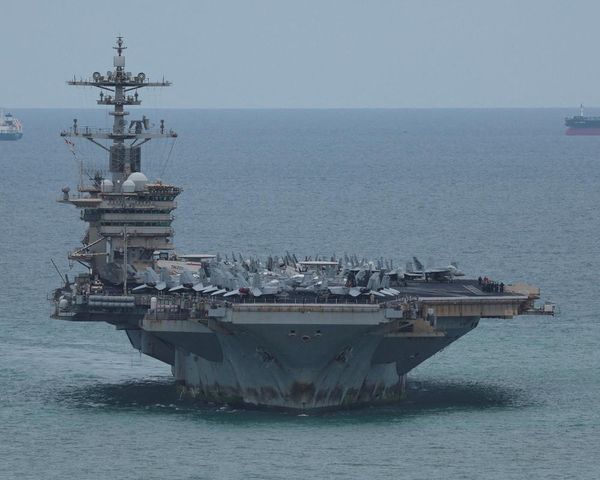
Iran’s military said it had deployed 15 cruise missiles, targeting a US air base in Kuwait as well as vessels in the Indian Ocean. The attacks form part of what Tehran has framed as retaliation against US forces in the region.

The rapid succession of strikes – and the number of countries affected – highlights how quickly the conflict has expanded beyond its initial flashpoints. Yet, despite the escalation, European powers are presenting a united front, emphasising defence, deterrence and support for regional stability.

(with newswires)

Sign up to read this article
Read news from 100’s of titles, curated specifically for you.
Already a member? Sign in here
Related Stories
Top stories on inkl right now
Our Picks
Fourteen days free
Download the app
One app. One membership.
100+ trusted global sources.