
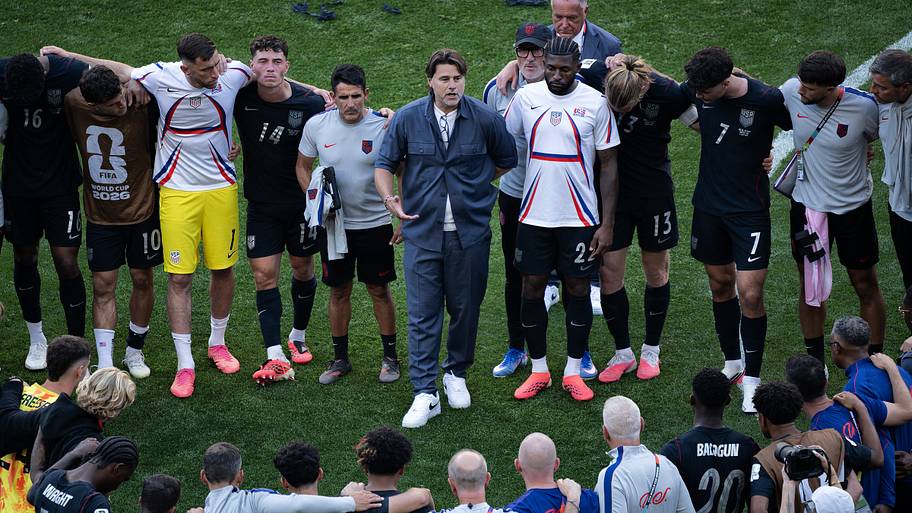
The U.S. men’s national team will long to forget Monday night.
The 2026 World Cup cohost was utterly humiliated in the round of 16, falling to Belgium 4–1 in Seattle for a rude awakening, as if its dreamy tournament run had truly been nothing more than a dream itself.
The only bright spot of the evening was a free kick goal taken by midfielder Malik Tillman in the 31st minute, but even Belgium spoiled that fun just 61 seconds later with a goal of its own.
The Americans will head to the couch, pondering how such a fantastic start could have such a dismal end. Meanwhile, the Belgians charge forth, clashing with a ferocious Spanish side on Friday in Los Angeles.
Here’s four takeaways from the lopsided defeat.
Afraid and Caught Off Guard
When Belgium opened the game’s scoring in just the ninth minute of play, it wasn’t a surprise. In fact, it had already felt long overdue.
From the kickoff, the European heavyweight was jumping down the Americans’ throats. It had its first big opportunity just 30 seconds in, requiring the pure heroics of USMNT goalkeeper Matt Freese, who made arguably the greatest save of his international career to date.
The Belgians then barraged Freese with four more shots before they finally broke through, as striker Charles De Ketelaere poked the ball into the net off of a driven ball across the box. It marked the first time that the U.S. had conceded first this World Cup.
Belgium continued to sustain pressure in the final third; the U.S. couldn’t even take hold of the ball long enough to put together a meaningful sequence. In just 15 minutes, the visitors had taken eight shots to the hosts’ zero, threatening a long and grueling night in Seattle.
Mauricio Pochettino’s men were timid, discombobulated and reactive. They were second to every ball, especially in their own defensive box. The Belgians set a tempo that they simply couldn’t match, let alone exceed.
WIN FIFA WORLD CUP 2026™ FINAL TICKETS & OTHER PRIZES
The USMNT was starkly different from who it had been all summer up until this point. The cohosts had defined themselves by their aggressive front-footedness, clinical organization and ability to get out in front of opponents early. In fact, the U.S. entered the match as the tournament’s highest scoring nation (8) in the first half, including goals within the first 11 minutes in three of the four previous tournament matches.
There was no semblance of that swagger for the USMNT on Monday, though, especially in the first half. In fact, it looked more like its former self—the scared prey of a European predator—that was thumped 5–2 by Belgium four months ago in an international friendly.
Sure, this was the first real challenge of the tournament for the USMNT, but many believed the U.S. was no longer that scared side from March. That it would enter with the confidence and poise that had defined it all summer long.
Perhaps this performance against Belgium was inevitable. Perhaps the U.S. never should have expected to match the level of a top-10 global power.
Defensive Disaster
Veteran captain Tim Ream had been strong throughout the summer beside fellow center back Chris Richards; however, Monday night was when his clock ran out. The 38-year-old was a step too slow in the box, especially on Belgium’s first goal, when he was caught ball-watching. He completely forgot about his mark, De Ketelaere, who easily struck the ball just yards away from the goal mouth with no pressure on him whatsoever.
On De Ketelaere’s second goal in the 33rd minute, Ream simply couldn’t handle the 25-year-old’s physical strength. The Belgian striker easily outmuscled the aging center back to head the ball into the net off of another cross.
Ream isn’t the only one to blame defensively, though. The entire USMNT came up short in that department, and it started with carelessness. The players did not properly communicate their marks, and they struggled to clear the ball out of the box. Two of Belgium’s four goals came off of improperly-cleared balls.
Freese made a disastrous defensive error that he won’t be quick to forget, as it led to Belgium’s third of the night and cemented the loss. He rightfully come out of his box to take control of a bouncing ball; however, as De Ketelaere ran at him, Freese hesitated for a moment, allowing De Ketelaere to dispossess him and poke the ball to teammate Hans Vanaken, who punished the U.S. with a blasted ball into the net in the 57th minute.
Richards later capped off the atrocious night by playing the ball right into the feet of Vanaken. The ball then ricocheted to veteran star Romelu Lukaku, who buried Belgian’s fourth in stoppage time and solidified an utterly embarrassing affair.
Difference-Makers Prove Utterly Indifferent
The nail in the coffin, though, was perhaps when U.S. Soccer poster player—the almighty “Captain America”—Christian Pulisic went to strike the ball in the 54th minute, yet instead struck the leg of his Belgian opponent. The clumsy incident caused Pulisic a great deal of foot pain, and he needed to be substituted off of the pitch just minutes later.
Pulisic was shown with his head in his hands for much of the remainder of the match. The USMNT needed its talisman to step up and be the difference-maker, and he failed the task. Even before his premature exit, the star winger struggled to generate anything offensively. He had just one touch in Belgium’s box and didn’t get a single shot off.
Similarly, emerging star Folarin Balogun had a forgettable night up top. The striker was expected to do big things on Monday night, especially after the chaotic scandal that allowed him to miraculously take the pitch in the round of 16 in the first place.
Much of Balogun’s poor performance can be attested to the lack of possession and attacking buildup that the U.S. had as a whole; however, the 25-year-old is known for capitalizing on even the narrowest of chances, which he failed to do in Seattle. He had just three shots all night, only one of which was on target.
World Cup Success or Failure for the USMNT?
Prior to the start of the World Cup, perhaps advancement to the round of 16 would have been considered simply adequate. After all, it has become the USMNT’s most common finish at soccer’s most prestigious competition.
Yet the Americans showed a side of themselves this summer that was more tenacious, talented and capable than ever before. They made history in the group stage, with consecutive dominant victories to earn the Group D crown with a match to spare, before dismantling a gritty Bosnia and Herzegovina side 2–0 in the round of 32 to achieve its first knockout stage win in over 20 years. Pochettino’s side just seemed ... different, firing on all cylinders and poised to make a deep run this summer. All of a sudden, Pochettino’s claims of a semifinal finish didn’t seem so outlandish.
Monday’s loss was a rude awakening, not only because it crushed those very real World Cup dreams, but also because it gave flashbacks to a past version of the U.S., one that simply didn’t have the skill set to compete with the globe’s best.
It was a disheartening loss precisely because of how much it went against everything the USMNT embodied this summer and everything the team had already achieved. It will leave the sting of failure for a long time to come.