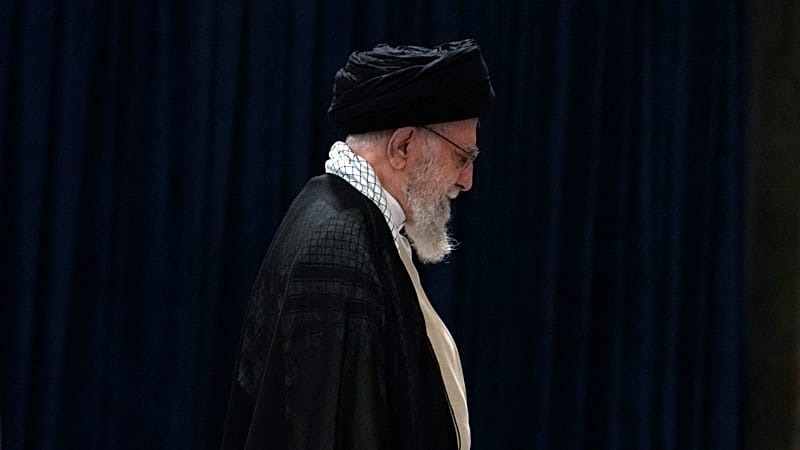
Ali Khamenei was one of the few world leaders who made no trips abroad during his leadership and never gave an interview to any media as supreme leader, whether domestic or foreign. Critics say he considered himself beyond accountability.
He was at the apex of power from the beginning of the revolution and eventually took the helm of guiding the country for years after the death of Ruhollah Khomeini, the founder of the Islamic Republic of Iran.
Khamenei had the final say in foreign policy and his hostility to the United States made it impossible for any Iranian official to imagine a resumption of political relations between Tehran and Washington.
Khamenei: from humble beginnings to the political stage
Sayyid Ali Khamenei was born on 19 April 1939 in Mashhad. His father, Sayyid Javad, was born in Najaf but moved to Tabriz with his family as a child. There, he studied theology until completing the "Sath" level, then migrated to Mashhad. He passed away from a heart attack in July 1986.
His mother, Khadija Mirdamadi, passed away on 15 August 1989, approximately two months after her son officially became the leader of Iran.
Ali Khamenei was the second child in the family. He has three brothers, Mohammad, Hadi, and Hassan, and a sister, Badri, who was married to Sheikh Ali Tehrani.
The second leader of the Islamic Republic began his religious studies in Mashhad and studied briefly at the seminary in Najaf in 1957. However, he returned to Mashhad less than a year later and moved to the Qom Seminary shortly thereafter. During those years, he was a student of Hossein-Ali Montazeri, a professor who, decades later, was placed under house arrest at the behest of his former student.
It was during this period that he became interested in political affairs. In 1962, following the controversy over the Provincial and District Councils Bill and the Shah's "White Revolution" referendum, Ali Khamenei was commissioned by Ayatollah Milani to deliver reports on public opinion in Mashhad to Ruhollah Khomeini in Qom. This marked the first political contact between Ali Khamenei and Ruhollah Khomeini.
This connection grew stronger by the day, and in 1963, on the eve of Ashura, Ruhollah Khomeini gave him a mission to deliver messages to Ayatollah Milani in Mashhad.
It was around this time that Ali Khamenei was first arrested. Just three days before the arrest of Ruhollah Khomeini on June 5, 1963, he was detained by the 'Shahrbani' (state police) while in Birjand.
Following the events of 5 June, he was transferred to Mashhad, where he spent 10 days in detention before being released.
He was repeatedly detained before the Revolution's victory. Nevertheless, his anti-government activities continued. He was later exiled to Jiroft and Iranshahr, where he remained until July 1978.
A month before the Revolution, on January 12, 1979, he was appointed by Ruhollah Khomeini to the Revolutionary Council. Other prominent members included Akbar Hashemi Rafsanjani, Mohammad Beheshti, Morteza Motahari, Mohammad Javad Bahonar, and Abdolkarim Mousavi Ardabili.
This membership marked the beginning of Ali Khamenei's influential role in the government, which was established a month later.
Fall of the Shah and the rise of Khamenei
After the fall of the Shah's government, the Revolutionary Council assumed the role of law-making in the country's new political system.
The council was later merged into the interim government, but after the abdication of Mehdi Bazargan, the interim prime minister assumed de facto control of the country. Finally, the Revolutionary Council ended its work after the formation of the First Assembly.
But this was just the beginning of Khamenei's ascent in the arena of power. He was initially appointed deputy to the Ministry of Defence during Mehdi Chamran's tenure as minister, and at the same time, he headed the Guards.
Khamenei made his way to Parliament in the first elections to the Islamic State Assembly as a representative from a Tehran constituency.
But perhaps one of his most important roles in the Islamic Republic's power ring was his appointment as Tehran's Friday imam by Ruhollah Khomeini. From January 1958 until the end of his leadership period, he remained Imam Juma of Tehran, and during this period, he held Friday prayers nearly 250 times. Although during his leadership period, he rarely appeared at Friday prayers.

Young Khamenei survives bomb attacks
Ali Khamenei was targeted twice.
The first attempt occurred on June 27, 1981, exactly one day before the bombing of the Islamic Republic Party headquarters and a week after Abolhassan Banisadr was dismissed from the Presidency.
While he was delivering a speech at the Abu Zar Mosque in Tehran, a massive explosion rocked the site. Khamenei was critically injured and rushed to the hospital.
The bombing was attributed to the Forqan Group. The device was concealed inside a tape recorder placed on the podium to his left, near his heart. However, moments before the blast, his bodyguard moved the recorder to the right side. Although Khamenei survived, his right hand was permanently disabled.
The second attack took place on March 15, 1985, while Khamenei was leading Friday prayers at Tehran University. It was carried out by the MEK.
The bomb was hidden among the worshippers, near the prayer mats, and did not injure Khamenei personally. However, approximately 14 people were killed, and 84 others were wounded. Despite the chaos, he continued his sermon and did not leave the podium.

Khamenei in the presidency
Shortly after the assassination of President Mohammad-Ali Rajai on 30 August 1981, the Islamic Republic Party, which had become the most powerful political institution, backed Ali Khamenei’s candidacy for the presidency.
Although it is said that Ruhollah Khomeini initially opposed having a cleric in the office of the presidency, he eventually deferred to the party's decision.
The elections were held on 2 October 1981, and Khamenei was elected with over 95% of the vote, becoming Iran’s third president.
Despite his landslide victory, Khamenei’s relationship with the Parliament was strained. After taking the oath of office, he introduced Ali Akbar Velayati as his choice for Prime Minister. However, the Parliament rejected the nomination. Consequently, he was forced to introduce Mir-Hossein Mousavi, who was favoured by the MPs, and was confirmed as Prime Minister.
The friction between Khamenei and Mousavi eventually led Khamenei to decide to run for re-election against him in 1985. However, Khomeini characterised his candidacy as a "religious duty," prompting him to run for a second term.

Some reports suggest that he made his candidacy conditional on the freedom to choose his own prime minister. However, after the election, Khomeini did not deem a change of prime minister "expedient" and urged Khamenei to retain Mir-Hossein Mousavi in his post.
Khamenei viewed Mousavi as an "imposed" prime minister who relied on Khomeini's unwavering support. The deep-seated discord between the two dates back to this period.
Khamenei served as Iran's president for a total of eight years, marked by constant crises, ranging from political infighting among revolutionary factions to daily assassinations by opposition groups and, most significantly, the Iran-Iraq War.
On the path to leadership
The dismissal of Hossein-Ali Montazeri from the position of successor-leader, along with internal government disputes between the President and the Prime Minister, and between Parliament and the Guardian Council, as well as other legislative gaps, prompted Ruhollah Khomeini to appoint a 20-member committee on 24 April 1989, to revise the constitution. Ali Khamenei was among those appointed.
The council, in which Khamenei served as the first vice-chairman, introduced several amendments, the most significant of which concerned leadership qualifications. Notably, the requirement for the leader to be a 'Marja-e Taqlid' (Grand Ayatollah, the highest level of religious scholarship), as stipulated in the first constitution, was removed.
Another crucial change was the elimination of the 'Leadership Council' from Article 5 of the revised constitution. This paved the way for the leadership of Ali Khamenei, who was not a Marja-e Taqlid at the time.

53 days to permanent leadership
On 4 June 1989, shortly after the end of the war and before the new constitutional draft was put to a referendum, Ruhollah Khomeini passed away. The Assembly of Experts convened immediately and elected Ali Khamenei as leader that same day.
The first proposal, which met the Marja'iyya (religious authority) requirement, was Ayatollah Safi-Golpaygani, but it was rejected by the members.
The second option was a Leadership Council comprising Mousavi-Ardabili, Ali Meshkini, and Ali Khamenei, but it also failed to garner the necessary votes.
Eventually, Akbar Hashemi Rafsanjani, who chaired the session, took the initiative. Citing a memory of Ruhollah Khomeini, he presented Ali Khamenei as the preferred successor.
"In a meeting with the heads of the three branches, we expressed our concern to the Imam about a leadership vacuum following Mr Montazeri’s dismissal. The Imam replied, 'There is no vacuum; you have people.' When we asked who, he pointed to Mr Khamenei," he recounted.
Rafsanjani’s efforts shifted the consensus toward the incumbent president. Despite Khamenei’s own expressed reluctance, over 80% of the members voted in favour of his "interim leadership." This interim status was necessary because the constitutional amendments removing the requirement of Marja'iyya (collective religious authority held by the highest-ranking Shia clerics) had not yet been put to a plebiscite.
The new constitution was approved in a referendum on 28 July 1989, removing the legal obstacles to his permanent leadership. Less than ten days later, the Assembly of Experts reconvened and officially elected Ali Khamenei as the second 'Supreme Leader of Iran.'
Throughout over three decades of leadership, Ali Khamenei shifted the balance of power by gradually centralising authority. Consequently, elected bodies like the government and Parliament, even those with high popular mandates, lost much of their decision-making influence, as the core of power moved toward a limited, unelected inner circle.
The widening gap: state vs. society
At the same time, security and military institutions, particularly the IRGC, gained an increasing presence in politics, the economy, and the media. According to critics, this trend both undermined healthy economic competition and made the country's political atmosphere more securitised and closed.
Having experienced a reformist government, Khamenei virtually blocked the path to political reform from within the system. The crackdown on the Green Movement, the narrowing of electoral competition, and the marginalisation of moderate figures conveyed the message to society that peaceful change was no longer possible.
The result of this approach was a decline in political participation, the accumulation of social discontent, and the further radicalisation of protests in subsequent years, protests that no longer sought reform but demanded fundamental change.
In the realm of foreign policy, a continued emphasis on a confrontational approach and the slogan of "resistance" imposed high costs on the country without a concrete exit strategy.
Persistent tensions with the U.S. and the West exposed Iran to extensive and eroding sanctions, the consequences of which directly impacted the economy and people's daily lives.
Alongside these, the growing gap between the state and society, particularly among the younger generations, became another legacy of Khamenei's leadership, a generation whose cultural, social, and economic demands were often ignored and met with the language of national security.