Get all your news in one place.
100's of premium titles.
One app.
Start reading
We Got This Covered
We Got This Covered
Sadik Hossain

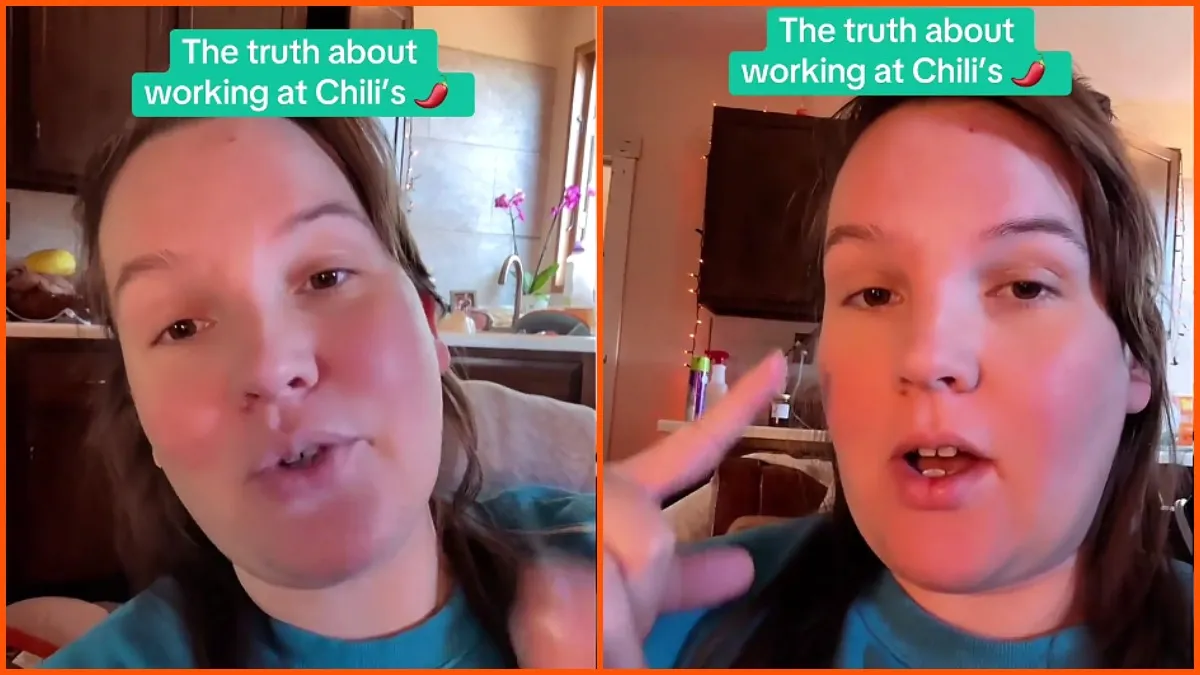
Former Chili’s server says everything you touch at Chili’s is frozen. Then exposes the one policy that made her quit for good: ‘one hour ticket times’

A TikTok user who goes by @rachaelontheprairie said in a video that she worked at Chili’s on and off for several years across multiple states, mostly as a student or for extra income alongside a full-time job. Rachael, the creator, said her time there ranged from what she described as a favorite job to an experience so bad she vowed never to work at another Chili’s location again.

Rachael said in the video that nearly everything served at Chili’s starts out frozen. She said the queso and soups arrive in bags and are thawed using a large hot water tank, which she called a “hot super warmer.” According to her, if the restaurant runs out of queso or soup, it can take about an hour to thaw more, which she said causes delays.
She said the only items actually made in-house were the pico de gallo, salsa at some locations, and the ranch and honey mustard, since those required fresh ingredients.

Server says tip-out structure changed significantly over the years

Rachael said that when she started working at Chili’s around 2012, servers only had to tip out 1% to the bartender because those locations reportedly did not have bussers or dedicated food runners. She said a “QA person” sometimes ran food instead. She said this has “changed a lot in the last few years.”

@rachaelontheprairie

Ziosks, tip out, and bad management. #chilis #restaurant #server

♬ original sound – rachaelontheprairie

She said that at Chili’s locations now using tableside iPads, servers are required to tip out not just the bartender but also food runners and bussers, based on a percentage of total tips. She gave an example: if two customers order the “3 for $10” deal and each tips 20%, the server would earn about $4 total, but would be left with only about $1 after tip-out.

Rachael described a Florida location where, during lunch shifts, a manager allegedly did not schedule a dishwasher or food runner. She said this meant she and one other employee had to seat guests, manage an 18-table section, wash dishes, and run food all at once, calling it a “constant circle” of tasks.

By contrast, she said she worked at what she called one of the top-rated Chili’s locations in Oklahoma, where she said rules were strict and the restaurant was “managed very well.” She said the food was good, even though she considered it “basically fast food.”

Her worst experience, she said, was at a Missouri location. She said, “The food came out a minimum of one hour ticket times, and food was constantly getting comped. People were constantly not paying their ticket.” She said this was surprising to her since most menu items are fried or grilled. She said managers and cooks at that location could not get food out any faster, which she said led to frequent arguments in the restaurant.

Rachael said she once picked up a Mother’s Day shift at the Missouri location, expecting to make good money. Instead, she said families came in but did not tip, partly because dinner reportedly took one to two hours to reach tables. She said servers could only offer so many free chip, salsa, and drink refills before customers grew upset. She described the shift and the location overall as “absolutely deplorable” to work at, citing what she called “terrible, terrible management and badly cooked food.”

She said that in several states, she was paid the standard tipped minimum wage of $2.13 an hour, and said she sometimes left a 14-to-18-hour double shift with only about $60. She called this “absolutely disgusting” given the length of the shifts. She also acknowledged that tipping culture has expanded to more service settings recently, which she said has made some customers less willing to tip at all.

Rachael also said Chili’s uses customer satisfaction surveys to grade servers, cooks, and hosts on their performance. She said that if problems occur in the kitchen, servers can still be penalized through their schedules, sometimes losing shifts as a result. She said employees with lower survey scores are treated as “low priority” when trying to pick up or swap shifts until their numbers improve. She claimed the same survey-based scheduling system is also used at Olive Garden, though she did not elaborate further on that comparison.

According to Rachael, Chili’s has increasingly prioritized survey scores in recent years, to the point where she said they are now “the only thing that matters” for servers, hosts, to-go staff, and cooks trying to secure shifts.

She said Chili’s used to be one of her favorite places to work, and noted it was her first waitressing job when she turned 18. However, she said her experience at the Missouri location changed her outlook permanently, stating she would “never work at another Chili’s ever again.”

The video’s comments section drew reactions from other current and former restaurant workers, along with some clarifications from Rachael herself. A commenter wrote, “I currently work at chilis and my tip out is 6.5% of my sales. So if you come in and have a $100 bill and tip $0, I pay $6.50 for that table at the end of the day.” Rachael replied, “Omg 6.5% now?? That’s insane. Last I worked there in 2023 I think it was 3 or 4%. Wow.”

Another user commented, “i work at ihop and we only tip 1% of my sales on weekends if we have a food runner, most of the time we don’t. i’m very greatful for that.” Amanda responded, “Sometimes I wish I was working at a place like that but we have food and drink runners we pretty much just stand and put in orders on the iPad I feel I’m able to flip more tables faster so it’s more money at the end of the day.”

Some commenters raised questions about tip-out math discussed in the video. A user wrote, “Your math isn’t matching. 1% of $10 is .10¢, so a $2 tip on a $10 tab would leave you with $1.90.” Rachael responded, “With the extra iPad employees it was 4% total but when I worked in Missouri people didn’t tip at all or if they did they would leave round up change. There were many times I had to pay out of pocket to compensate the tip out.”

Sign up to read this article
Read news from 100's of titles, curated specifically for you.
Already a member? Sign in here
Related Stories
Top stories on inkl right now
One subscription that gives you access to news from hundreds of sites
Already a member? Sign in here
Our Picks
Fourteen days free
Download the app
One app. One membership.
100+ trusted global sources.