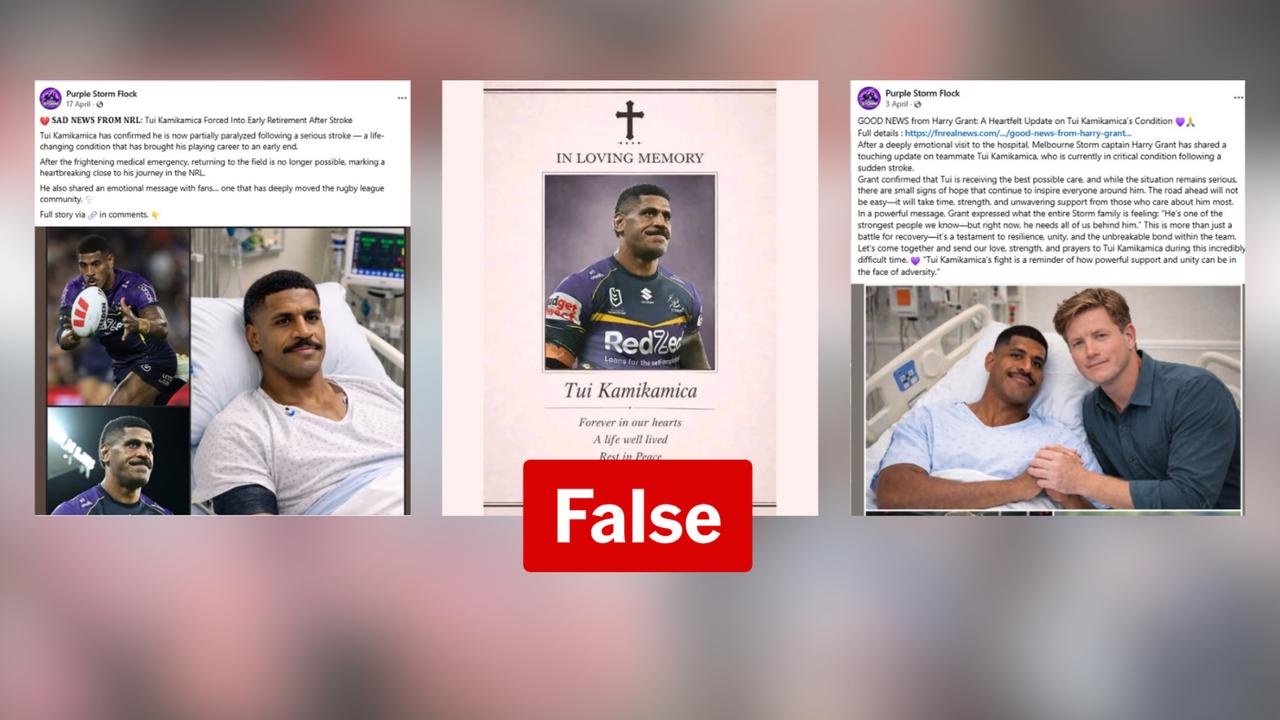
Hear about the NRL star who dropped dead? Or the Richmond players who refused to wear an AFL rainbow armband?
What about the Brownlow medallist involved in a stoush with Foreign Affairs Minister Penny Wong on live TV?

If you're a footy fan who follows your code on Facebook, you may be among the millions who have read these and other alarming posts only to discover they're fictitious.
AAP FactCheck staff have found dozens of supposed NRL and AFL fan pages, largely run from Vietnam, pumping out disinformation designed to generate clicks and profits.
Some such as Storm City Rugby Fans (Melbourne Storm), Rooster Pride Hub (Sydney Roosters) and Lions Fanclub (Brisbane Lions) churn out AI-generated content daily.
The posts typically focus on high-profile players and coaches, placing them at the centre of fabricated tragedies, feel-good moments or polarising debates, particularly around LGBTQI issues.
Numerous of them, for example, claim NRL figures James Tedesco, Payne Haas and Craig Bellamy along with AFL players Marcus Bontempelli, Bailey Smith and Josh Weddle have refused to participate in diversity awareness campaigns.
Sydney Swans favourite Isaac Heeney has supposedly clashed with a transgender athlete, while former Brisbane Lions captain Lachie Neale has allegedly testified in court against the so-called ISIS brides.
Melbourne Demons coach Steven King has meanwhile been accused of calling for LGBTQI fans to be banned from the MCG.
Mystery illnesses are another popular storyline.
Swans key forward Charlie Curnow, Tigers coach Damien Hardwick and Penrith Panthers hooker Mitch Kenny have all been struck down.
None of it is true. But who is behind it and why are they doing it?
University of Queensland online disinformation expert Anne Kruger says the choice of subject matter is a very deliberate ploy by bad actors.
"We align with our clubs, our different sports teams and the highs and lows of the players and their journeys," she says.
"Indeed the regular schedule of wins and losses and injuries is enough to make grown adults cry.
"This is a perfect way to get the attention of a wide range of people, with posts prompting users to click on links to external websites laden with adverts."
Social media algorithms worsen the problem because highly controversial posts are more likely to be amplified and pushed into users' feeds, Dr Kruger adds.
Little is known about the operators behind the pages, although Facebook transparency data reveals most are run by users in Vietnam.
Accounts in the Philippines, Bangladesh and Russia have also been linked to the pages.
Artificial intelligence appears to be supercharging the operation.
It allows overseas actors with little or no knowledge of local issues to identify and exploit emotionally charged topics, while also being used to generate increasingly convincing fake images.
These include one depicting Brisbane Broncos fans performing a Nazi salute and another showing Collingwood star Nick Daicos collapsed in the sheds.
The operation would not be possible without AI, according to AAP FactCheck Editor Ben James.
"These operators in Vietnam likely know very little about the players, teams or local issues they are posting about," he says.
"Just a few years ago, this would have been impossible to pull off.
"Today, AI allows them to identify emotionally charged topics and quickly produce convincing content tailored to Australian footy fans."
It also lets them operate at an enormous scale, James adds.
"Social media is being inundated with these fabricated posts and many fans are struggling to tell fact from fiction."
The impact of the disinformation is not confined to social media, as staff at Sydney's Redfern All Blacks Indigenous rugby league club, discovered.
Ex-player Nathan Merritt, who also turned out 195 times for the South Sydney Rabbitohs, revealed a terminal cancer diagnosis in March.
Days later calls and messages pinged between club staff, president Keith Munro told FactCheck.
Friends and former teammates had discovered a supposed family statement on Facebook, confirming his death.
It was nothing other than a product of the disinformation operation.
A similar scenario emerged in the days after Storm player Tui Kamikamica was hospitalised for a suspected stroke.
"The Melbourne Storm are deeply saddened to announce that player Tui Kamikamica has passed away after receiving treatment in hospital following a medical emergency," one viral post falsely claimed.
The club says players and staff came across and shared several of the disinformation posts, adding that the content was particularly disturbing.
Kamikamica spoke to AAP in late April about his surgery and recovery and has since received a medical clearance to resume his playing career this season.
Both the NRL and AFL say they are aware of the pages and working with Meta to have them removed.
Ron Issko, president of the AFL Fans Association, is more direct.
"You're not welcome, you're a rat bag," he says of those responsible.
"If you're making up stories about coaches and players, you just don't belong in our footy community and hopefully the authorities will catch you and stop you."
Meta says it tackles misinformation via a range of measures, including its partnerships with third-party fact-checkers such as AAP FactCheck.
The company says it also targets inauthentic behaviour - efforts to mislead users about the popularity of content, the purpose of pages or who is behind them - through automated detection systems and manual enforcement.
Lifeline 13 11 14
beyondblue 1300 22 4636