Get all your news in one place.
100's of premium titles.
One app.
Start reading
Guitar World
Guitar World
Entertainment
Jamie Dickson

“For under $600 it does something quite special – it opens up a new sound-world”: Gretsch Electromatic CVT Baritone review

Gretsch Electromatic Baritone CVT.

What is it?

For a long time, Gretsch meant rock ’n’ roll in its ’50s leathers – twang on steroids. But lately the company has broadened its offer, and one of the main tools used to do that is its Electromatic range.


The name ‘Electromatic’ derives from the first electric guitars and amps the company ever sold, back in 1939. But the name was resurrected in 1998 for a range of affordable instruments that offered an easier entry point to the brand than its premium Japanese-built models.

Another useful thing about the Electromatic range, from Gretsch’s perspective, is its malleability. Gretsch offers Electromatics with P-90s and a variety of pickups that offer a more contemporary drive than the traditional Filter’Trons.

All this helps them get the attention of guitarists who wouldn’t normally reach for a Gretsch guitar, including the increasing number of players who use baritone electrics for girthy high-gain riffs and evocative, brooding cleans.

Indeed, Gretsch now offers two baritones in the Electromatic range – an Electromatic Jet Baritone with a 755.65mm (29.75”) scale length and this double-cut CVT Baritone with its more hand-friendly 685.8mm (27”) scale.

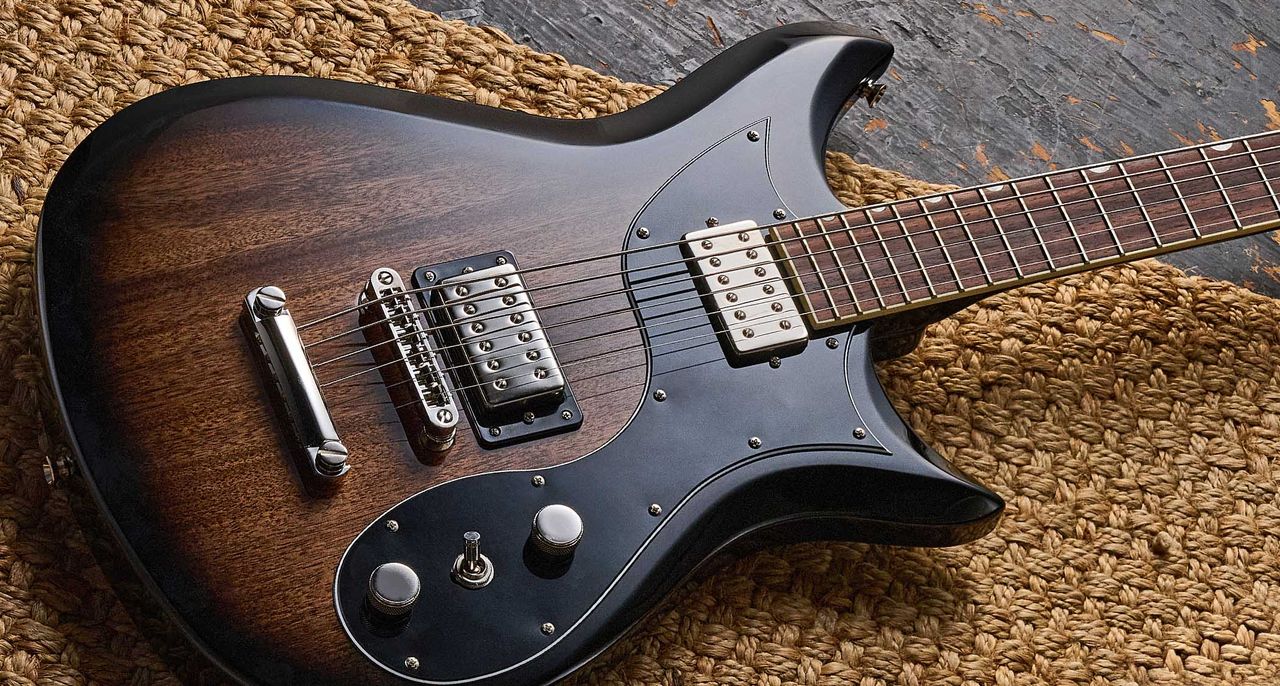
The engine room of this CVT Baritone is a pair of Sphera Twin Six humbuckers with 12 adjustable poles, evoking Gretsch’s famous Filter’Tron humbuckers. Built around a pair of Alnico 6 magnets, the idea behind the Twin Six is to ‘bridge the tonal gap between modern Alnico 5 clarity and vintage Alnico 2 warmth’.

Featuring a solid mahogany body with bevelled edges, our review guitar is finished in a smoky Bristol Fog sunburst – the only finish option available for this model.

The body appears to be three-piece, although the dark sunburst obscures some of the top, making it hard to confirm. The 22-fret neck is made of maple, though it’s covered by black gloss paint so we’ll have to take Gretsch’s word on that. The fretboard is bound rosewood.

(Image credit: Future/Lucy Robinson)

The CVT Baritone also sports a pair of Twin Six humbuckers – except these have Alnico 5 magnets and not Alnico 6, as found in the Premier Jet, so we might expect a more conventionally brightish, mid-forward sound here. It has a trick or two up its sleeve in terms of electronics, too.

There’s a treble bleed on the master volume so the sound doesn’t get muddy when you turn it down, plus it features a pull-push pot that engages a coil-split on the neck pickup. Meanwhile, the single tone control has a pull-push pot that operates a coil split for the bridge pickup.

Specs

(Image credit: Future/Lucy Robinson)
  • PRICE: $599 | £599 | €589
  • ORIGIN: China
  • TYPE: Double cutaway solidbody baritone electric
  • BODY: Solid mahogany
  • NECK: Maple with painted headstock, with Performance ‘C’ profile
  • SCALE LENGTH: 685.8mm (27”)
  • NUT/WIDTH: GraphTech NuBone/ 40mm
  • FINGERBOARD: Bound rosewood. 241.3mm (12”) radius.
  • FRETS: 22 nickel silver, medium jumbo
  • HARDWARE: Nickel-finish Adjusto-Matic bridge, three-ply black/white/black acrylic pickguard, knurled plain top metal knobs
  • TUNERS: Die-cast sealed
  • STRING SPACING, BRIDGE: 55mm
  • ELECTRICS: Two Twin Six humbuckers. Master volume with treble-bleed, push/pull for coil splitting neck pickup, master tone with push/pull for coil splitting bridge pickup. Treble bleed circuit.
  • WEIGHT (kg/lb): 3.8/8.4
  • LEFT-HANDERS: No
  • FINISH: Bristol Fog (as reviewed)
  • CONTACT: Gretsch

Build quality, usability and sounds

(Image credit: Future/Lucy Robinson)

The CVT Baritone’s world is brooding, low chords, and melodies with drama and grandeur.

You can’t play all your old, familiar clichés – there are no bluesy bends on the stiff strings of a baritone – so you have to ‘say something’ and take the melody somewhere. It feels like a guitar for writers, rather than noodlers, and it’s all the more satisfying for it.

(Image credit: Future/Lucy Robinson)

Reverb, delay and drive all pair powerfully with the CVT – though we found ourselves using the coil-splits more often than the full humbucker sounds for added clarity.

The action is comfortable and that shorter scale means it’s not a struggle to reach or fret notes. It’s a really intriguing and rather addictive experience, bridging the gap between bass and guitar.

Verdict

Verdict: ★★★★½

(Image credit: Future/Lucy Robinson)

Guitar World verdict: The Baritone is a truly intriguing proposition – for under $600 it does something quite special: it opens up a new sound-world, new paths of expression for the uninitiated. And it does so comfortably, effectively and affordably.

Hands-on videos

Guitarist

Gretsch

Sign up to read this article
Read news from 100's of titles, curated specifically for you.
Already a member? Sign in here
Related Stories
Top stories on inkl right now
One subscription that gives you access to news from hundreds of sites
Already a member? Sign in here
Our Picks
Fourteen days free
Download the app
One app. One membership.
100+ trusted global sources.