
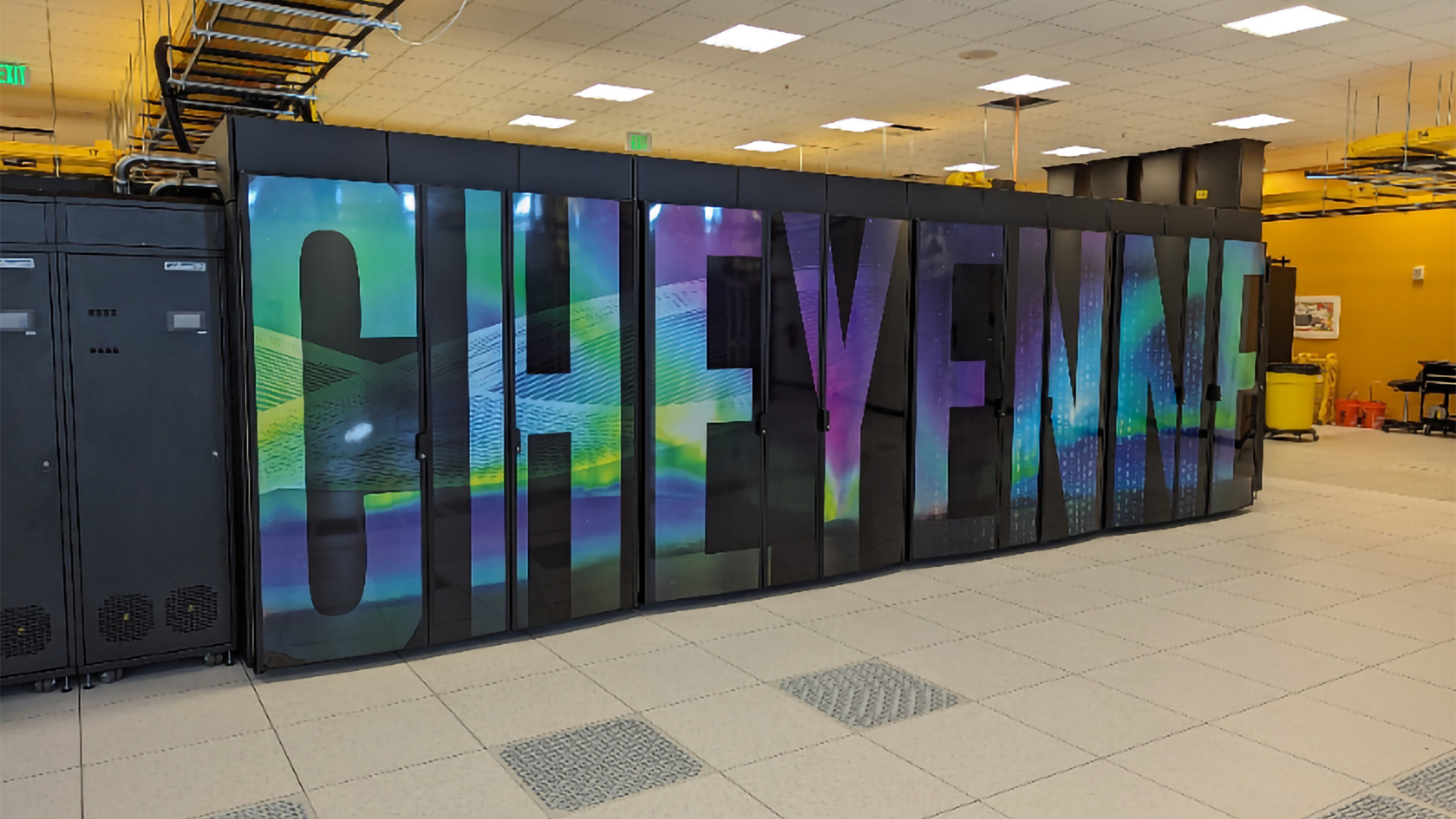
What was once the 21st most powerful supercomputer in the world is now available to the highest bidder — well, maybe, as the current bid of under $30,000 has not met the required amount. The U.S. General Services Administration opted to put the Cheyenne supercomputer, deployed in 2016, up for auction, in part due to ongoing repair and maintenance problems.
The retired supercomputer is, as the name suggests, a monster. It’s a 5.34 petaflops system, one of the last deployed by Silicon Graphics International after its acquisition by Hewlett-Packard. Since then, it's been a cornerstone of operations at the NCAR-Wyoming Supercomputing Center in Cheyenne, Wyoming.
The Cheyenne supercomputer is a water-controlled installation made up of SGI ICE XA modules with 28 racks holding 8,064 Intel E5-2697v4 CPUs. That totals 145,152 cores, for those keeping count. The main system is spread across 4,032 dual-socket nodes. Here are the specs of the primary components:
Each E-Cell weighs in at 1,500 pounds, and shipping is not included in the winning bid. The purchaser will need to hire a professional moving company to transport the supercomputer from the facility to its new home. The auction notes also state that the supercomputer will be sold as-is, and that it "is currently experiencing maintenance limitations due to faulty quick disconnects causing water spray." Not exactly the pinnacle of supercomputing achievements, then.
Beyond the above hardware, the supercomputer also includes two air-cooled management racks. These consist of 26 1U servers each, 20 of which have 128GB of memory and six with 256GB of memory. That's an additional 8TB of DRAM, if you're wondering. The management racks also include 10 Extreme Switches, and two Extreme Switch power units, and each rack weighs 2,500 pounds.
While the Cheyenne supercomputer has been in operation for the past seven years, the auction notes says the "expense and downtime associated with" fixing the current cooling problems makes it unworthy of continued maintenance. And of course, even though this was a lightning-fast supercomputer when it first launched, it would be considered sluggish by 2024 computing standards. This is a fate shared by many supercomputers, even some of NASA's most powerful ones.
Cheyenne peaked at number 21 on the Top500 list of the most powerful supercomputers back when it launched. Today, it sits at number 160 — based on an Rmax score of 4.79 petaflops. The paradigm shift to GPU-powered supercomputers over the past decade means that, as an example, you could potentially exceed that level of performance with around 23 Nvidia DGX H100 systems sporting 46 CPUs and 184 GPUs.














