Get all your news in one place.
100's of premium titles.
One app.
Start reading
The Times of India
The Times of India
World
TOI World Desk

For nearly 100 years, two giant dams trapped this American river. Then one historic decision brought it back to life

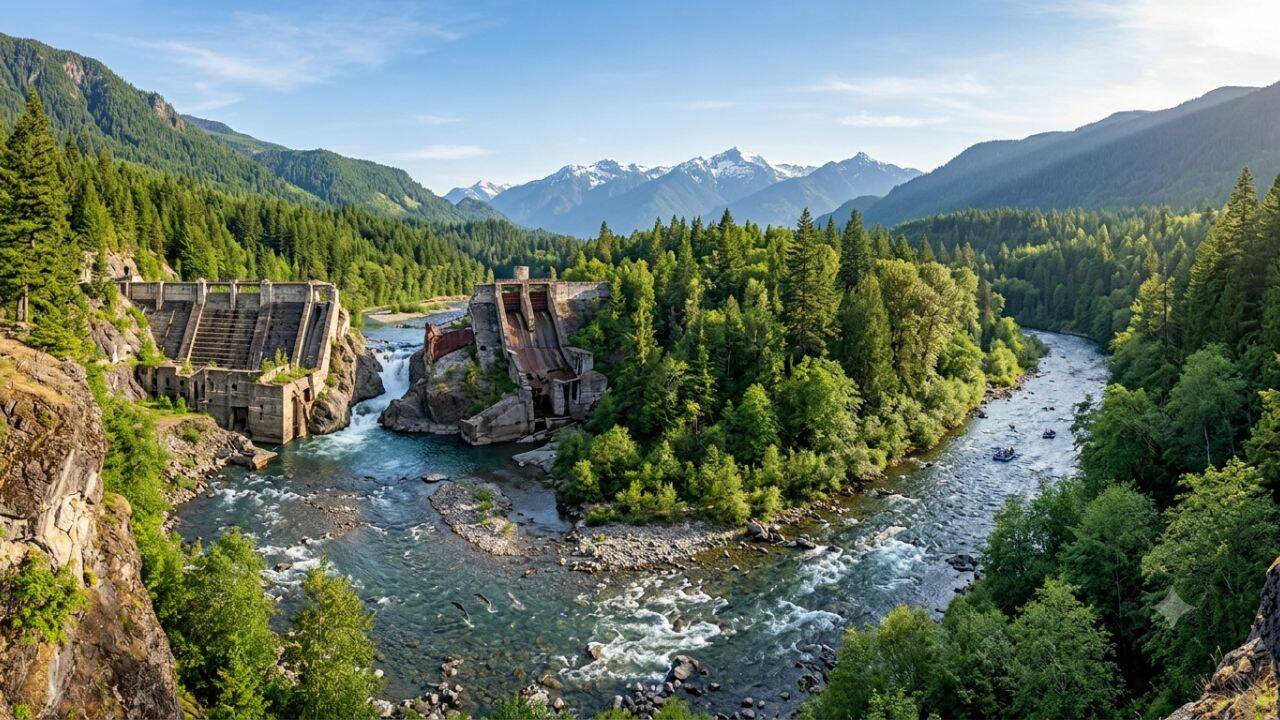
For much of the twentieth century, dams were widely viewed as symbols of progress. They generated electricity, supported industry and helped reshape landscapes to meet growing human demand. What received far less attention at the time was the lasting effect these structures had on rivers themselves. Fish migration was interrupted, sediment became trapped behind concrete walls and coastlines gradually lost the natural supply of sand and gravel that rivers had carried for centuries. Along Washington State's Elwha River, those changes remained in place for almost a hundred years. Then a decision was made to reverse them, beginning one of the largest ecological restoration projects ever attempted in the United States.

Get breaking news anytime, anywhere. Download the TOI app now!

How two dams transformed a river in the United States

The Elwha River runs for around 45 miles from the Olympic Mountains to the Strait of Juan de Fuca. Before dams appeared on the river, it supported one of the Pacific Northwest's richest salmon systems. The river was also central to the Lower Elwha Klallam Tribe, whose communities depended on salmon, shellfish and other natural resources for food, livelihoods and cultural traditions.

As timber production expanded across the Olympic Peninsula during the early 1900s, demand for electricity increased alongside it. As reported by National Geographic, the first major barrier, the Elwha Dam, entered service in 1914 near the river's lower reaches. A second and taller structure, the Glines Canyon Dam, followed in 1927 farther upstream. Together they supplied electricity that helped drive regional development for decades.

The benefits, however, came with lasting environmental consequences. Salmon could no longer reach large stretches of their historic spawning grounds, cutting off access to roughly 75 miles of upstream habitat. Sediment that would naturally have travelled downstream instead accumulated inside the reservoirs, slowly changing the river channel and reducing the material that once replenished nearby beaches and estuaries.

Why the dams eventually became a problem

By the second half of the twentieth century, the role of the dams had changed. The Olympic Peninsula had become connected to a wider electricity network, leaving the Elwha dams responsible for only a small share of local power generation. At the same time, concern over declining salmon populations continued to grow.

Reportedly, legal developments also shifted the discussion. After gaining federal recognition in 1968, the Lower Elwha Klallam Tribe became increasingly active in protecting treaty fishing rights. A 1979 United States Supreme Court ruling confirmed that Washington tribes were entitled to half of the state's salmon harvest, strengthening efforts to restore damaged fisheries.

During the 1980s, tribal leaders joined environmental organisations in arguing that the ageing dams caused more harm than benefit. Their campaign eventually led Congress to authorise the federal purchase of both dams in 1992 while studies examined whether complete removal could restore the river.

Why removing the Elwha dams was far harder than building them

Although the decision to remove the dams was made years before demolition began, carrying it out proved far more complicated than constructing them had been. Questions surrounded almost every stage of the project.

Engineers needed to decide how to deal with roughly 21 million cubic metres of sediment that had collected behind the dams over nearly a century. Releasing it all at once could overwhelm the river, while leaving it trapped would prevent natural recovery.

Rather than using rapid demolition, crews adopted a top-down approach. National Geographic reported, beginning in September 2011, sections of each dam were gradually removed over roughly three years. Lowering the structures in stages allowed sediment to escape progressively instead of arriving downstream in one enormous surge.

This careful sequence also protected nearby water supplies. New treatment facilities were built before demolition started, while restoration work included the expansion of fish hatchery facilities managed by the Lower Elwha Klallam Tribe.

How decades of trapped sediment rushed back to rebuild the river naturally

The scale of material released during the first years surprised even many specialists studying the project. Monitoring showed that about 8.2 million tonnes of sediment moved downstream during the first two years alone, several times greater than the river's typical annual sediment transport before removal began.

River flows during that period were only slightly above average and major flood events remained relatively modest. Even so, suspended sediment concentrations reached exceptionally high levels at times, while large volumes of gravel and sand also travelled along the riverbed.

Scientists identified several distinct periods when sediment movement accelerated. Much of this occurred as former reservoir banks eroded naturally, supplying fresh material into the recovering river channel. At other times, transport slowed because remaining reservoirs temporarily trapped sediment or because seasonal low flows reduced the river's carrying capacity.

While these conditions created short-term changes in water clarity, they also restored a process that had been absent for generations.

From river to sea: How the Elwha restoration reshaped an entire coastline

National Geographic reported that the returning sediment did not stop within the river itself. As sand, gravel and finer particles reached the Strait of Juan de Fuca, the coastline around the river mouth started to change.

Fresh deposits rebuilt riverbanks, expanded gravel bars and formed around 70 acres of new beach and estuary habitat. These changing landscapes created conditions that favour species including Dungeness crabs, surf smelt, sand lance and various shellfish that rely on shallow coastal environments.

Offshore, areas previously dominated by rocky seabed gradually became covered by mud and sand. Although different from the earlier habitat, these new conditions supported another range of marine species, illustrating how river restoration can influence ecosystems extending well beyond freshwater channels.

The remarkable return of salmon that revived an entire river ecosystem

Perhaps the clearest sign of recovery came from the fish that had originally driven much of the restoration effort.

Within months of sections of the river reopening, steelhead and coho salmon had moved beyond former dam locations and spawned in tributaries that had been inaccessible for decades. Chinook salmon soon followed, reaching upstream sections that no living fish had occupied for generations.

Wildlife responded almost immediately to these returning migrations. American dippers, small river birds that feed in fast-flowing streams, were observed feeding on salmon eggs and young fish soon after spawning resumed. Studies examining nitrogen levels within the birds indicated that nutrients carried inland by salmon were once again entering the surrounding food web.

Other species adjusted more gradually. Vegetation established across the drained reservoir beds attracted deer and elk, although local wildlife biologists observed that some elk herds were initially slow to explore these newly available feeding areas despite being nearby.

Why scientists believe the Elwha River is entering an entirely new ecological era

Removing the dams did not erase a century of environmental change overnight. Scientists continue to study how the altered landscape develops as vegetation matures, river channels adjust and wildlife populations respond over longer timescales.

The large sediment release itself has permanently reshaped parts of the valley, leaving deposits that are expected to remain visible far into the future. Restoration has therefore created a new river system rather than recreating an exact copy of the one that existed before the twentieth century.

Debate has also continued around some management decisions, including hatchery operations designed to support fish recovery. These discussions reflect the wider challenge of balancing ecological restoration with practical conservation measures.

A turning point for river restoration

The Elwha project has become a reference point for river restoration across the United States. Hundreds of smaller dams have since been removed nationwide, reflecting a broader reassessment of ageing infrastructure whose original purpose has diminished.

Large dams remain essential in many parts of the world for electricity generation, water storage and flood management, meaning removal is not always practical or desirable. Yet the Elwha experience demonstrated that where conditions allow, reconnecting a river with its natural flow can revive ecological processes that had been interrupted for generations.

Today the river reaches the sea without crossing concrete barriers for the first time in around a century. Salmon again have access to long-blocked spawning habitat, sediment continues to reshape the coastline and the landscape is still adjusting to a transformation that began with the gradual dismantling of two ageing dams.

Sign up to read this article
Read news from 100's of titles, curated specifically for you.
Already a member? Sign in here
Related Stories
Top stories on inkl right now
One subscription that gives you access to news from hundreds of sites
Already a member? Sign in here
Our Picks
Fourteen days free
Download the app
One app. One membership.
100+ trusted global sources.