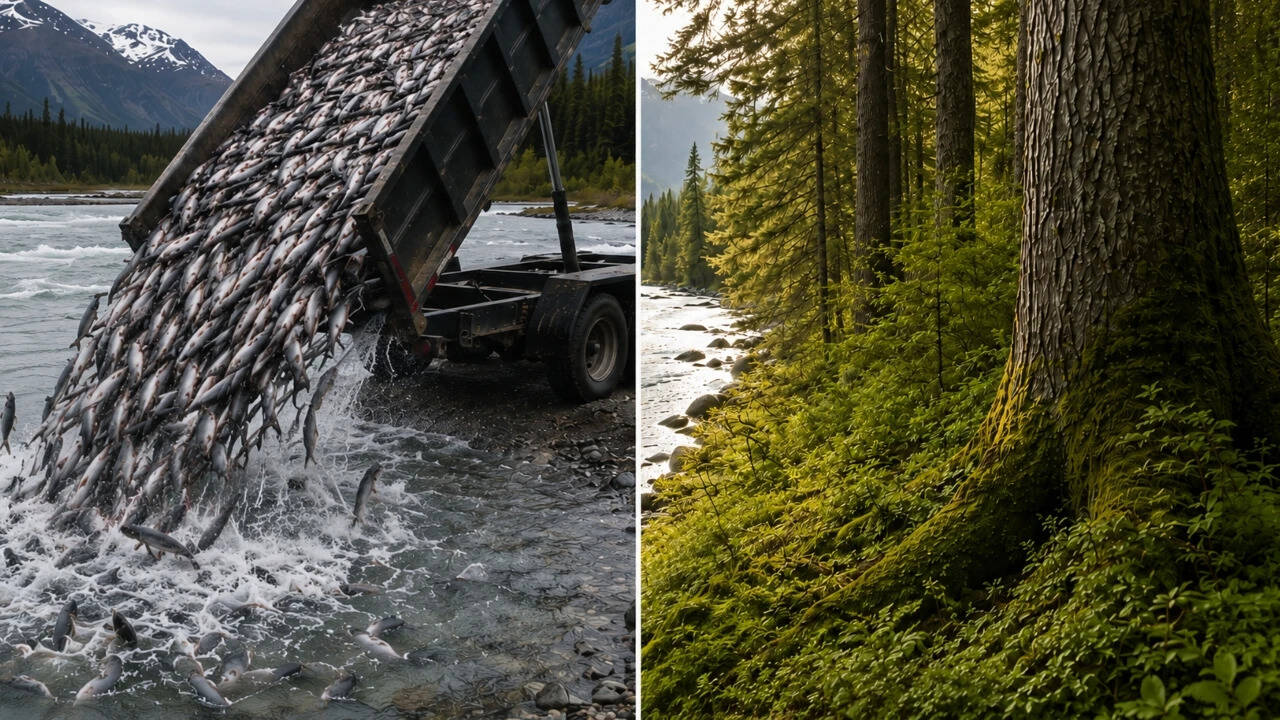
What began as a way to avoid counting the same dead fish twice became a long-running demonstration of how salmon nourish ecosystems. For two decades, researchers working alongside a small stream in southwest Alaska consistently tossed the carcasses of spawning sockeye salmon onto the same riverbank after recording them. By the end of the experiment, nearly 600,000 pounds (about 272,000 kg) of salmon had accumulated on one side of the Hansen Creek, creating a natural fertiliser that boosted the growth of nearby spruce trees. According to the University of Washington , the accidental experiment revealed how nutrients carried inland by spawning salmon can reshape vegetation, thus providing rare long-term evidence of the intimate connection between rivers and surrounding woodlands.
Get breaking news anytime, anywhere. Download the TOI app now!

An accidental experiment with notable results
Hansen Creek, a shallow stream in Alaska’s Bristol Bay region, hosts one of the densest sockeye salmon runs in North America, and the University of Washington reported that approximately 11,000 sockeye salmon return to the creek every year to spawn before dying, as is typical of Pacific salmon. Since the mid-1990s, researchers studying bear predation counted every dead fish before throwing it onto the left bank of the stream to prevent recounting it during daily surveys. This practice continued for 20 years and eventually deposited remains of 217,055 salmon, which is equivalent to nearly 600,000 pounds of biomass, on one side of the creek while the opposite bank remained comparatively depleted.
As per the study published in the journal Ecology , lead author Tom Quinn only wanted a consistent method of handling carcasses to avoid recording them twice. However, over two decades, the repeated practice of transferring marine-derived nutrients created a natural experiment. Notably, after accounting for fish moved by brown bears and partially consumed carcasses, the researchers estimated that around 267,620 kgs of salmon were deposited on the enhanced bank compared with only 45,200 kgs on the right side, a 5.9-fold difference in nutrient input.
How dead salmon helped forest thrive
To determine whether the carcasses had influenced forest growth, researchers collected core samples from white spruce trees growing along both banks of Hansen Creek. The Ecology study mentioned that they compared annual tree rings from 20 years before the carcass transfers began with those formed during the experiment. Interestingly, before the study, the trees on what later became the nutrient-poor bank actually grew faster because of greater sunlight exposure. However, once the fertilisation period was underway, the salmon-derived nutrients completely overcame this environmental deficit: the growth rate of the carcass-rich trees accelerated dramatically, overtaking their baseline performance and proving that marine-derived nitrogen directly drives superior biomass expansion even in light-limited conditions.