Scientists uncover hidden history of abandoned cows : What began with just five abandoned cattle on a remote subantarctic island turned into one of the world's most remarkable feral animal stories. Left behind in 1871 after a failed settlement attempt, the animals somehow survived for more than a century on isolated Amsterdam Island, enduring fierce winds, cold conditions, limited freshwater, disease, and repeated culling, as per a report.
Now, a new genetic study has uncovered how they managed to beat the odds. Researchers analyzing preserved DNA from the long-gone herd found that the cattle carried a surprisingly diverse genetic background, which may have helped them thrive despite descending from only five founders, as per an Eco News report.

Five abandoned cows built a thriving wild herd
Amsterdam Island, a small French territory in the Southern Ocean located about 2,760 miles southeast of Madagascar, hardly seems like a place where cattle could flourish.
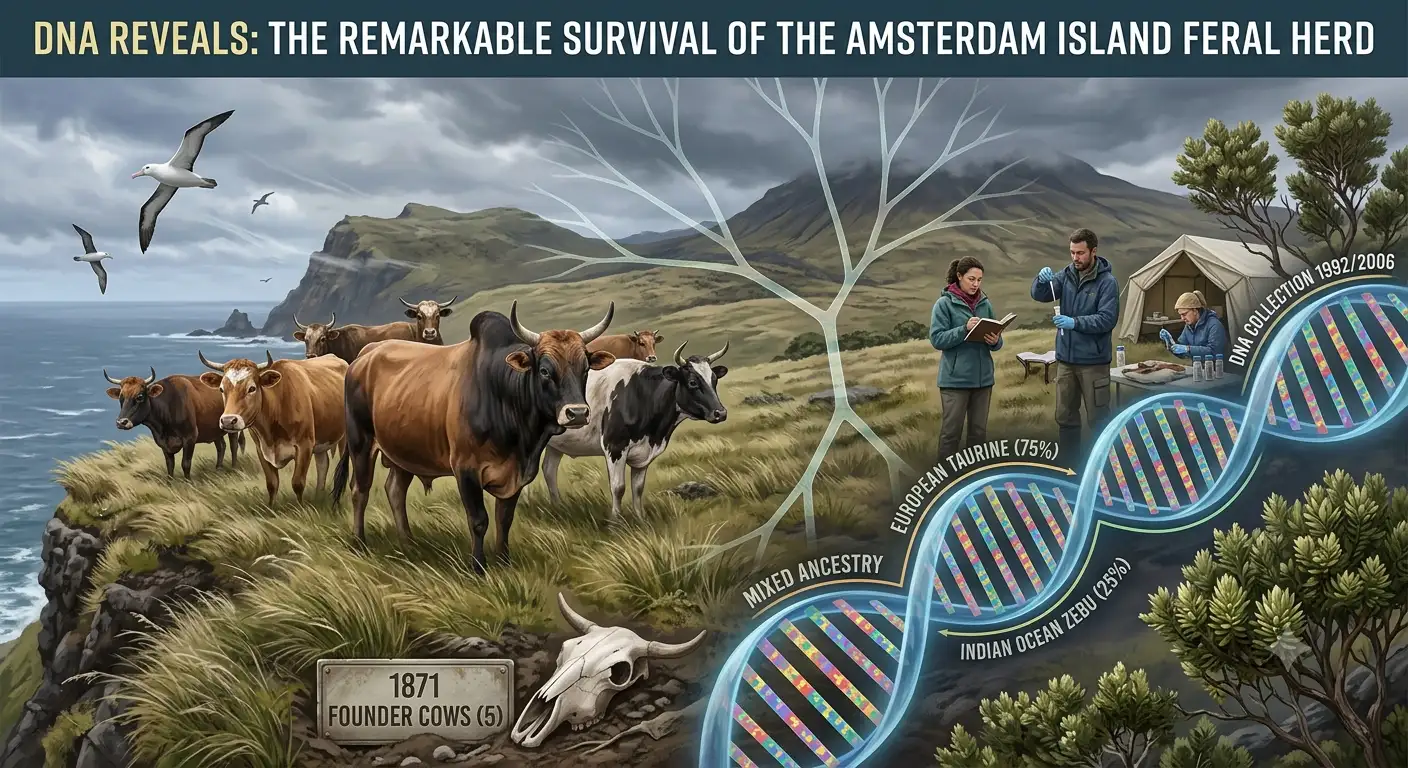
Historical records show that in 1871, a farmer named Heurtin brought five cattle from Réunion while attempting to establish a settlement on the island. The settlement failed within months, but the animals were left behind.
Instead of disappearing, the cattle adapted to life in the wild and established a feral population that grew for generations.
Over time, the herd expanded dramatically, reaching around 2,000 animals in both 1952 and 1988. Even periods of disease and culling failed to wipe them out.
READ ALSO: Life performs better in heat, but what happens next surprised scientists
Preserved DNA offered scientists a second chance
The cattle ultimately disappeared in 2010 when the last animals were removed as part of conservation efforts aimed at protecting Amsterdam Island's native species.
Because no coordinated effort was made to preserve biological material before the eradication, scientists could easily have lost the opportunity to study the herd forever.
However, DNA samples collected from 18 cattle in 1992 and 2006 had been preserved. Researchers later used modern genetic techniques, including whole genome sequencing on eight animals, to reconstruct the herd's genetic history.
The work, led by geneticist Mathieu Gautier and collaborators from INRAE and the University of Liège, sought to answer a simple question: How did just five cattle avoid extinction?
DNA revealed an unexpected genetic advantage
The analysis showed that the island cattle did not come from a single ancestral line.
Researchers found that roughly 75% of the herd's ancestry traced back to European taurine cattle, closely related to today's Jersey breed, as per the Eco News report. The remaining 25% was linked to Indian Ocean zebu cattle, similar to animals found in Madagascar and Mayotte.
This mixed ancestry may have given the original founders more genetic diversity than expected.
Scientists believe the cattle brought from Réunion may already have carried this blended heritage, helping the small founding group retain enough variation to survive and expand.
The study also suggests that much of the herd's European ancestry came from regions with cool, wet, and windy climates, meaning the cattle may have already been well suited to Amsterdam Island's harsh conditions.
The herd survived an extreme genetic bottleneck
Starting with only five animals created a severe genetic bottleneck, and researchers estimated inbreeding levels at around 30%, as per the Eco News report
Despite this, the study found no evidence of the dramatic genetic collapse many scientists might expect from such a tiny founding population.
Researchers believe the herd expanded rapidly after arriving on the island, limiting the amount of genetic diversity lost during the early years.
Earlier observations even described many of the cattle as being in "excellent health and condition."
Scientists revisited the island dwarfism debate
The new genetic study also challenges a long-standing idea that the cattle became significantly smaller because of island life.
A previous study published in 2017 suggested the animals had shrunk to roughly three-quarters of their original size, making them an example of classic island dwarfism, as per the Eco News report
However, the latest research argues that the original founders likely already belonged to relatively small cattle types.
DNA evidence also pointed to possible selection involving genes linked to the nervous system, suggesting the cattle may have undergone rapid behavioral adaptations instead.
Conservation efforts eventually ended the herd
By the late 1980s, conservationists faced a difficult decision.
Researchers had identified the cattle as a major threat to Amsterdam Island's fragile ecosystem, including habitats used by the endemic Amsterdam albatross and the rare Phylica arborea tree.
A compromise initially divided the island and removed cattle from large sections of it, but the final animals were eventually eradicated in 2010.
Today, restoration efforts continue across Amsterdam Island, which forms part of the wider French Austral Lands and Seas, added to UNESCO's World Heritage List in 2019, as per the Eco News report
READ ALSO: A common plant is doing something to water that has researchers completely puzzled
FAQs
Where is Amsterdam Island located?Amsterdam Island lies in the Southern Ocean, about 2,760 miles southeast of Madagascar.
How many cattle originally arrived on the island?
Historical records indicate that just five cattle were left on the island in 1871.