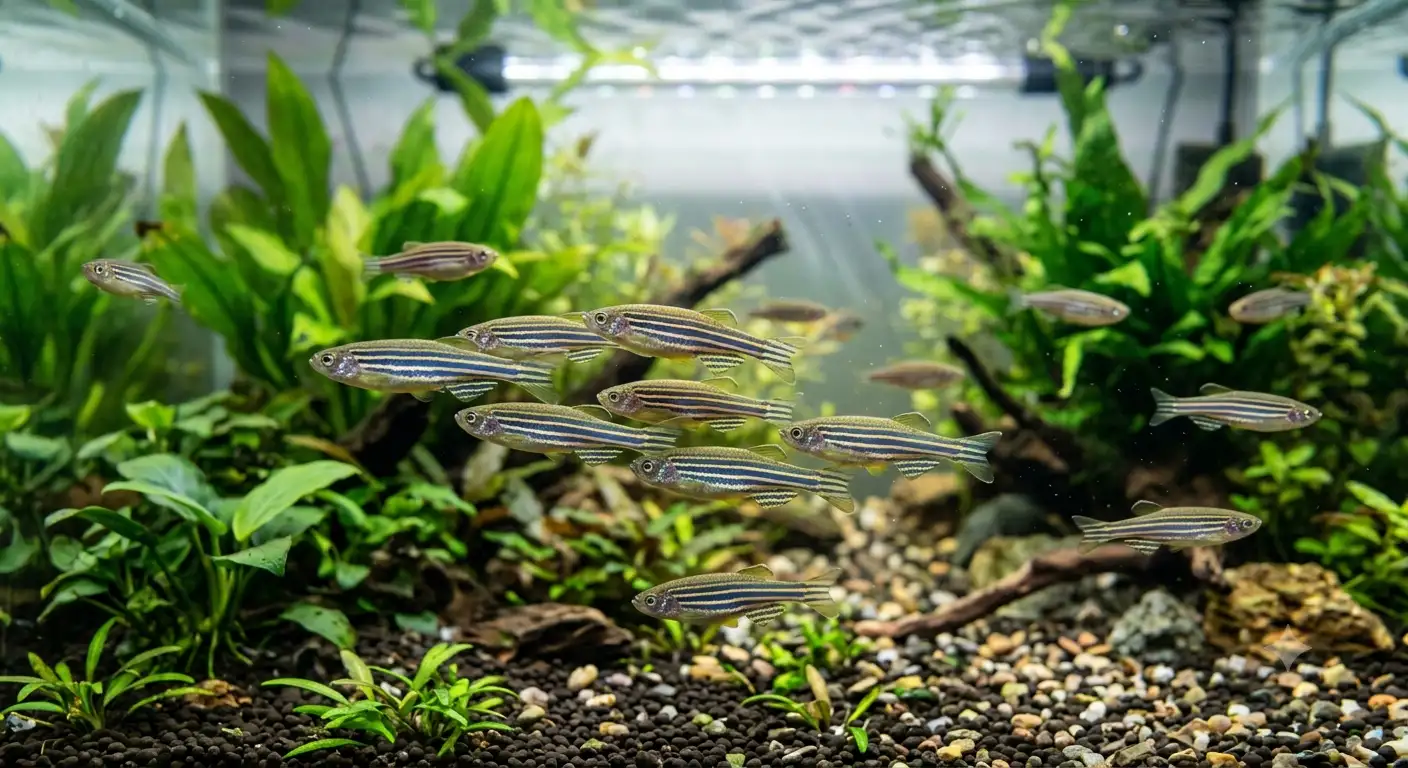
Fish sleep like humans study explained : People are not the only ones who follow sleep routines. New research has found that zebrafish not only sleep, but also go through different sleep stages, take daytime naps, and show sleep patterns that resemble those seen in humans.
The findings, published in Nature Communications, suggest that fish sleep may be far more complex than scientists once believed.
Zebrafish go through four different sleep stages
Unlike humans, zebrafish do not have eyelids. However, they regularly enter periods of inactivity during which they become less responsive to their surroundings, as per a report.
To better understand what happens during these resting periods, researchers tracked the eye movements of 105 zebrafish. They discovered that the fish experience four distinct sleep substates, and three of those stages involve eye movements, as per a Smithsonian Magazine report.
Researchers had previously noticed occasional eye movements in resting fish, but natural sleep had never been studied in such detail.
The study's co-author Vikash Choudhary of the Max Planck Institute for Biological Cybernetics, said, “That’s why I was astounded when I first saw the fish’s eyes moving in such characteristic ways,” as quoted by Smithsonian Magazine.
Some fish sleep stages look a lot like human sleep
Humans experience several stages of sleep, including rapid eye movement (REM) sleep, when most dreaming occurs. The zebrafish study revealed a similarly organized sleep structure.
Researchers found that the fish first enter a deep sleep stage in which the eyes remain still. Later, especially toward morning, the fish spend more time in stages where their eyes move sideways or alternate between movement and stillness. The fourth sleep state turned out to be something unexpected: a daytime nap.
Fish really do take naps during the day
The fourth sleep substate occurred almost exclusively during daylight hours and was the most common sleep state observed.
Scientists tested whether these periods were genuine sleep by presenting visual stimuli to the fish. The zebrafish showed low levels of arousal, confirming that they were truly asleep.
Researchers also found that fish deprived of sleep were more likely to enter this nap-like state shortly afterward, much like humans often feel the need to nap after losing sleep, as per the Smithsonian Magazine report.
Transparent fish gave scientists a rare look inside the brain
To conduct the study, researchers used a self-driving microscope that followed freely moving larval zebrafish.
Because zebrafish larvae have transparent bodies and brains, scientists were able to monitor whole-brain activity in real time while simultaneously observing behavior.
Choudhary said, "This is the first time we can record the whole brain of a freely moving animal,” as quoted by Smithsonian Magazine.
By combining brain recordings with behavioral observations, researchers were able to map the fish's complete sleep architecture.
Scientists still don't fully understand why animals sleep
Researchers say they are now interested in understanding what each sleep stage actually does.
The study co-author Jennifer M. Li, pointed out that, “We are very curious about what roles the different sleep stages play,” and explained that, “Sleep is important for so many processes, from reactivating memories to waste clearance, but we don’t yet totally understand why and how this is organized in time. Zebrafish, with their transparent brains, give us a powerful way to find out,” as quoted by Smithsonian Magazine.
The study adds to growing evidence that sleep is widespread throughout the animal kingdom. Previous research has even shown that creatures without brains, such as jellyfish and sea anemones, spend about one-third of their time asleep.
FAQs
Do fish actually sleep?Yes. Zebrafish enter periods of inactivity during which they become less responsive to their surroundings.
How many sleep stages do zebrafish have?
Researchers identified four distinct sleep substates.