
Get all your news in one place.
100's of premium titles.
One app.
Start reading
Motorsport
Motorsport
Franco Nugnes

Ferrari set to follow Austria engine updates with new turbo after F1's summer break

Ferrari has already plotted its second ADUO-influenced power unit update for 2026, with a new turbocharger expected to arrive after the summer break to help close the gap to Mercedes.

Following the first ADUO (Additional Development and Upgrade Opportunities) checkpoint post-Montreal, Ferrari has been granted the opportunity to make two engine developments this season.

Its performance gap, measured by FIA technical inspectors, was found to exceed 4% compared with the Red Bull-Ford internal combustion engine. The FIA's measurements suggest that Red Bull has the current benchmark power unit in Formula 1, although this is disputed by the team.

Ferrari has already plotted a first round of modifications for Austria aimed at reducing the gap to Mercedes, which most observers (except the FIA) consider the true benchmark.

The team is aiming to manage expectations over the first ADUO update, which features modifications to the combustion chamber through the use of a steel-alloy cylinder head. This allows engineers to pursue pressure and temperature levels that would be impossible to achieve with a traditional aluminium-alloy engine.

At the start of the season, the “small” turbocharger was a deliberate choice that paid off in reducing turbo lag following the removal of the MGU-H.

However, the advantage that was expected, especially at race starts, has effectively been neutralised. The FIA’s five-second pre-start procedure has allowed all manufacturers sufficient time to spool up their turbos for safety reasons and avoid stalled cars on the grid, which has worked against Ferrari.

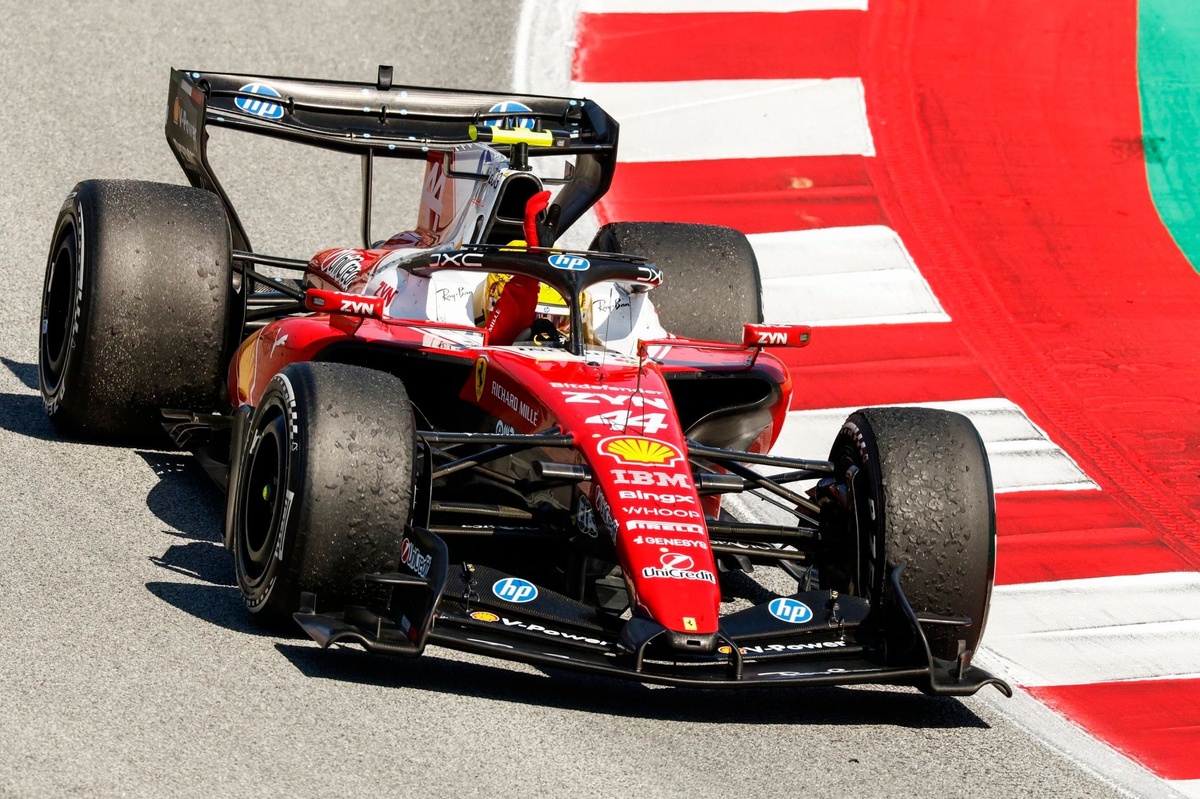
Charles Leclerc, Ferrari (Photo by: Guido De Bortoli / LAT Images via Getty Images)

Ferrari will introduce a newly designed turbocharger with its second ADUO credit, likely at Zandvoort or Monza.

The impeller diameter will remain unchanged, but the number and angle of the blades will be different, and developments in materials are also expected. Mercedes and Honda will not be introducing ADUO engines and Ferrari, like Audi already did in Barcelona, will aim to gather an early advantage.

For Austria, Ferrari has doubled down on the 'hot engine' concept by running the cylinders at 110C (compared with the current 100C) during the combustion process.

Engines can theoretically run more efficiently at high temperatures and, when combined with a Shell fuel possessing a higher calorific value, it allows more particles to be burned while producing fewer residual emissions. This increases the mechanical work of the engine, and thus boosts power.

A side-effect of running at higher temperatures is that it allows radiators to be smaller, as the delta between heated and cooled engine coolant is smaller.

Ferrari's upgrade package for Barcelona demonstrated that the team was able to compensate for the 067/6 engine’s power deficit relative to Mercedes through more efficient, lower-drag aerodynamics. In the intense Spanish heat, the rumoured 25-horsepower deficit seemed to disappear.

Sign up to read this article
Read news from 100's of titles, curated specifically for you.
Already a member? Sign in here
Related Stories
Top stories on inkl right now
One subscription that gives you access to news from hundreds of sites
Already a member? Sign in here
Our Picks
Fourteen days free
Download the app
One app. One membership.
100+ trusted global sources.