
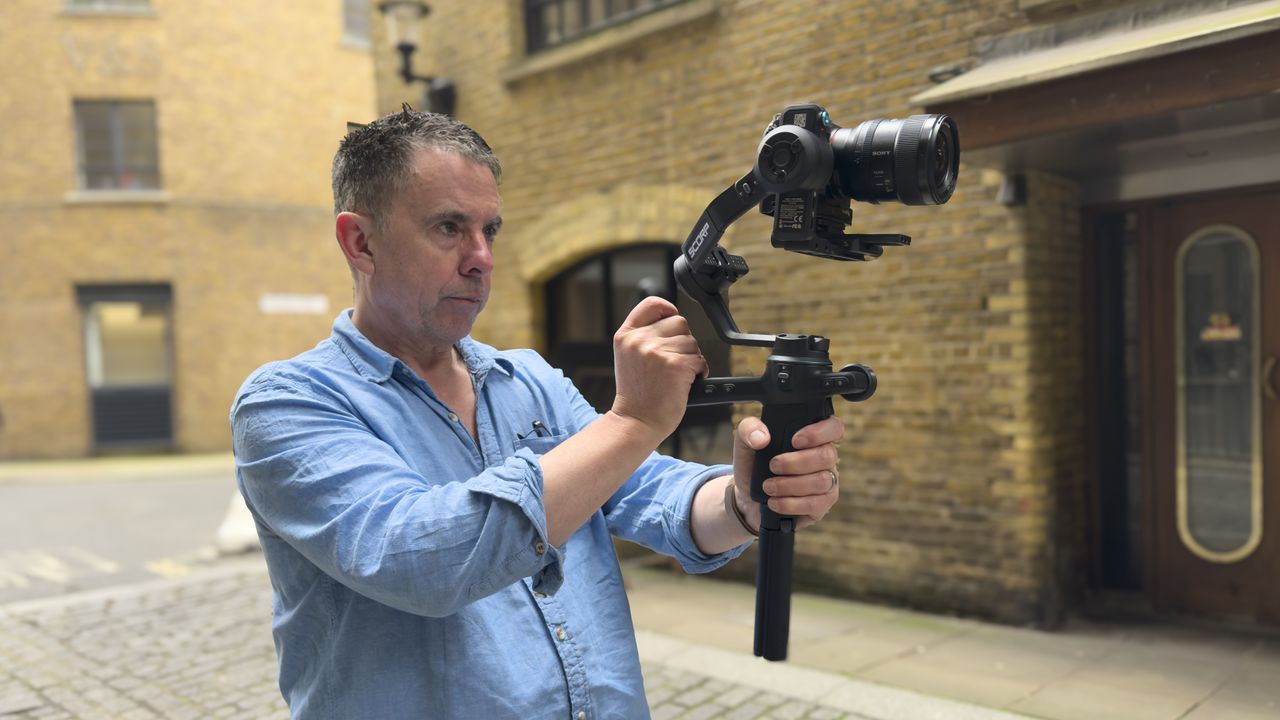
Stabilisers like the Feiyu Scorp-C2 are designed to keep your camera’s horizon level as you perform a wide range of handheld pans, tilts, and low-to-high angle tracking shots. They also enable you to shoot tripod-steady handheld shots without the burden of having to carry and set up a classic tripod (though you can rest a stabiliser on its own mini tripod and perform smooth pans and tilts using its built-in joystick). Unlike the handheld cages and rigs, gimbals have three motorised arms that enable you to pan, tilt, and roll your camera smoothly. The downside of using a gimbal is that you need to balance your camera and lens (the payload) carefully before each shoot. An unbalanced payload puts strain on the stabiliser’s motors, which can cause camera shake (or even force the gimbal to shut down to protect its motors!). With a cage/rig, you are the motor, so no time-consuming balancing is required.
I’ve rested and reviewed a few Scorp gimbals for Digital Camera World, starting with the Feiyu Scorp Mini, followed by the Scorp 2. All the gimbals in Feiyu’s Scorp range share one key design feature - a hooked sling handle that looks like the tail of a scorpion - hence the branding ‘Scorp’. I’m a big fan of this design feature as it enables me to easily glide the gimbal-mounted camera very close to the ground to follow a subject and then crane it up to head height in one smooth motion. To enjoy a smartphone-friendly version of the Scorp, check out my review of the Scorp Mini 3 Pro.