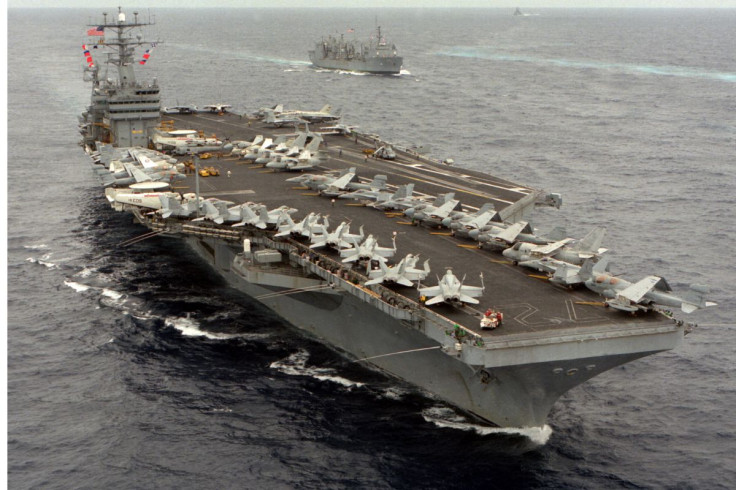
The USS Abraham Lincoln is heading back to San Diego after what the Navy says is a record-breaking 272 consecutive days at sea, the longest continuous deployment in modern US naval history.
Its crew of around 5,000 sailors and Marines, now relieved in the region by the USS George Washington, are returning home after more than nine months in the Middle East without a single port call.

Families say morale on board fell sharply during the deployment amid physical hardship and worsening mental health. One sailor told his mother that life on the carrier felt like a horror film, saying it was as though 'everybody is dead but they don't know it yet'.
The remark has come to reflect concerns about the psychological toll on those serving at sea for extended periods.
Deployment Supposed To End in May
The deployment, originally scheduled to last six months and end in May, was extended after the outbreak of the war with Iran. Iranian missile and drone strikes on 28 February, the first day of the war, caused heavy damage at Naval Support Activity Bahrain, the Fifth Fleet's main supply hub in the region.
With the base out of action and Persian Gulf routes considered too dangerous for lightly armed supply ships, the Navy rerouted its logistics network through Diego Garcia. The British-administered island outpost, roughly 2,200 miles away in the Indian Ocean, became a key link in a supply chain stretched across thousands of miles.
The resulting delays caused shortages of food, drinking water and essential supplies, and removed the option of shore leave.
Crew Endures Inedible Food, Extreme Heat on Deck
For the sailors aboard the carrier, the logistical bottleneck quickly affected daily routines. Crew members reported eating skimpy meals that were, at times, barely fit to eat.
Around them, broken toilets, mouldy showers, failing plumbing and unreliable laundry services made basic hygiene difficult.
Flight deck plane captains worked in temperatures reaching 120F while hauling 100-pound chains, leaving many physically exhausted and dehydrated.
Behavioural scientists say prolonged uncertainty can be particularly damaging, especially when people are repeatedly given expectations that are not met. As homecoming dates were pushed back, the strain on the crew increased and mental health concerns rose. Former Navy medical personnel described the conditions as 'tragic' and 'untenable'.
Mental Crisis Pushes Sailors To Jump Overboard
Families reported serious mental health crises among the crew, including accounts of several sailors attempting to go overboard. On 3 August, one sailor entered the water wearing a life vest and was rescued nearly an hour later.
Other sailors were reportedly restrained from doing the same. Some crew members stopped reporting for duty, hoping that refusing to work would lead to them being sent home.
One sailor described life aboard to his mother as 'a scene out of American Horror Story', saying he felt as though 'everybody is dead but they don't know it yet'. The account was among several shared by military families that described the psychological impact on the crew.
Leadership Asserts Carrier Is Well-Maintained
Senior political and military figures publicly rejected the reports. President Trump dismissed them as 'fake news', saying the deployment had been 'not nearly long enough' and insisting the ship was 'beautifully maintained'.
He said that view was based on third-hand reports from an unnamed retired admiral. Defence Secretary Pete Hegseth said conditions on board had been 'completely misrepresented'.
Frontline Personnel Expressed Discontent With Graffiti
Signs of discontent among the crew have also emerged. A photograph taken by a US service member in the Persian Gulf showed messages scrawled in the dust on the flaps of a deployed aircraft and attracted more than 18 million views online.
The messages included phrases such as 'Operation Epstein Fury' and 'All this for the Holy Land'. They appeared to reflect a belief among some frontline personnel that the war is not serving US national interests.
Former naval officers have warned that public dissent and doubts over the war's purpose could have a lasting effect on the modern Navy. Some have compared the situation to the crisis of morale and confidence that affected the US Army during the Vietnam War.
The USS Abraham Lincoln is expected to arrive in San Diego within a few weeks. The Navy has yet to confirm an exact date for the carrier's return and has not said whether the ship will make any port calls on its way home.