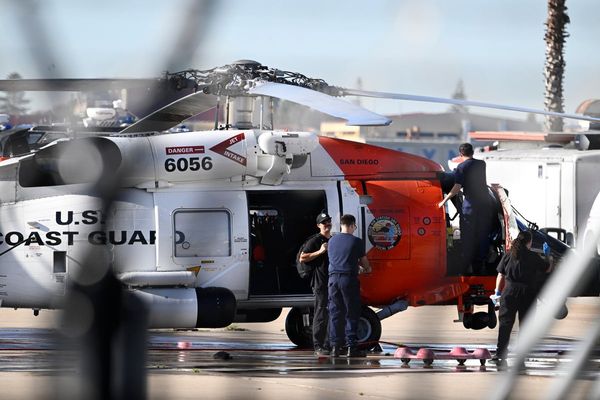
From U.S. v. California, decided yesterday by Judge Christina Snyder (C.D. Cal.):
"A state law or regulation impermissibly discriminates against the federal government if it treats a state entity more favorably than it treats a comparable federal entity." Furthermore, the Ninth Circuit has held that a state law may not "single[] out" the federal government for greater burdens "than that which applies elsewhere in the State," even where the statute seeks to address a specific harm controlled by the federal government.
The No Secret Police Act's facial covering prohibition applies to "law enforcement officers," who are defined as any "peace officer, as defined in Section 830 [of the Cal. Penal Code], employed by a city, county, or other local agency as well as any officer or agent of a federal law enforcement agency or any law enforcement agency of another state or any person acting on behalf of a federal law enforcement agency or law enforcement agency of another state." This definition does not "single out" the federal government because it also applies to local law enforcement officers and law enforcement officers for states other than California. However, it excludes California state law enforcement officers, such as California Highway Patrol officers.
In evaluating the government's unlawful discrimination claim, it is critical that the Court compare similarly situated federal and state actors. "So if the State defines the favored class by reference to job responsibilities, a similarly situated federal worker will be one who performs comparable duties." The Court is not persuaded by California's arguments that state law enforcement officers are not similarly situated to federal law enforcement officers. First, California concedes that some state law enforcement officers perform similar law enforcement functions to federal officers, including the types of interactions with the public that the facial covering prohibition generally targets.
Second, those state law enforcement officers are not differently situated merely because state law enforcement officers have not recently engaged in "large-scale operations while wearing facial coverings," like some federal law enforcement officers. While the Act may be a direct response to recent federal law enforcement practices, the Act's text plainly addresses the harms caused by the use of facial coverings by "law enforcement" generally during enforcement activities. The Act, therefore, does not directly regulate federal functions or target federal practices but rather generally applies to law enforcement officers in California. However, the Act treats federal law enforcement officers differently than similarly situated state law enforcement officers.
Accordingly, the Court finds that the United States is likely to succeed on the merits of its claim that the facial covering prohibition of the No Secret Police Act unlawfully discriminates against the federal government in violation of the intergovernmental immunity doctrine.
{At the hearing, counsel for the United States acknowledged that the No Secret Police Act would not be unlawfully discriminatory if it was amended to apply to all law enforcement officers in California.}
The federal government also argued that the law was independently invalid because it unduly interfered with federal law enforcement; this argument, if accepted, would have applied even for a law that was amended to include state officers as well. But the court rejected this argument, both as to the masking ban and a separate law that generally required law enforcement officials to visibly display their agency identification and a name or badge number. Indeed, since the identification display requirement applied to all officials and thus wasn't discriminatory, the court held the requirement was likely constitutional: