Get all your news in one place.
100's of premium titles.
One app.
Start reading
Latin Times
Latin Times
Politics
Rebecca Montecinos

Fear of ICE Still Keeps LA Latinos From Calling Police, a Year Into the Crackdown

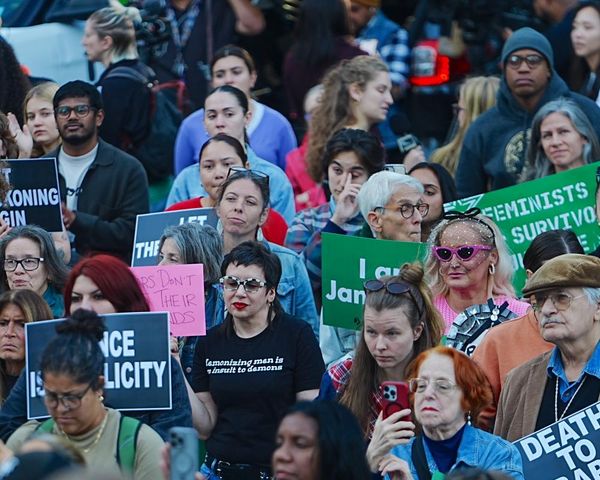
LOS ANGELES, CA - MAY 01: A man calls for the shutdown of the U.S. Immigration and Customs Enforcement agency during a march on May Day, also known as International Workers Day, on May 1, 2019 in Los Angeles, California. People are participating in multiple May Day marches and rallies around Los Angeles, calling for support of labor and immigrant concerns such as wage improvement, immigration reform and a citizenship question in the upcoming national census. (Credit: Photo by David McNew/Getty Images)

More than a year after federal agents flooded Los Angeles with immigration raids, community organizers and legal advocates say a quieter casualty keeps piling up alongside the arrest tallies: crime victims who never dial 911 in the first place.


A Warning First Sounded in 2017

Los Angeles has watched this pattern before. In March 2017, months into the first Trump administration, then-LAPD Chief Charlie Beck told reporters that reports of rape among the city's Latino residents had fallen by a quarter that year, and domestic-violence reports had dropped by roughly a tenth, compared with the same stretch the year before. No other ethnic group showed a comparable slide, and Beck tied it directly to fear of deportation. Nearly a decade later, with a far larger federal operation running through the same neighborhoods, advocates describe an identical dynamic resurfacing, even though a precise, up-to-date version of that statistic does not yet exist for 2025 or 2026.

The current wave began in late May 2025, when federal agents fanned out across car washes, Home Depot parking lots, garment factories and farms. Human Rights Watch's analysis of federal arrest data found ICE agents picked up an average of 540 people a week during the roughly two-month surge that followed, compared with about 139 a week under the same administration before the surge, and just 87 a week in the year and a half before President Donald Trump returned to office. Roughly two-thirds of those detained in the Los Angeles area during that surge had no criminal record at all, the group found, and only 5 percent had a prior violent or sex-offense conviction.

That mismatch between the administration's stated targets and who actually got swept up helps explain why unease has spread so widely through neighborhoods such as Pico-Union, Westlake, Boyle Heights, MacArthur Park and South LA, home to a large share of the region's roughly six million Latino residents. Families told Human Rights Watch they had skipped graduations, medical appointments, even trips to the grocery store. One mother, describing why she stopped taking her grandson to the playground, said she felt "not safe anywhere. It's like I'm in a cave."

What Surveys Say About the Silence

Local statistics on crime reporting specifically remain hard to come by, but national survey data points the same direction. A Cato Institute review published in August 2025 cited a 2025 poll of attorneys and caseworkers who assist domestic-violence victims in immigrant communities, in which 76 percent said their clients were hesitant to call police. A separate KFF poll from that same spring found roughly four in ten immigrants nationwide worried a household member could be detained, and that survey wrapped up before the summer's enforcement surge even began. The same Cato analysis notes that immigrants have historically reported violent crime more often than U.S.-born residents, which makes any reversal driven by fear a public-safety loss extending well beyond immigrant households.

A Legal Fight Over Who Gets Stopped, Still Unresolved

That fear has been reinforced by an ongoing court battle over how agents choose whom to detain. Los Angeles-area workers and civil rights groups sued in the case now known as Vasquez Perdomo v. Mullin, arguing that agents were relying on little more than skin color, a Spanish accent, someone's presence at a car wash or bus stop, or the kind of work they did. A district judge agreed and blocked the practice that summer, and a Ninth Circuit panel left most of that order standing in August. The Supreme Court's conservative majority then granted an emergency stay in a 6-3 vote on September 8, 2025, letting agents resume relying on those factors while the case continued, over a dissent from Justice Sonia Sotomayor joined by two of her colleagues.

The lawsuit's name changed for an unrelated reason: President Trump removed Kristi Noem from the Homeland Security post this spring, and the Senate confirmed Oklahoma Sen. Markwayne Mullin as her successor before he was sworn in at the end of March. The case, meanwhile, has kept moving. A judge denied the government's bid to dismiss nearly all of the claims in February 2026, and the government's appeal of a separate preliminary injunction has been pending before the Ninth Circuit since January. This summer, plaintiffs asked for a new injunction targeting warrantless arrests specifically, plus class-action status for everyone affected. At an August 13 hearing, the judge signaled she was leaning toward the plaintiffs, indicating in a tentative ruling that agents may need to conduct a formal risk assessment before arresting someone without a warrant, though that position had not yet become a final order as this story was being prepared.

LAPD Says It Stays Out of It, but the Numbers It Tracks Keep Climbing

LAPD Chief Jim McDonnell has repeatedly stressed that his department, bound by a policy dating to 1979, does not ask about immigration status or help carry out civil deportation arrests. "I want everyone, including our immigrant community, to feel safe calling the police," McDonnell said in a statement the week the raids began. Mayor Karen Bass, who is seeking re-election this fall, later directed the department to track and publicly report possible misconduct by federal immigration officers. The most recent of those monthly counts, covering this past June, found 12 qualifying incidents, the highest since the tracking program started in March and a sign that friction between local and federal law enforcement has not eased. That same month, the number of people ICE held nationwide reached its highest point in roughly a year and a half.

Enforcement Went Quiet, Not Away

Formal tallies show just how sharp the 2025 spike was: arrests across greater Los Angeles roughly tripled that year, to somewhere around 14,300, up from about 4,700 in 2024. Numbers fell just as sharply in early 2026, dropping from more than 1,500 arrests in January to roughly 800 in February, according to federal data obtained through public-records requests. But the retreat proved temporary. By July, national ICE arrests had climbed to a new monthly high of nearly 50,000, and the population held in the Los Angeles area's immigration-detention system had roughly doubled compared with levels before the 2025 raids began. Immigration attorneys describe an enforcement posture that has simply grown less visible, leaning on routine check-ins and community arrests rather than the televised sweeps that defined last summer.

For families weighing whether a break-in, an assault or a domestic dispute is worth a call to police, organizers say that calculation has not gotten any easier, and a year of legal whiplash and quietly climbing enforcement numbers has done little to change their minds.

Sign up to read this article
Read news from 100's of titles, curated specifically for you.
Already a member? Sign in here
Related Stories
Top stories on inkl right now
One subscription that gives you access to news from hundreds of sites
Already a member? Sign in here
Our Picks
Fourteen days free
Download the app
One app. One membership.
100+ trusted global sources.