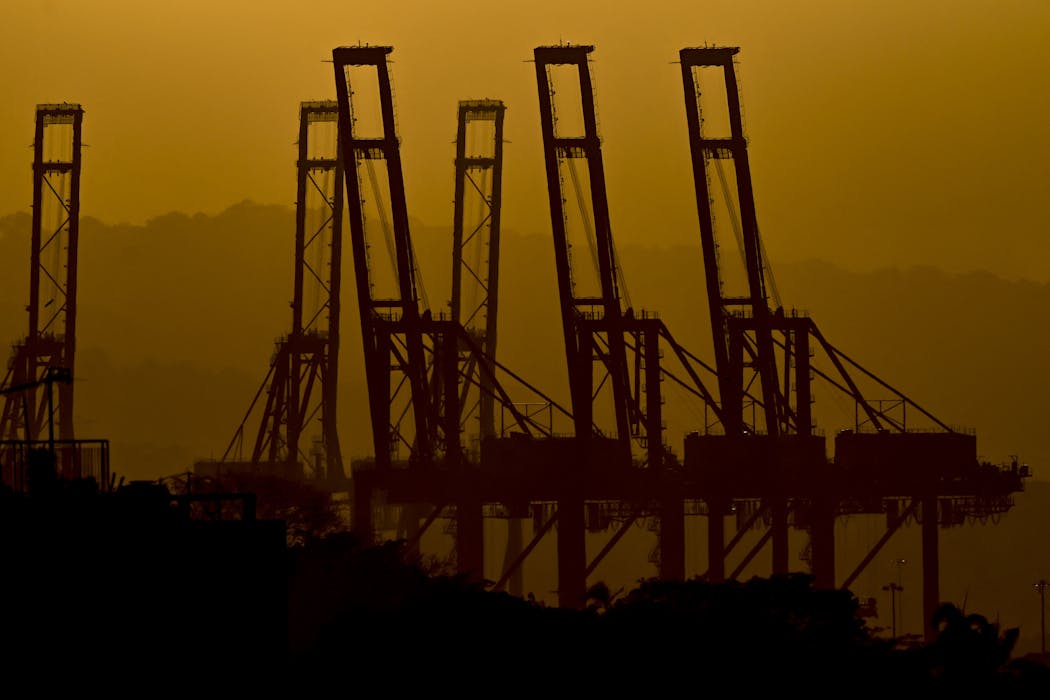
In late February 2026, the Panamanian government took control of two ports in the Panama Canal that had been operated by a Hong Kong conglomerate for two decades. The move is the latest in a long-simmering legal battle after Panama’s high court voided the company’s contracts.
Far from just a local dispute, however, the episode has drawn in the United States and China, whose competition over global ports and trade routes has intensified in recent years, including in the crucial Panama Canal Zone, where China’s presence has repeatedly drawn the ire of the Trump administration.

Chinese firms now own or operate terminals at more than 90 ports worldwide, including many of the busiest. The network spans Africa, Europe, the Middle East and Asia, with growing activity in South America.
The scale of China’s involvement in overseas ports has fueled debate over whether these investments are purely commercial or serve broader strategic goals.
Much of that debate has relied on case studies and politicized headlines, including in the case of the Panama Canal. But understanding where these ports are located, and whether there are consistent patterns in the countries that host them, is important given that disruptions to global shipping lanes can reverberate across the world economy.
In a recent study, we – researchers in maritime security, global infrastructure and trade – built the first global database of Chinese-affiliated ports and analyzed 133 coastal countries to understand why some host Chinese port investments while others do not.
We found that China’s overseas port expansion is not random. Far from being driven primarily by general business climate measures, the investments cluster near maritime chokepoints and piracy-prone shipping corridors, with more modest evidence that resource-rich countries are also more likely to host these ports.
The importance of chokepoints
Some sea routes are more important than others. The Suez Canal, the Strait of Hormuz and the Strait of Malacca are examples of chokepoints – narrow routes through which large volumes of global trade and energy shipments must pass.
In our findings, countries near primary or secondary chokepoints, such as Panama or countries bordering the Dover Strait, such as France, were substantially more likely to host a Chinese-affiliated port. Put simply, proximity to critical trade bottlenecks strongly predicts Chinese investments.
This makes economic sense. China depends heavily on maritime trade to sustain economic growth. And ports near chokepoints sit along the world’s most sensitive shipping corridors and offer long-term commercial access in strategic locations.
Despite concerns in the West that Beijing is developing ports for military reasons, not every port is a naval base in disguise.
Most Chinese-affiliated facilities are commercial terminals. However, commercial infrastructure can still have strategic value. China’s first overseas military logistics base in Djibouti sits alongside the Chinese-operated Doraleh port complex. A report from the Congressional Research Service notes that the facility supports naval operations and regional access in the western Indian Ocean.
That does not make other Chinese-owned or operated ports military installations. But control over terminals, logistics platforms, and supply chain data can shape economic and security relationships over time.
The role of piracy and resources
The same corridors in which Beijing is concentrating port investment are also hot spots for maritime crime. In separate research, we found that seaports can facilitate illegal, unreported and unregulated fishing when oversight is weak. Our latest findings show that Chinese-affiliated ports are more common in countries already experiencing piracy and maritime insecurity.
That overlap does not mean ports cause illicit activity, but it shows these investments often occur in higher-risk maritime environments.
One of the most surprising findings from our study was the relationship between piracy and port investment.
Between 1991 and 2018, thousands of piracy incidents were recorded worldwide. But rather than avoiding risky waters, Chinese-affiliated ports are more common in countries experiencing higher levels of piracy.
Why invest in unstable corridors? One explanation is that piracy signals where trade routes are both vulnerable and valuable. Investing in ports in areas such as the Gulf of Guinea or parts of Southeast Asia may help Beijing protect its shipping interests. In this sense, piracy may signal not just risk but opportunity.
We also examined natural resource wealth of port host nations using a broad measure that includes extractive mineral and agricultural resources. We found modest evidence that countries with higher resource levels were more likely to host at least one Chinese-affiliated port, though this relationship was not consistent across all models.
Some commonly cited explanations as to where and why China invests in ports did not hold up in our analysis.
Broad measures of business climate and governance, such as ease of doing business or institutional stability, were not consistent predictors of Chinese-affiliated port presence.
This suggests that geography and maritime risk factors may matter more than general economic or governance indicators.
Broader implications
Whatever the motivations behind Chinese investments, their implications extend beyond local trade and logistics.
Ports are no longer just local infrastructure projects. They are nodes in global supply chains and increasingly in geopolitical competition.
And while not every investment signals a covert military ambition, it would be naive to treat all port projects as politically neutral.
Read more: China is losing ground in Latin America
Recent U.S. policy responses reflect these growing concerns. In early 2026, the White House outlined a plan to strengthen the U.S. shipping industry and reduce reliance on foreign-controlled maritime infrastructure. The administration has also taken a closer look at foreign involvement in key facilities in the Western Hemisphere, including ports linked to the Panama Canal.
Such moves suggest that control over maritime infrastructure is no longer viewed in Washington as just a commercial issue but increasingly as a matter of economic and national security.
And as the map of countries with Chinese-affiliated ports suggests, Beijing’s investments are following the world’s most consequential trade routes not by accident, but by design.
The authors do not work for, consult, own shares in or receive funding from any company or organization that would benefit from this article, and have disclosed no relevant affiliations beyond their academic appointment.
This article was originally published on The Conversation. Read the original article.