Get all your news in one place.
100’s of premium titles.
One app.
Start reading
PC Gamer
PC Gamer
Justin Wagner

Fallout was a 'B-tier product' that lost both the licenses it was banking on and had its lead dev joking, 'In a week, we’re going to be asking whether people want fries with their meal,' but now he thinks those trials 'turned out to be positives'

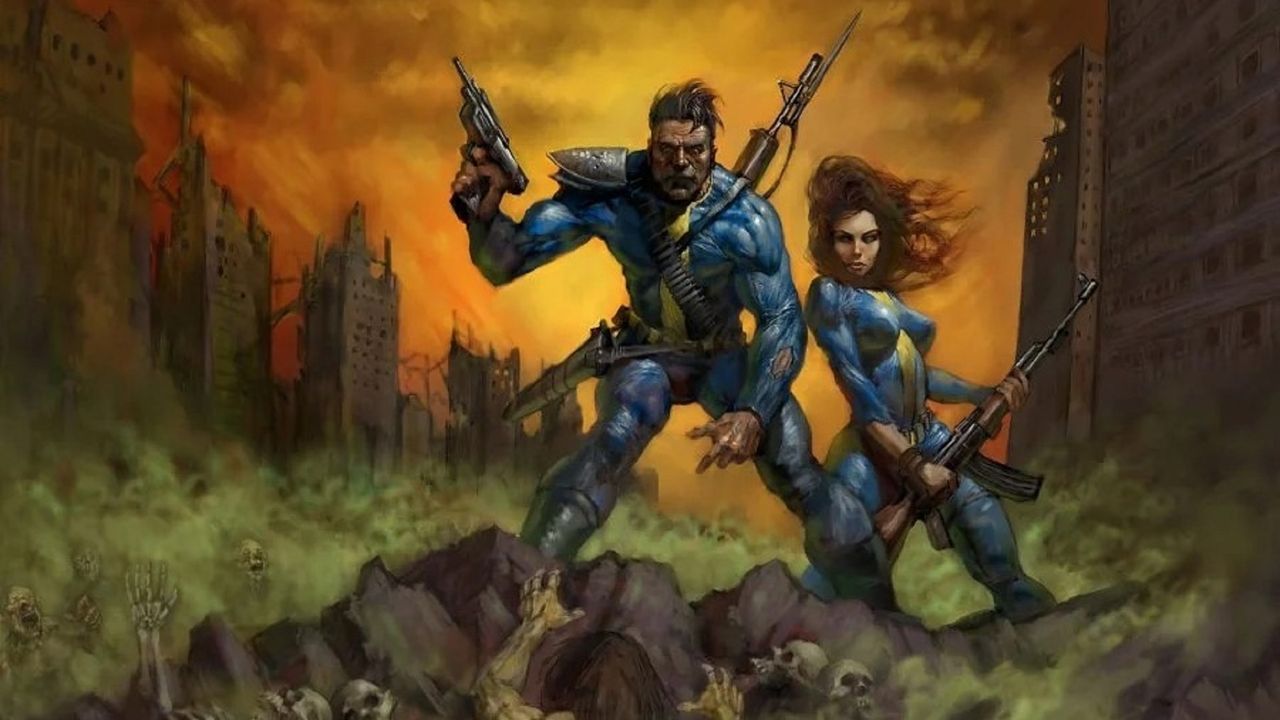
Male and Female Vault Dweller holding guns and cresting a hill with ruined city in background.

Fallout's everywhere now, with half a dozen games and two seasons of television under its belt, but it used to be "a B-tier product," as series co-creator Tim Cain recently told Game Informer. A lot went wrong during development and the team didn't have much power to do anything about it, but Cain said that constraints and hardship may have been key to the game's eventual success.

"That sprite engine I wrote had limitations we had to work around, and those workarounds ended up making the game really cool," said Cain. "But it was one of those things that, at the time, it felt like, 'Oh no, another setback,' and it turned out to be a positive thing in the long run. It did help me view things differently years later."
For instance, Fallout was originally going to be an adaptation of Steve Jackson Games' GURPS, the "Generic Universal Roleplaying System" and a staple of '80s tabletop. But when the team showed the game to Steve Jackson himself, he was put off by Fallout's ultraviolence juxtaposed with its smiling Vault Boy mascot, and pulled out of the project.

Designer and art director Leonard Boyarsky recalled that this led to the creation of the SPECIAL stat system, "which was way better for a computer game than trying to make a really faithful GURPS adaptation."

Then there's Wasteland, which Fallout might have been a sequel to had publisher Interplay been able to secure the rights. But as Wasteland designer and Interplay cofounder, Brian Fargo, recalled in the interview, "EA said, 'No, not going to happen.' We were being hopeful for a while, but ironically, that pivot ended up being wonderful because we ended up with Fallout, which obviously ended up being a good thing."

Tim Cain has talked in videos on his YouTube channel about how the team wanted to distance itself from Wasteland and do its own thing, noting that "some people on the team were flat out worried that we would get [the license]." Regardless of how Fallout might have been different were it a Wasteland sequel, things obviously worked out in the end.

"So many negatives turned out to be positives, said Cain."Even being called a B-tier product, which, at the time was an insult, you know, 'We can’t wait for you to get done with this so we can put you on D&D or something,' turned out to be a great thing because we were pretty much ignored for years," he continued. "No one really cared about what we were doing because there wasn’t anything huge tied to it, and that just let us kind of do our thing."

That's not to say the team knew it would pan out at the time. As Boyarsky recalled in the interview, "I wish we had the email, because I sent [Tim] an email. I said, 'In a week, everyone’s going to know how great Fallout is' before we shipped. And Tim emailed me back, and he said, 'In a week, we’re going to be asking whether people want fries with their meal.'"

Sign up to read this article
Read news from 100’s of titles, curated specifically for you.
Already a member? Sign in here
Related Stories
Top stories on inkl right now
One subscription that gives you access to news from hundreds of sites
Already a member? Sign in here
Our Picks
Fourteen days free
Download the app
One app. One membership.
100+ trusted global sources.