Get all your news in one place.
100’s of premium titles.
One app.
Start reading
GamesRadar
GamesRadar
Technology
Andrew Brown

Fallout 4 is a great RPG, but it took 10 years and a radioactive lighthouse for me to see it

Kingsport Lighthouse settlement in Fallout 4.

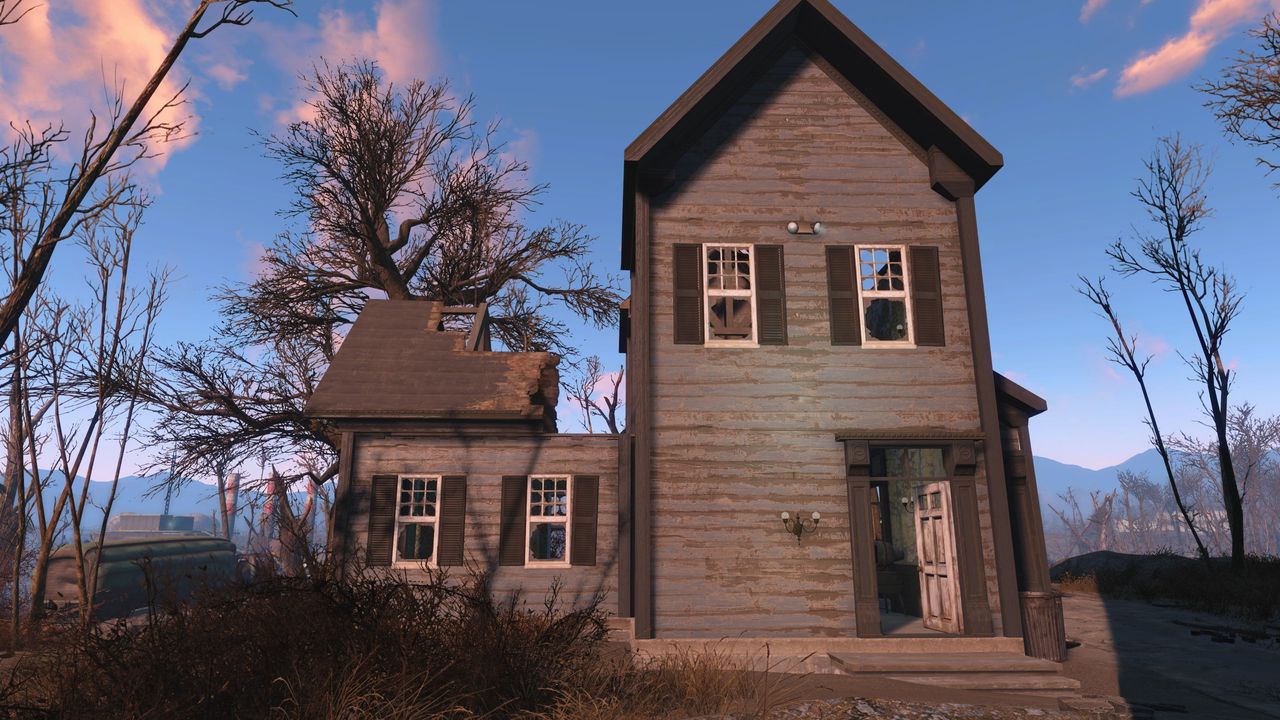
Kingsport Lighthouse is a fixer-upper. Its namesake is a thin concrete tower, jutting over a two-story home with no roof and a boathouse that stands precariously on a rotting dock. But wisdom lies in the deepest throes of lighthouse renovation, and as I survey my future homestead in Fallout 4 I'm granted a revelation: I do not know the first thing about lighthouse renovation.

My new home is too narrow and full of stairs to fit much else. Puddles of green plasma pool on the ground – the remains of former tenants, cultists who spite me in death as immovable goo-splashes. Mutated seagulls crowd the dock, while the body of a Glowing One I tried (and failed) to throw in the sea irradiates the shore. Again: it's a fixer-upper.

I've spent the last few days trying to turn the settlement's boathouse into a boathome, and if you're wondering why I'd settle here instead of Diamond City or sunny Sanctuary, two words: role-play. I'm treating Fallout 4 like a life sim, ignoring the protagonist's missing son in favor of exploring and scavenging like every other schmuck in the Commonwealth, and every wastelander needs somewhere to call home – no matter how far you have to stretch the meaning of the word.

This approach has changed the way I see Fallout 4. For the last decade I've considered the game to be a great shooter but middling RPG – but after stepping beyond its guardrails, it's impossible to stand by that.

Viva las Commonwealth

(Image credit: Bethesda)
Civilization
(Image credit: Bethesda)

We've ranked the best Fallout games - where does your favorite land?

When I move into Kingsport Lighthouse, I have the option to make things easier by establishing a supply line between there and my old digs at Red Rocket. Doing so would have given me a mountain of building supplies – but where's the fun in that? Instead, I drag a bed into the boathouse and craft a single rug before running out of materials to build with.

The next morning, I search the coast for supplies. I don't know what I'm looking for – only that I need stuff – so I hoover up every junk item I come across. When you have nothing, everything has value: rusty tin cans, desk fans, TV dinner trays, all of it disappears into my inventory. I clear out another enclave of Children of Atom, who have settled in a highly radioactive crater, and strip the dingy clothes from their corpses. You say rags, I say rugs.

(Image credit: Bethesda)

Further up the coast, I carefully skirt around Salem's Museum of Witchcraft – no amount of screws are worth going in there – and beeline toward the town itself. Salem is bursting at the seams with loot, and I even help the town's lone resident fend off mirelurks and reactivate his turrets – a quest I've never found before! By this point it's dark, and sticking to the basic role-playing premise that humans need sleep, I haul my full inventory home.

The next few in-game days follow a similar routine: I wake up, spend some time doing up Kingsport Lighthouse, then head out on foot to find more junk. Locked into this groove, the RPG side of Fallout 4 shines. Fallout 3 and Fallout: New Vegas are more narrative-driven RPGs, in that by following the structure of their main quests, you're likely to see the vast majority of each game. Fallout 3's side quests (mostly) ship you out from hubs like Megaton and Rivet City, whereas the Courier's story takes them to every corner of the Mojave.

(Image credit: Bethesda)

On the other hand, Fallout 4's conveyor belt is narrower and its hub locations aren't as dense. Diamond City is painfully sparse, while too many faction quests are radiant and repetitive. Fallout 4's golden path paves over its strengths as an RPG, which are at their best when there isn't a guiding hand pressing you forward. Look at the settlement ecosystem: not only does it allow you to create entire towns out of nothing, it also creates value for every scrap of salvage in the game – a far cry from cartons of cigarettes being the only loot worth grabbing.

Once you treat building as the engine of Fallout 4, the game opens up dramatically. Quests do a poor job of curating the Commonwealth, but running out of aluminum and screws will send you pinballing between points of interest to find more. Bethesda's dungeon design is at its apex in Fallout 4, with nearly every location boutique in some way, which makes stumbling upon them naturally even more exciting. Case in point: I had no idea that there was an enterprising capitalist hawking tinned ghoul meat until I stumbled into his cannery in search of aluminum to fix my power armor, nor that one of Vault-Tec's grizzliest experiments lay beneath Malden Middle School.

It makes me wonder – with 374 hours and counting in the game, what exactly have I been doing to have missed all of this? Not role-playing as a post-apocalyptic lighthouse keeper, presumably, but it does feel like I've missed the trees for the forest. Still, rebuilding Kingsport Lighthouse (or at least its dingy little boathouse) is an apt way to make up for lost time. Speaking of which – spare a little aluminum, would you?

Bethesda reflects on 10 years of Fallout 4: "You have to accept the creative choices you make on every game, even in retrospect"

Sign up to read this article
Read news from 100’s of titles, curated specifically for you.
Already a member? Sign in here
Related Stories
Top stories on inkl right now
One subscription that gives you access to news from hundreds of sites
Already a member? Sign in here
Our Picks
Fourteen days free
Download the app
One app. One membership.
100+ trusted global sources.